An Ever Evolving Journey

by Roisin Jenkinson

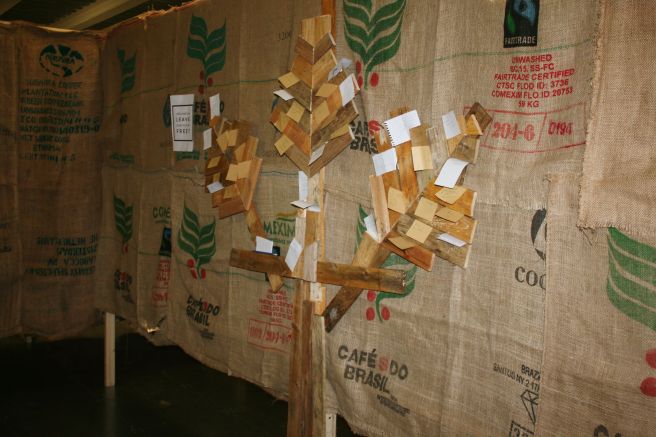
About half a year ago, I embarked on a journey that has been ever evolving. Matthew Huber, facilitator of Creative Collective Dublin, initiated an idea that would invite people to take time out of their busy schedules to rest and reflect upon whatever may be bothering them in life, in the hope that they would become refreshed and feel peace. In collaboration with numerous artists, this idea became Lenten Labyrinth: A Journey of Solace, which exhibited at Block B, Smithfield from March 7th to April 14th this year. After months of brainstorming meetings and de-seaming coffee bags (which we used for building the walls of the Labyrinth), we managed to open on-time with various artworks on the walls of the Labyrinth to loosely guide the viewer towards feeling restful and refreshed. The artists included Alessia Meloni with embroidery on fabric, Jacinta O’Reilly with a large-scale painting, Mattew Huber with carpentry, Martin McCormack with small scale paintings using peat, Ashwin Chacko with graphic design poetry, Peter O’Brien with audio, and myself and Milena Matejko collaborated on a poetry book with illustrations.

While the Labyrinth had the intention of bringing people on a journey as they walked through it, it also became part of the journey itself, constantly evolving throughout the month as we added little things here and there and viewers left their mark on post-its that they could stick on Matthew’s tree in the Labyrinth’s centre. During the second last week of the exhibit, some children discovered the Labyrinth, turning it into a playing ground for a few hours – something the Labyrinth did not forsee, yet it was beautiful to witness (even if a little stressful for myself). Their playful screams echoed around the space, leaving marks of their own.
Matthew Huber.jpg

Earlier in the month, as I was invigilating there one day, an idea came to me of curating a performance event to coincide with the Labyrinth and its concept of rest and reflection. I knew it would be a lot of work, especially on such short notice, however, I decided to just go ahead and see what happens. And so another journey began. In collaboration with seven performance artists, we created a fun, flowing and somewhat experimental experience for each other and our audience. I entitled the event Letting Go / Taking Up, a concept we are familiar with during the time of Lent, yet it is also a concept for keeping balance throughout this journey of life.

Zdzislaw G-Deck Cwynar and Valerian Aszkielovicz began the experience with beats on the box drum and darbuka, respectively, to which Cian Downes quietly began by transitioning marbles from a bucket in a corner to a bucket in the farther corner of the space; an act of moving more information than one can hold. As Cian slowly made his way to the opposite corner with hands full of an array of marbles, many inevitably fell to the metallic floor, the sound contributing to the percussion beats as G-Deck and Valerian gradually drew their rhythms to silence and allowed for the marbles hitting the floor to be the only sound. While Cian’s performance began frantically, it became meditative as he crawled over the floor to collect the fallen marbles one by one. Each time he dropped a marble into his hand it would make a small ‘click’ sound and as the marbles began piling up, some would fall out of his hand again. This would seem to be frustrating, yet he kept composure as he would just pick it up again and you cannot but be transfixed in a peaceful state. There was a slope in the space, and at one point in his performance, a marble rolled down that slope. It was an epic moment of expectation, as I wondered whether he would go for it. He became still as his eye followed it until it stopped rolling somewhere beneath the Labyrinth itself, to which he then continued collecting the marbles in his vicinity.

CianDownes_duo.jpg

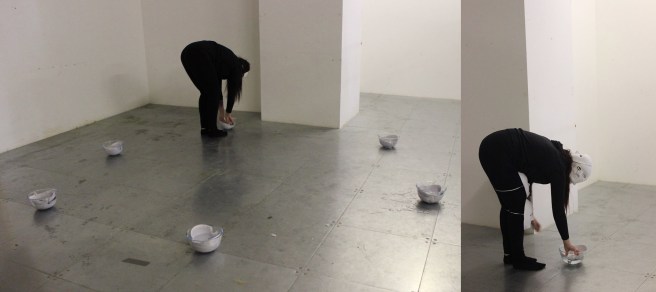
Rebecca Kealy then turned the viewers gaze as she began to tell a story of turmoil of the mind through spoken word poetry, introducing another dimension to the experience and connecting the performances, as Amy Guilfoyle prepared to perform in the space behind Rebecca. Standing in the centre of a clockwork of water-filled bowls, with dust proof face masks strapped over her head, arms and legs, Amy began methodically removing these masks, which represent negative thoughts, and placing each one in a bowl of water to dissolve. When she had removed and dissolved them all she lay down in the centre of the circle, tapping the floor like a heartbeat as she let go of her concerns and took up rest. This piece was the centre piece of the event and its concept.
AmyGuilfoyle_duo.jpg

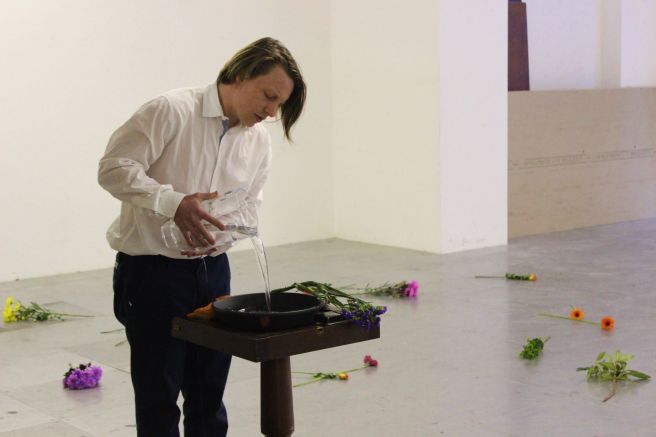
Rebecca Kealy then performed a second poem in front of my iridescent film hanging from the exit of the labyrinth, transitioning from Amy’s to Jack Beglin’s performance, during which we all held hands to create a human chain of communion as Jack led us through the Labyrinth, while verbalising a Shambhala chant, developed from a contemporary version of Tibetan Buddism, to behind the Labyrinth where was a display of colourful roses dispersed across the floor. Jack then recited poetry of his Grandmother, referring to linage, while making measured movements of contemplative meditation and ‘planting’ the flowers strewn across the floor into a flat pan of water. The whole event had built up to that moment of experiencing a reflective peace and the desire to hold onto that.
Jack Beglin.jpg

He then gave a flower to each of the audience, inviting them to interact with the installation by planting a flower themselves, but before they had time, Rebecca spoke a final poem, taking people out of their comfort zone and opening up Possibility, and G-deck and Valerian performed on percussion again to bring it full circle. After the poem ended, everyone clapped and, feeling peace amongst so much colour and light, it was beautiful to witness people planting flowers.

JackBeglin_tri.jpg

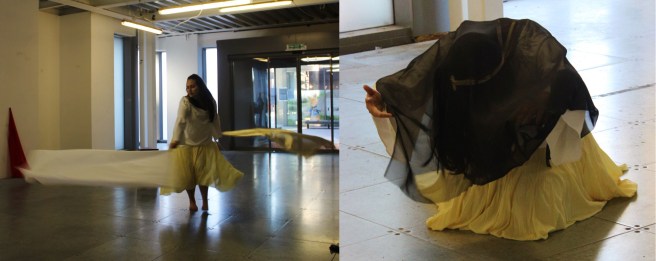
Éva Anna Szántó-Nádudvari closed the show dancing with flags to the song Tower by Anne Harring. It was a beautiful way to end the show and she danced expressively, full of the Holy Spirit’s peace. While Letting Go / Taking Up was stressful to organise under a limited time period, it proved to be fun, experimental, reflective and, above all, a restful and purifying experience. My only hope is that those who witnessed these remarkable performances were affected positively and went home that evening feeling refreshed and feeling peace.
Eva_duo.jpg

All Photographs by Áine O’Hara. You can follow Roisin on Facebook @RoisinArt
Art of Restraint

by EL Putnam

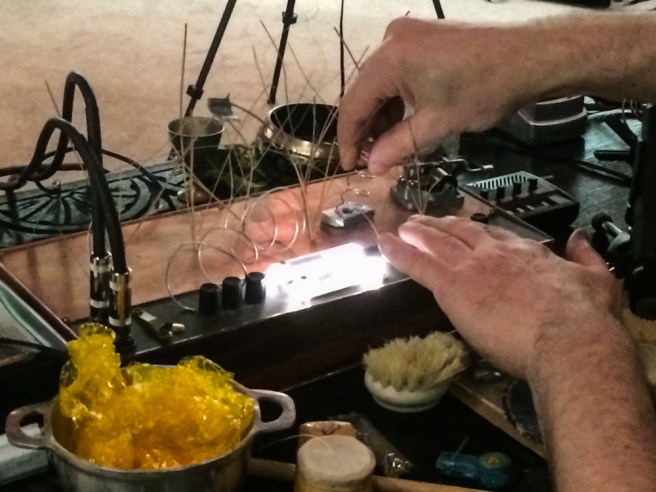
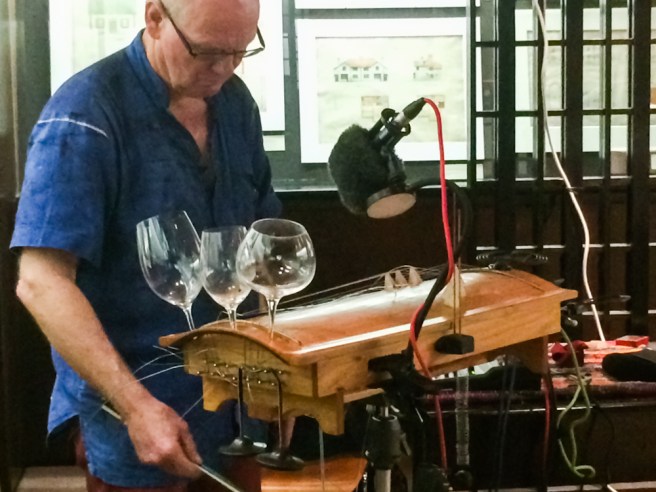
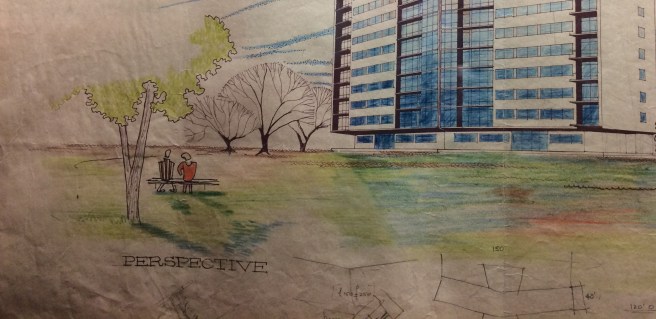
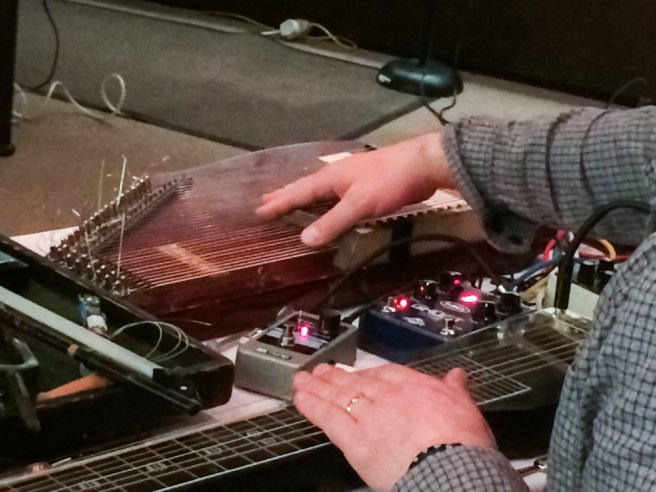
Entering the gallery, I am struck by the complex subtlety of sound. The quiet is loaded between sonified pulses and crackles of noise, building with an unmeasured pace through the cohesion of the three artists, David Stalling, Anthony Kelly, and Harry Moore. Irregular rhythms and semblances of melodies drift in and out. In what can be considered a Cageian silence, attention is drawn to ambient contributions — the slip of zipper, the clacking of heals on stone from the hall, the chatter of passersby. The bareness of the improvised composition match the structure of some of the architectural plans on the wall, stripping buildings down to geometric impressions. As the artists continue to play, the sounds take on a range of textures, from Anthony Kelly’s rumbling noise to David Stalling’s omnipresent tones and Harry Moore’s delicate slips of melody. The interplay of sound and quiet that emerges from the collective playing of these artists through handmade and modified instruments, combined with electronics, creates a sonic compliment to the visions of house and home of the gallery’s exhibition. With bows barely scraping strings in controlled grips, echoes of an invisible house fill the space — an uncanny form with its settling foundation and shifting walls; the sound is sculptural.

ArtRestraint-1.jpg

ArtRestraint-2.jpg

ArtRestraint-3

Not quite music and not quite noise, the performance of these artists emphasizes the sonification of gestures, predicated on the art of restraint. The mood shifts and another movement emerges. Energy builds as the artists take visual and sonic cues from each other; acts of improvisation that hinge on corporeal communication. The sound takes on an unassuming weight, not attempting to overpower the foreign noises that sneak around corners, like muffled music playing from speakers in a distant room. Even though the artists and audience stand apart, dispersed throughout the gallery, there is an intimacy that we share in the common experience of listening.
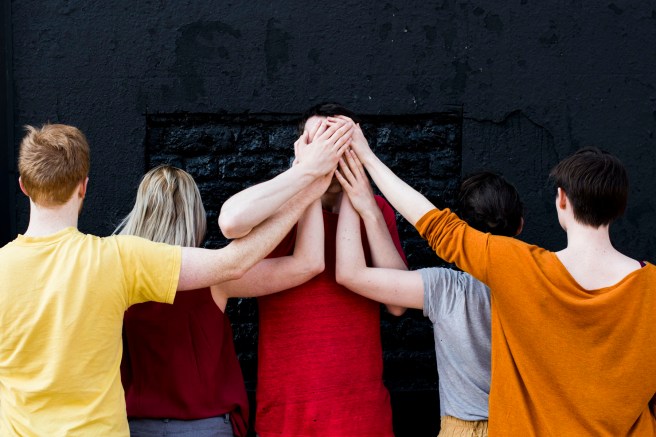
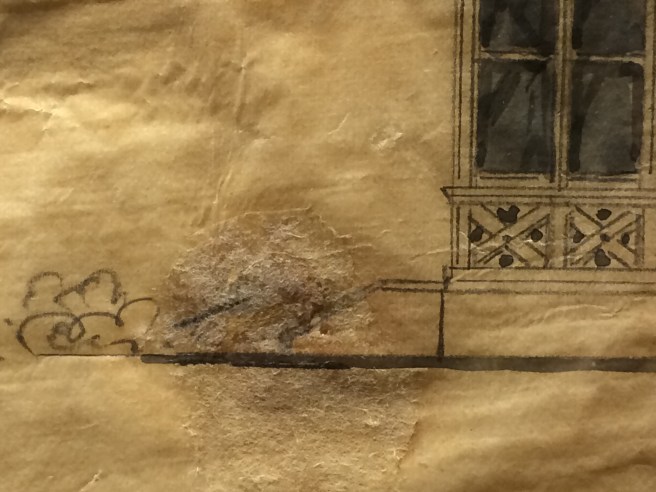
At one point, it becomes evident that the energy is fading. Despite the shifting sensations throughout, there is not really a climax to speak of — rather, coalescing pulsations of energy that shift depending on the level of contributions from the artists. There is a lingering presence of sounds that roll back from the edge of an abyss, only to sputter out and get lost in the revving of a motorcycle from the street, letting the sounds to melt into silence. No applause follows; just subtle smiles and nods that confirm an end. Once the sounds dissipate, I walk through the room taking a look at the drawings and plans of houses placed behind glass vitrines. Presenting residential architecture designated for different parts of Ireland, with some designs realized and others not, I take note of the rough texture of the paper that offers a visual compliment to what I just experienced sonically.

IMG_7019

IMG_7016 copy


Sounding Space, with David Stalling, Anthony Kelly, and Harry Moore, took place at the Irish Architectural Archive on 28 March in response the current exhibition House and Home. Photos by author.

Likemotherlikedaughterlikemother

by EL Putnam

The Bbeyond Performance Monthly tests boundaries: self and other, artist and audience, subject and object, process and outcome, private and public. Within this amalgamation of bodies, objects, gestures, and relations, I have been finding ways to build upon my practice as an artist while pushing me from the comfort zone, especially in presenting performance actions outside the gallery context. There is an ongoing process of growth that accompanies regularly attending the Performance Monthlies, as I learn to trust engagement with others, building relations through the regular fostering of aesthetic interaction.

I have been bringing my daughter to participate since she was two months old (or as was pointed out to me, in utero). I don’t bring her along to every Performance Monthly, as when I am with her, I find it impossible to completely melt into the aesthetic present. There is always some part of me that cannot turn off the hyper attention affiliated with being a parent. I am incapable of entering the immediate flow of a performance, as I always have my senses partially tuned elsewhere. Instead I try to discover a common ground between the performance and my engagement with Sonja, without giving either up completely. I want to bring Sonja into the performance, allowing her to engage with me as I am working, but not letting her completely guide our interaction. Instead, it is a constant to and fro of ongoing influence that is unpredictable — increasingly unpredictable as she gets older.

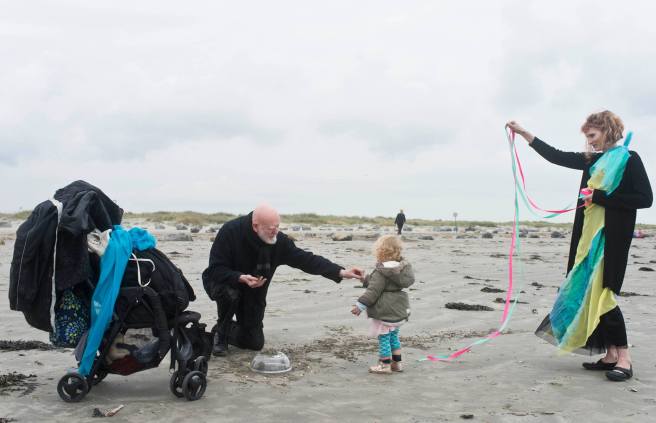
This method of working has taken different forms throughout the Monthlies. One of the varying factors is the context of the performance — when a Monthly takes place in an indoor space, like a gallery, I feel less alert than when we are performing in the rawness of a public area, such as Writer’s Square. When we performed near the Albert Clock, Sonja had recently begun walking. The area is bordered by busy roads, and I found myself in a heightened state of anxiety due to the potential hazards of the environment. The only way I could feel part of the performance was to let Sonja lead, but I wanted to maintain a sense of security. I attached the piece of black cloth I had draped around me to her hood and proceeded to follow her as she walked through the square. I shortened my stride and kept pace with her steps — a stop and go staccato of baby footwork. After a while, I noticed that someone began following us, moving their feet in the same rhythm. Later another person joined, forming a small parade that Sonja was unaware she was leading. Our imitation of her rhythm made the particularities of her movements more pronounced; an interaction that naturally extended from my engagement with Sonja — where my anxieties concerning her safety became the impetus for an aesthetic interaction. Blending within the energy of the group, these actions were an understated coalescence that observers may not have noticed.

12747534_236086510066566_4787630815847116086_o

14567506_358140021194547_2704626957047407346_o.jpeg

Through this experience, I became fascinated by the visual indicators of my relationship with Sonja and wanted to build on it, making its form more tangible. In a later performance, I again physically connected us, though used a 10-foot teal ribbon I interwove between us like a cat’s cradle. Again, I let her lead our engagement, though this performance took place inside a deconsecrated church in East Belfast; an indoor space that meant there were less environmental variables to trigger my concern. The Performance Monthly was noisy that day, meaning that Sonja’s and my actions to emerge as part of an amorphous, chaotic scene of gestures and material interactions. For most of the performance, Sonja sat in my arms or nursed as we tucked away in a pew. Sometimes she would fondle the ribbon with her fingers, chew on it as she observed the others. As time progressed, Sonja felt comfortable enough to walk around and stopped acknowledging the ribbon. She found a piece of chalk and began to draw on a piece of paper, the floor and on my black clothing. I let myself attune to her actions, drawing my energy from her engagement with the scene.

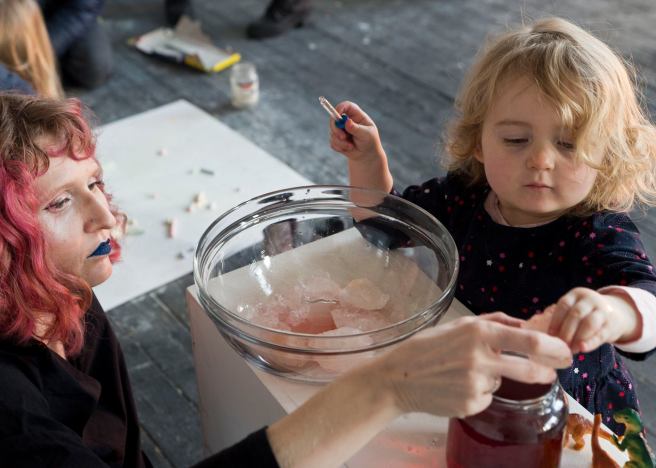
However, our engagement is not unidirectional during a Performance Monthly. Sometimes Sonja tries to mimic my actions, taking control of my materials and perform the simple and occasionally absurd tasks I have delegated for myself, like dripping red water onto salt crystals one drop at a time, or playing a radio antenna as a Theremin. The influence is a mutual flow between us; an unspoken bond of mutual dependency. I notice that when I am performing with Sonja, I find it difficult to interact with anyone else, as she captures my whole attention. At times, it is Sonja who extends our engagement beyond the two of us, as her curiosity carries our interactions to include others. In other instances, like the Alfred Clock example noted above, the inclusion of others is subtle. Anything more feels forced.

As a whole, the Performance Monthly challenges the implied use of public space, and my interaction with Sonja within this context brings another variable into play — the slippage between the private and public that comes with parenting. What could be described as a mother playing with her daughter, our interactions during these times are framed by the performance context and experienced through aesthetic sensibilities. Even though they are just play for Sonja (at least to my knowledge), but this collapse of the roles of mother and artist have different implications for me — they become a way to explicitly interconnect these roles while also opening up my practice to unpredictability. I perform the intimacies of maternal labour in a public artistic context, emphasizing the plurality of motherhood. At the same time, I am performing a centuries old motif in art history — that of the mother and child.

16252038_414505338891348_8195666085482156284_o.jpeg

DSC_8662

13975467_330537913954758_1239184864457769413_o.jpeg

Images by Jordan Hutchings.

a Glove is a Gift

by Léann Herlihy

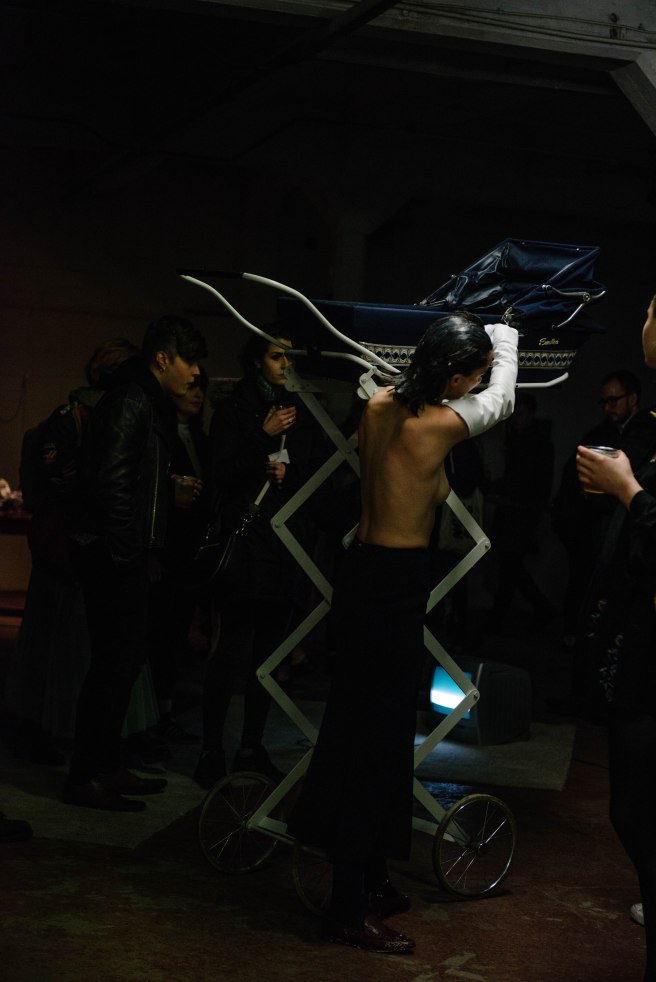
Setting foot in the space, the soles of the audience are met by a plush red carpet — rich and vibrant in colour. A gold filigree frame hangs on the wall, its image concealed by my stance, an abnormally tall pram stands beside me. Image, body, object: a triptych.

Standing facing the audience, my red leather shoes pivot to the floor; a long skirt drapes over my navel, straight down to my ankles; dressing me from finger tip to shoulder blade, stark white leather; my breasts lay bare.

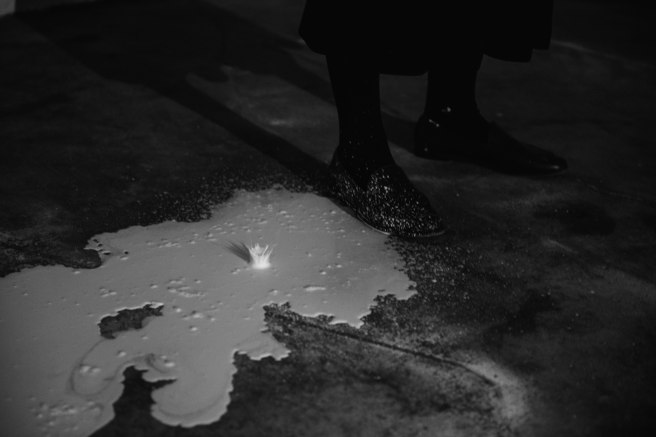
My right fist clenched, my eyes reach out to the gaze of an audience member. Once met, I stiffly poise my palms outwards, the crackling sound of cold leather reverberates.  Releasing grip, milk suddenly begins to drip from the inner lining of my right glove. A repetitive fast paced rhythm of drips drum down on the floor, eventually losing momentum, falling to silence. Accumulating beneath me, a puddle of milk – white on red.

The room’s atmosphere falls into awkwardness: the viewers seem bounded to a sense of shame — watching a half nude woman stand before them, a maternal liquid dripping from her, gathering on the floor, resembling the act of a “water breaking”. Rather than mirroring the audience’s shame, I stand dismissively — a sense of pride.

Léann Herlihy, a Glove is a Gift, phot. Amber Baruch.jpeg

From my skirt, I remove a wrapped small brick. Peeling back the foil I reveal a block of lard. Resisting the impractical restraints of the leather gloves, I lift my hands towards my head, one of which has a firm grip on the lard. Slowly, but rhythmically, I comb back the hair from my face. Now, a scalp bereft of hair, all femininity has become muddled.

My right hand becomes a white leathered fist once again. Lifting it, I beat my bare left breast in one smooth movement — a patriotic gesture. Leaving my hand there, I wait until my line of gaze is met by an audience member. Once the connection is met, my hand is released down to my side. My eyes direct towards the viewer beside the first, perform the same swift movement, and continue on, until, finally, I have met the gaze of all audience members. Eventually, the rhythm of a beating chest ceases, leaving a raw red breast.

I reach under my skirt and retrieve a plastic bag full of milk. Raising the bag to the red breast, I apply pressure. I outstretch my free arm to the pram’s handle — our first interaction. Soothing my breast, I simultaneously begin to rock the pram gently, back and forth in a swaddling motion.

Léann Herlihy, a Glove is a Gift, photo. Amber Baruch.jpeg

Dropping the excess milk to the floor, I grip the pram with both hands and manoeuvre it to face the audience, impairing my own line of vision. Composing myself, I plough my way through the audience; people separating like the red sea.

Automatically the crowd are categorised into two groups: the ones that remain fixated to the remainder of my previous presence, two negative footprints in a puddle of milk; and those who follow like a herd of sheep, looking with an inquisition, at what could possibly  be in this pram — nothing; empty.


Léann Herlihy performed a Glove is a Gift, a performance which addresses the position of the female body as the focus of repressed histories and political desires under the regulation of the nation State. Performed on February 02 2017, at the exhibition Ban an Tí. Photographs courtesy of Amber Baruch.

Neoliberalism made strange: a response to Jelili Atiku’s Argumenta Dialogorum (What did I buy from you?)

By EL Putnam

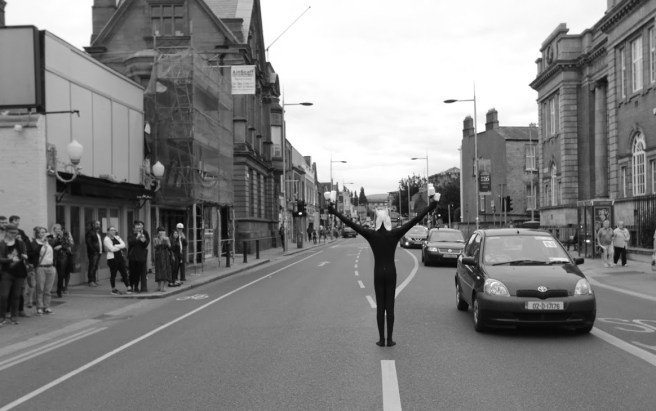
A body appears, made androgynous by the covering of a black, biomorph suit. This body walks with purpose to the middle of the road carrying the mask of a horse’s head and candles atop yellow and black striped sticks. Though his body and expressions are obscured, his posture denotes a resoluteness. Cars and buses continue to drive by, occasionally slowing to catch a glimpse at the unusual sight, perhaps out of curiosity or annoyance at the break from routine behaviours. The audience collects on the sidewalk, forming a mass of witnesses, enraptured by the danger building as Jelili Atiku stands between the two lanes of traffic — an intervention into the mundane. When Atiku returns to the gallery, he picks up a small teddy bear. Purchased from a local charity shop, as evidenced by the price tag still attached, he walks through the audience, showing each individual this bastardised memento while handling it with the reverence due to a relic. He repeats the process with a second teddy bear, attaching both to the wall. His body between them form an index of a crucifixion to consumerism.

IMG_1169x.jpeg

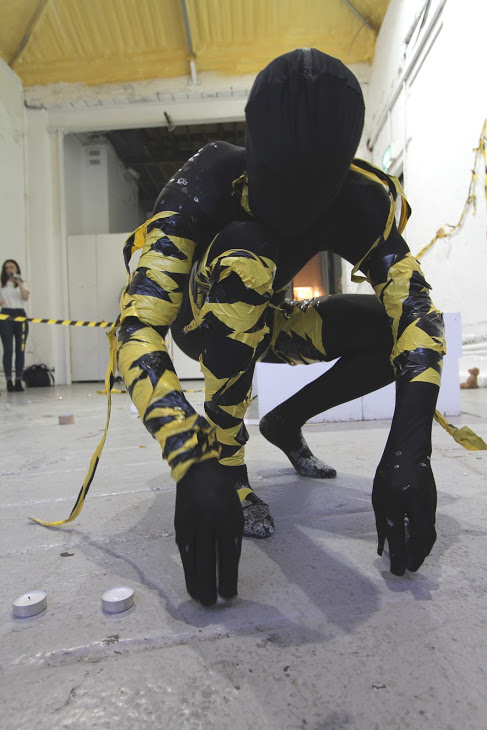
This performance, Agurmenta Dialogorum (What did I buy from you?), constitutes a series of rituals, blending gestures of spiritual reverence with elements of neoliberal existence. Transformation is a prominent theme throughout the work. As Atiku wraps his body in yellow and black striped tape, he undertakes a process of metamorphosis from a human form to a monstrous being. Winding the tape around his legs and torso, he inserts candles that create spines along his corporeal curves. The task is slow and methodical; a proprioceptive transformation that not only shifts how he moves through space, but how others relate to him. At some points, he grabs the nostrils of the horse mask that he wears, indicating difficulty breathing, though these perceived physical tensions do not deter him from his actions. He does not perform for his audience, but engages their presence, asking for them to light the candles that decorate his body using unique drawings, each of which request the individual recipient to “Kindly Light the Candles.” This gesture of hospitality warms the crowd. As he becomes a human candelabra, people grasp the long matches, seeking out wicks in need of light. We engage in a unorchestrated dance, making Atiku’s body burn brighter. The wax drips at odd angles, taking on a seminal quality in its inability to resist gravity. Atiku then returns his body to a state of self, shedding the burning candles, the tape that had become a second skin, and finally the black, biomorph suit.

HL_4.JPG

Throughout this event, Atiku creates a scenario of danger and beauty, where everyday items become the impetus for sculptural actions. The performance challenges the limits of safety, but without pushing the body over the threshold of harm. As an artist, Atiku utilises what German theatre scholar Erika Fischer-Lichte refers to as the transformative power of performance — where simple materials, mundane spaces, the human body, and our relations to each other are metamorphosised through actions. The intentions motivating these actions may not always be clear as the work unfolds, but such is the appeal of this medium that sits at the cross-section of different forms of expression. Existence as we take it for granted is made strange through the performance encounter. Even though these experiences are ephemeral, they alter us as we re-enter the ongoing stream of life. While Atiku undergoes a visual and spatial metamorphosis through his ritual gestures, he is also changing us witnesses through the staging of this encounter. What each witness takes from this experience may vary — I considered my interactions as an American with a Nigerian in Ireland encompass the sort of cultural reciprocity encouraged by neoliberalism. The subtitle of the work, What did I buy from you?, supports this interpretation. Just as neoliberalism as opened up channels of travel and exchange around the globe, making the world appear more open and brighter, there is a nefarious underside to this ideology. Despite impressions of new freedoms and broader horizons, there is the risk of being shackled by these privileges as we are increasingly indebted to omnipotent and ineffable creditors; the more we consume, the more we contribute to the system that provides for and entraps us. The price of compliance is financial, but also environmental, ethical, and human. Atiku’s use of tape to hold up candles we light while simultaneously binding the body provides an apt metaphor for this tension. At the same time, actions have mutual reactions — we collectively contribute to the production of a scene that entangles us. Atiku’s performance raises the question: is it possible to escape the binds of the system with our bare bodies and humanity in tact?

img_1351x


Jelili Atiku presented Argumenta Dialogorum (What did I buy from you?) at the 2016 Dublin Live Art Festival, curated by Niámh Murphy at Mart Gallery in Rathmines. Photos by Blueprint Photography.


Channels of Creativity

by EL Putnam

What drives a person to create? Where does the impetus to take the experiences, the emotions, the sensations that run through our beings and twist them into something to share with others? Words, gestures, and tones emerge from our bodies in attempts to share sentiments that exceed linguistic structures.

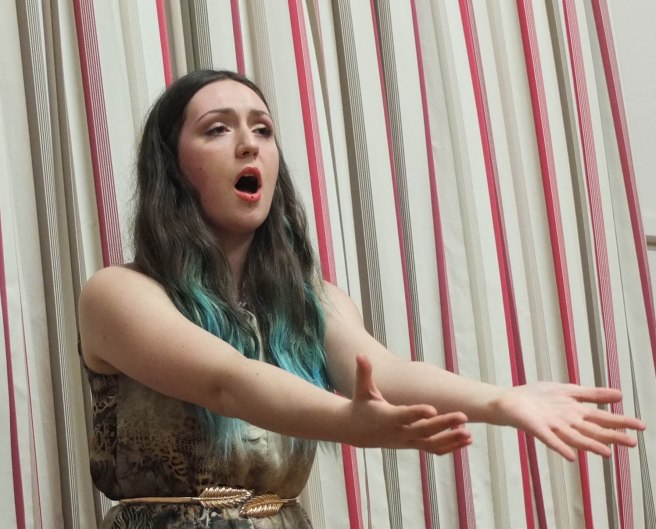
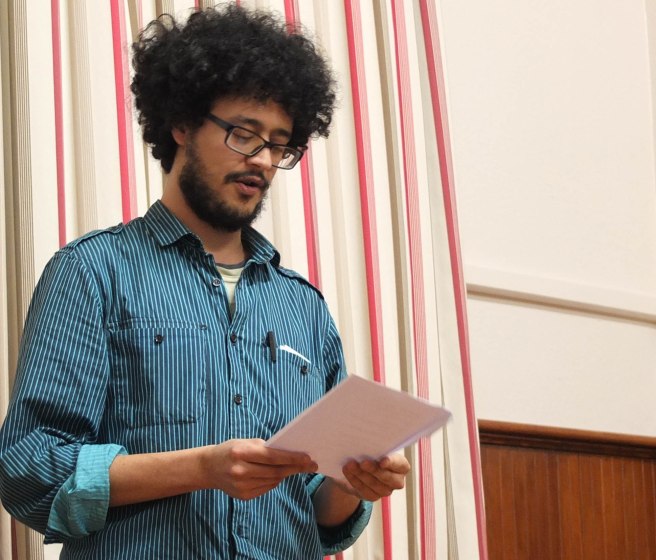
These are some of the questions that drifted through my mind when I attended the “Celebration of Creativity,” curated by Roisin Jenkinson in early February. Tucked into the heart of Howth, various poets, writers, artists, and singers came together to share their creative expressions live with others. The night began with a collection of songs, as Michaela Jenksinson’s rich voice filled the hall. Her body and sounds projected a joy that transmitted through the air, with audience members tapping their feet and humming along. This was followed by Robert Fullerton reading a short story. Even before I could differentiate the words of his text, the pronounced rhythm of his voice carried an intensity that enraptured my attention.  As the verbiage began to solidify into narrative, I let myself be carried along with the quirky tale, smiling in sync with the laughter that grew in the room. The night continued with Rauairi Conneely, a self-declared “poet by accident.” As he let his verses break the silence, he drew attention to mundane idiosyncrasies, shifting perspective just enough to bring beauty even to the humble sneeze.

Copy of DSCF8142.jpg
Michaela Jenkinson
DSCF8148.jpg
Ruairi Conneely

Even at this early point of the night, I am struck by the varieties of expression, as people slip from different corners of the imagination to craft an ephemeral expression of human existence. Next up was the performance of a theatrical scene by members of the Ballymun Writers’ Group (Nancy Matchton Owens, Maria Francis, and Hazel Masterson) that offered a playful spin on tropes of Irish hospitality and family dynamics. Beneath this humorous presentation is the pull of human tensions, the inevitable clash of emotions that accompanies conflicting desires. Their rendition was followed by Christina Molloy reading some of her poetry, who articulated another undercurrent of the evening — creativity behaves as a form of spiritual practice.

“The position of the artist is humble. He is essentially a channel.” — Piet Mondrian

Even though I do not share the Christian faith expressed throughout the evening, I identify with the use of creativity as a means of connecting to something beyond myself, opening a common ground between us. In his poetry and dance, Brian Miller further emphasised how performance can be a form of prayer, where dance becomes worship.

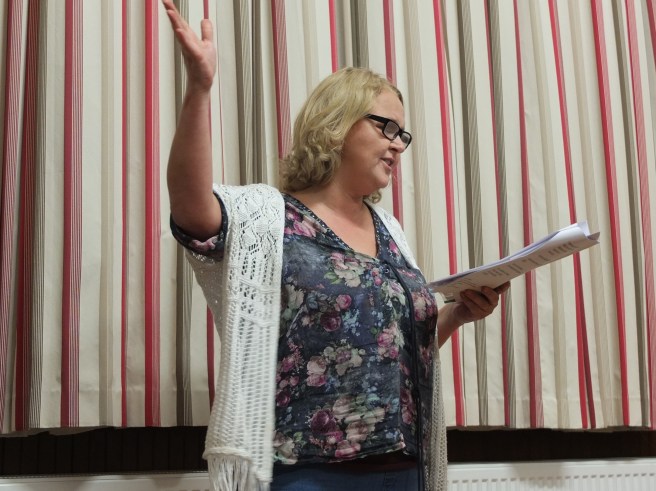
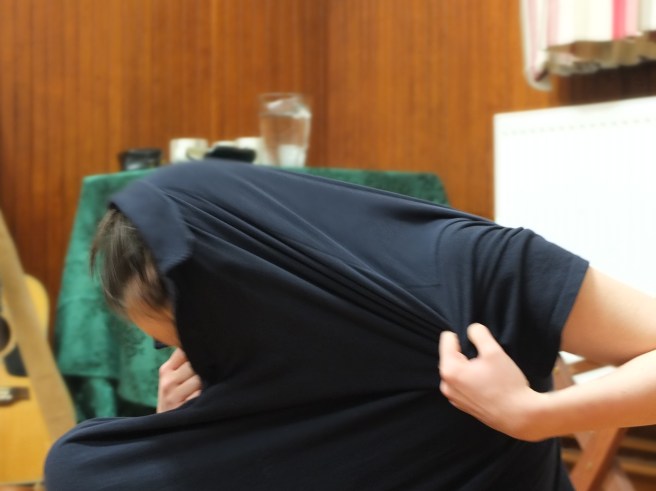
The atmosphere of the room shifted as the lights dim and Milena Matejko shared her poetry, giving form to questions of art’s purpose through her passion fueled expression. Then, there was a bold transition as Sarah Muthi presented a work of performance art. Standing in front of the room, she let her hair swallow her visage as she twisted and molded her body within her clothing. Her limbs protruded in sculptural angles and the cloth stretched, engulfing her body into its folds. She hid in plain sight, simultaneously exposing and covering herself at a tempered pace. I glance around the room — wondering if this was some people’s first exposure to performance art. The bringing together of poetry and performance art is a particular interest of Roisin Jenkinson’s. Muthi’s body encompassed the distillation of emotion into gesture, what poetry does to language, forcing the audience to slow down, opening a space to think without direction that breaks from the flow of words that had dominated the evening thus far. The juxtaposition of Muthi’s actions with the other performers emphasizes how whatever the means of expression, people desire to share ineffable emotions, giving form to these sentiments, whether through language, melodic sound, or the body itself.

dscf8154
Christina Molloy
dscf8166
Sarah Muthi
dscf8174
Shay Phelan

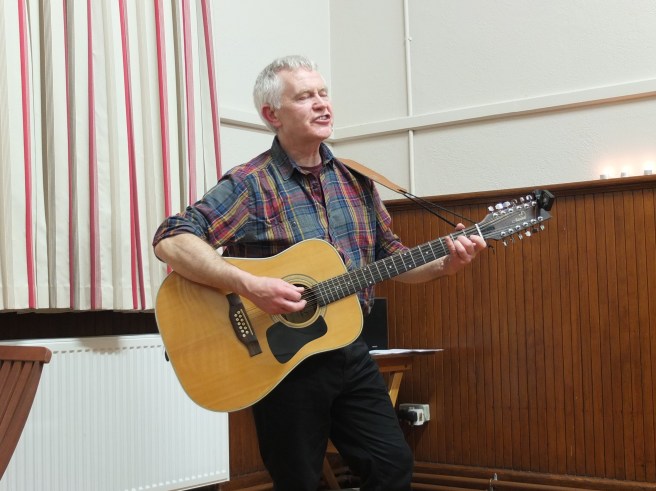
Shay Phelan returned us back to narrative with his songs, where he shared stories intermingled with his hopes and faith. The evening ended with Seán O’Donoghue, someone who was not on the original line up, sharing a poem that recounted a traumatic experience of almost drowning while working as a deep-sea diver on an oil rig. I was humbled into silence as he transformed a horrific event into a beautiful recount, where the ripples in the ocean are traces of human labor — the unknown men and women working in dangerous conditions to fuel our lives. The image of subtle waves flowing through the water reinforced another common theme found amongst the works — as individual humans, we are connected to worlds, milieus and courses of experience greater than us all.

Throughout the night, an honest creativity drifted from the performers, emphasizing the importance of people coming together to share their imaginative escapades with each other. Despite the differences, each performer presented a story of the self, sometimes in the form of a narrative, sometimes as an aesthetic gush of emotion.

A “Celebration of Creativity”  is organized by Michael Connaughton. The next event is scheduled for 2 June 2017 and is looking for support and artistic contributions. Anything imaginative is welcome!

Creative Resistance and Existential Dread

By EL Putnam

Performance art has a way of expressing emotions that are difficult to pin down. Sometimes the only way to make sense of nonsense is to engage with the beyond sense — the ephemeral quality of being that escapes the concrete. 20 January 2017 marked the inauguration of a certain man as a world leader, whose path to power was paved with sentiments of bigotry fueled by fear while making a mockery of the democratic process through the collapse of politics with the tactics of reality television. Attending Queerstock at the Complex that evening, this event lingered in my mind, filling me with sentiments of existential dread for what is yet to come.

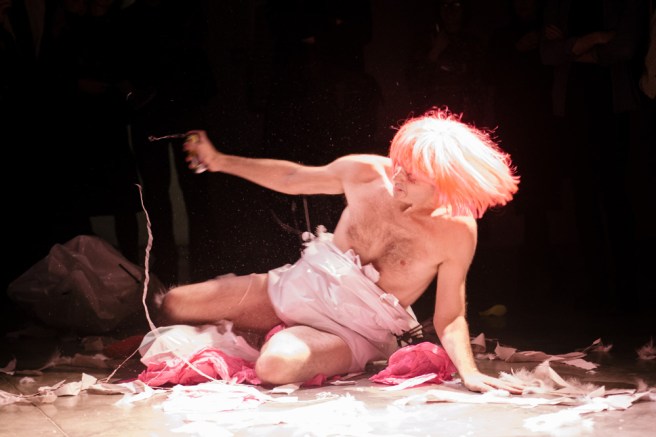
The room pulsated with a jovial atmosphere, colourful lights filling the space to the beat of music played by a giant pink triangle (Martin McCann). In a far corner of the room, a person (Ryan Backer) sat still under a rough, brown blanket, surrounded by a ring of empty beer bottles with their labels removed. Occasionally, the figure moved a bottle so it stood upright, becoming a corporeal clock, though it is unclear what time is being registered. As I shifted into the room’s ambiance, I took comfort in the colours and costumes of the mingling attendees. In the middle of the room there was a pile of white rubbish bags with black straws extruding from them. Presenting biomorphic forms, these bags took the appearance of a minimalist installation. The music changed and a man in a pink wig (Francis Fay), wearing only socks and underpants, emerged from one of the bags. He awkwardly shifted his body as he attempted to dance still encased in the plastic lining. He exuded celebration through his actions, moving his arms and shaking his feet to the beat of the music. Blowing up balloons and blowing out silly string, the man continued to dance against the plastic barriers, breaking free from the lining as he filled the room with his exuberance. It is a strange sight that defies mundane codes of conduct, but it is through these gestures that hope returns. No matter what happens to the course of history, artists have always found means of navigating a way of being in the world that resists when necessary, adapts when needed, and adopts new methods to challenge whatever may stand in the way.

FrancisFay_QueerStock0964Web.jpg

The night continued with a monologue by Ciaran O’Keefe. Listening to his melodic voice, I am reminded of the futility of human existence along with the joys of life’s pleasures, whether it’s an electric kiss, the subtleties of Marilyn Monroe’s cinematic performance, or the recounting of a Shakespearean monologue (Tomorrow and tomorrow and tomorrow…). Referring to his sexual orientation during the performance, I considered how there was a time in Ireland when being gay were not so openly accepted, and despite these prejudices, people have found ways to thrive.

Throughout the night, I thought about how people have the potential to overcome obstacles, including resurrected old ones. The various expressions of sexuality and gender fluidity, both explicit and inferred, presented at Queerstock, emerged from a creative energy, encompassing an emotional range of human experience  that cannot be suppressed. Here is where the potential for resistance flourishes.

AmyGuilfoyle_QueerStock1123Web.jpg

Ciara&Anna_QueerStock1531Web.jpg

DayMagee_QueerStock1341Web.jpg

DylanKerr_QueerStock1751Web.jpg

OllieBell_QueerStock1429Web.jpg

PaulFrancisQuinn_QueerStock1219Web.jpg

VickyCurtis_QueerStock1811Web.jpg

Images (top to bottom): Amy Guilfoyle; Ciana Spelman and Anne Ebeling; Day McGee; Dylan Kerr; Ollie Bell; Paul Francis Quinn; Vickie Curtis. Photographs by Aoife Giles.

Queerstock was presented at the Complex on 20 January 20, 2016, curated by Niamh Murphy. . LIVESTOCK is an bi-monthly performance art platform for both emerging and established performance artists, facilitated by Francis Fay and Eleanor Lawler.

.

Gestural Relativity

by EL Putnam

This piece first appeared in the 2017 Bbeyond calendar


Albert Einstein theorized that space and time are interwoven as part of a continuum, with how time is experienced varies depending on velocity. Moreover, time and space are not universals or constants, but interdependent. Performance art, an artistic medium where the body performs actions with materials, utilises time and space as key formal parameters. To abstract Einstein’s theory in order to define a physics of performance art, time and space are interconnected through a relative exchange, informed by the velocity of actions of participants, with each outcome enunciating a different encounter and aesthetic experience.

13913696_328103084198241_6784954666176770206_o
Bbeyond Performance, Münster, Germany, July 2016. Photo by Jordan Hutching

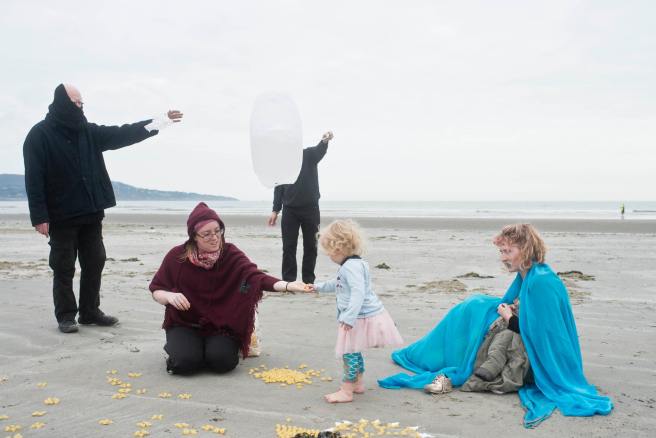
The framework of the Bbeyond Performance Monthly is simple and consistent — gather a group of people to perform actions with materials in a public space for a period of time.  The date and location are predetermined beforehand, word is spread about the latest iteration, and on the day, participants gather with possible planned  motivations. There is no official demarcation of a start; each Performance Monthly begins with someone unobtrusively performing an action. It could be the declaration of a word, the unraveling of yarn, or the filling of a receptacle. Some unspecified person initiates the event. Momentum builds as others also start their actions, sometimes beginning in isolation or actively engaging with a fellow performer. An audience grows; formed from passersby or people intentionally attending to witness the event unfold. Whatever actions a person performs varies depending on the materials brought and shared, the influence of people on each other, and how each person engages with the space. The velocity increases with attention being focused on the present as performers transform their materials and the space through gestural exchanges, cultivating a give and take of energy with each other and the environment. The pace of time dilates as performers interfere with the implied actions of the space, opening up a new means of experience. An ephemeral disturbance to the flow of the day, the actions performed during a Performance Monthly draw attention to the habits and routines that are engrained in our mundane ways of life, where their ritualistic pretence ceases being acknowledged as embodied existence is approached from another perspective. Throughout this process, creative play is key as new modes of relating to objects, places, time, and each other are explored.  Time slips and slides as energy flows, opening up an eternal present.

14633302_358140111194538_3870863456658006165_o
Bbeyond October Monthly, Bull Island, Dublin, Ireland. Photo by Jordan Hutching

Actions may reach a climax or multiple peaks depending on velocity and the relationship between time and space cultivated by the participants. At some point, however, there is a turn — gestures decelerate and people shift back into their everyday states of being. Just as the Performance Monthly began, so it ends; each person curtailing their actions and coming back together in a collective mass. Traces of whatever happened in that hour or two are cleaned up and removed, though the memories linger in the minds of passerby and the muscles of participants. The space is inevitably transformed and for that brief period, time travel became possible.

Enough Rope

by EL Putnam

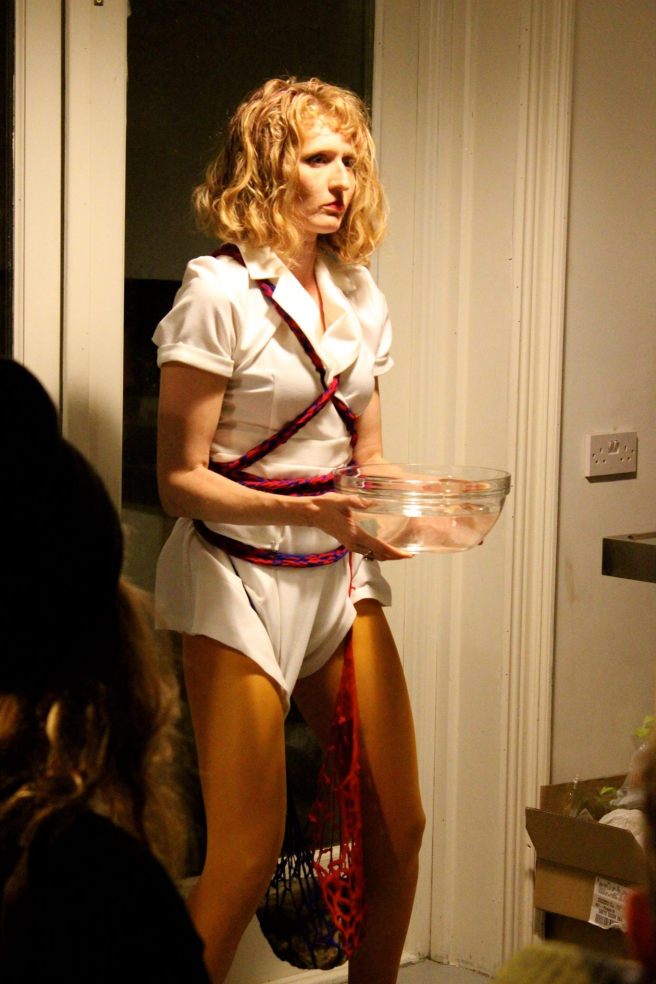
I am sitting on the ground, near the back of the room in front of a glass door. My legs are angled, heels on the floor, toes in the air. My hands touch the cold concrete below me, but my head is raised and I maintain an unfocused gaze. People enter the space — a kitchen in Arbour Hill, Dublin, Ireland. They chatter away, sipping on beers. A bowl of water sits between my legs and a metronome rests to my right. I turn on the metronome so it ticks at 42 beats per second — the regular clicking of the mechanical object draws the audience attention to my presence. I stare at them, scanning my gaze across the room. I slowly rise, letting my spinal cord unwind one vertebrae at a time. As I lift, it becomes apparent that a rock is suspended between my thighs, harnessed by a crocheted net and attached to a knit rope, created from red and blue yarn in a loose reference to the circulatory system. The rope wraps around my torso, chest, shoulders, allowing the weight to be distributed around me while melding its form to my body. I spread my legs in a subtle squat as I raise my back until my head is aligned with my pelvis. Then, I bend down, again at a leaden pace, even more slowly than the metronome in order to dilate time and allow my gestures to be pushed by the weight of the stone that enwraps me. I lift the bowl of water, though ensuring that the rock does not brush the ground.

enoughrope1

14468310_1101923819899618_3112234100824305068_o

Once the bowl is chest level, I recite from memory the first part of article 41, section 2 of the Irish constitution:

In particular, the State recognises that by her life within the home, woman gives to the State a support without which the common good cannot be achieved.

 I submerge my face in the bowl of water and let out a guttural scream, liberating a pent up anger amalgamated from fragments of experience as a woman, a mother, a foreigner, an outsider.  I last until my breath depletes, the water bubbling around my immersed features.

I lift my head, whipping my hair back, droplets releasing in sprinkled trajectories. I collect my composure, allowing the weight of the rock and the water to stabilise and ground me. I recite the second part of article 41, section 2 of the Irish constitution:

The State shall, therefore, endeavour to ensure that mothers shall not be obliged by economic necessity to engage in labour to the neglect of their duties in the home.

 My memory fumbles; I am unable to dictate it exactly, though I let the words tumble from my lips without making an attempt to correct them. I let my body curve downwards, descending with the force of gravity as I replace the bowl on the ground. Pulling myself into an erect posture, I move towards the front of the room, placing down each foot with the beat of the metronome, letting the repetitive pulse carry me. I continue through the hallway and make my way up the stairs, maintaining my rhythm. Someone follows me to the bathroom. I can feel her presence behind me. I enter the bright tiled room, shifting my body as I grab the door, swinging it shut. Our eyes meet for a moment as it slams in her face. I end my actions alone, deep in the core of the house.

enoughrope2

As an American living in Ireland, there is a part of me that always feels foreign — external and excluded. Stepping into this different cultural environment, my sense of familiarity is warped as I am forced to adapt to a new normal. Everything I thought I knew of the mundane is twisted as what I have taken for granted in the daily running and maintenance of my life turns alien.  Becoming a mother in a foreign context amplified these sentiments as I am made vulnerable to a medical system and cultural understanding of the maternal that counters my expectations. In particular, the influence of the Catholic Church that has seeped to the core of the nation’s infrastructure during its formation and development remains an ideological spectre. While the culture takes a secular turn, there are elements that linger. I did not anticipate it to affect me so greatly, drawing up memories of discomfort from a faith I left behind long ago. Like a spiritual muscle memory, it remains engrained in my physiology. Caught in this context, with a reflexive bristle whenever I find the need to adjust, I test the limits of my malleability. My emotions simmer as I come to a new, negotiated state of being, all the while ushering a new human into the world.

EL Putnam performed Enough Rope at “Room,”  organized by Angela McDonagh on September 30 2016. Photographs by Cathy Coughlan.

Your innovation can’t save us now

by EL Putnam

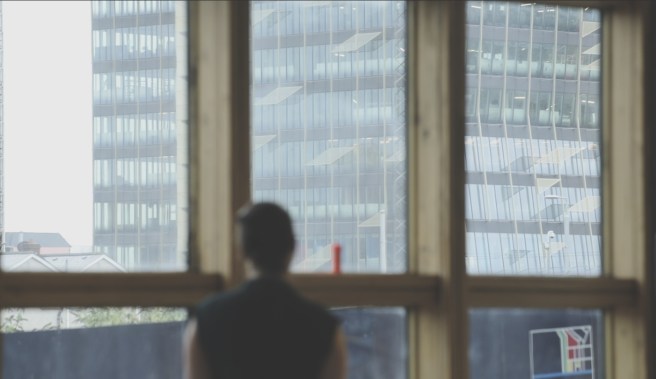
In 2016, eight years after the economy came to crashing halt and instigated the “Great Recession,” we have entered a state of intentional amnesia. Hence, Low Lying, developed by Ciara McKeon, Robbie Blake, and Jessie Keenan, is significant in that it draws our attention to the wreckage of the bubble bursting against the backdrop of a stilted recovery. The performance does not tell a story, but it asks spectators to consider the implications of our financial activities, pushed by massive overconsumption and claims of innovation. Dressed in articles of fast fashion clothing fresh from Penney’s rack, the performers blend musical composition with choreographed dance and performance action to create an eerily beautiful meditation. Located in the middle of the docklands, against a window that looks onto an incomplete building site claiming to be “Dublin’s new city centre,” emphasis is placed on the unfulfilled promises of growth. Voices echo through the chambers of the bare performance space, bouncing off the concrete structure at the corner of an apartment complex, serving as a cathedral to the free market. The harmony of voices is present yet fractured, as bodies move through the room like a herd of injured pigeons — an apt metaphor for the economic and urban infrastructure that has now overcome us, forcing us to adapt as we become the invasive species.

Screen Shot 2016-09-28 at 16.23.55.png

Low Lying 4.jpg

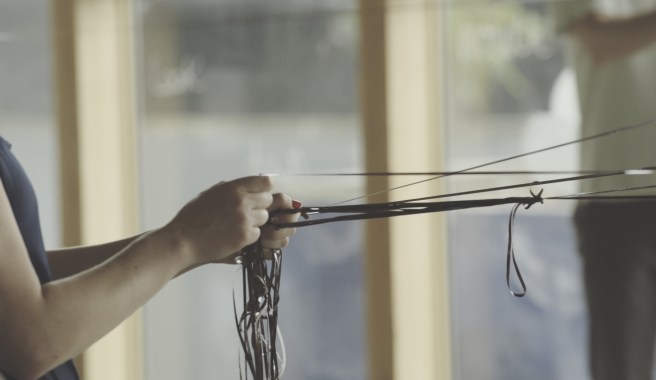
The performers claim to not do anything blatant and this restraint is their strength. Instead they sing ballads to the glory of the Liffey as performers decay under their own weight; create an interpersonal web with the tape of audio cassettes; and clean the windows with Cif Cream Cleaner, which instead of making the view clearer, only obscures perception of the scene while filling with the room with a distinctive lemony scent. Watching the performers interact through sound, movement, and material emphasizes the significance of human exchange in our increasingly dehumanizing system where people are alienated from each other and modes of experience, where work is contracted, made precarious and celluarized, where the bonds of friendship are replaced with profit-generating clicks on social networks.

Low Lying 5.jpg

low-lying-3

low lying.jpg

It can perhaps be said that the performance presents a resigned position in its meditation on the economic crisis. Even in the tensions it provokes between beauty, the sublime of our collective economic fall from grace, and the decaying traces we leave in our wake, there are no claims to provide solution nor proclamations of hope. Right now, we don’t need a proclamation of hope — hope, while important, is not sufficient. We can proclaim hope as we spend our ways deeper into debt, fragment our job opportunities into unstainable precarious contracts, and sell off our public support systems. We can proclaim hope as we vote in politicians who perpetuate government actions that support the upper economic echelon at the expense of others. Hope is being privatized and commodified, entrenching us in modes of economic and social relations that ultimately disenfranchise us, and yet we keep doing it because despite perceptions of freedom of choice, our options are limited. Italian philosopher Franco “Bifo” Berdadi describes how we have traded our future for the comforts of a perpetual present as “corporate capitalism and neoliberalism have produced lasting damage in the material structure of the world and in the social, cultural, and nervous systems of humankind.”[1] Low Lying opens an aesthetic encounter within the wreckage of this collapse, emphasizing the significance of maintaining the human touch. As we wade through the social fabric that enshrouds us, we must maintain these human bonds, for it is with these interconnections that we can identify the structural weaknesses of society and capture the propensity for change.

149LLselection WEB.jpg

Low Lying was presented as part of the 2016 Dublin Fringe Festival. Performed by the creators, visual artist Ciara McKeon, choreographer Jessie Keenan and composer Robbie Blake, along with singers Michelle O’Rourke and Rory Lynch, and dancers Sarah Ryan and Marion Cronin.

Photographs by Luca Truffarelli.

Works Cited

[1] Franco Berardi, After the Future, ed. Gary Genosko and Nicholas Thoburn, trans. Arianna Bove et al. (Edinburgh: AK Press, 2011), 11.