Enter the Spielraum

by EL Putnam

Imagine a childhood dreamscape embodied by the adult imagination: fantastical creatures, biomorphic forms, and elongated amalgamations of body parts — all constructed of household materials. Such is my primary impression of Celina Muldoon’s untitled live installation, which exudes a perfect crudeness in its performance of an engineered mythology. The work encompasses eight performers, with each adorned in a complex costume made of masking tape, hand drawn features, and in one case, a flowing plastic sheet. These participants shift through the space in a distinctive choreography that emerges from the material forms they wear. There is a delicacy to the actions that contrasts the bulkiness of the costumes. The energy builds as the gestures loop, accompanied by an electronic soundtrack that imbues an ethereal quality.

Celina Muldoon, 'Untitled',Temple Bar Gallery and Studios, Live installation-performance, May 2017, 1.jpg

The limits of this fantasy are revealed in the theatricality of the materials; instead of striving for seamless representation, the complex constructions do not hide their rough and ready nature. However, I cannot help but get caught up in the illusion, despite its obvious staging, imbuing the performance with a captivating honesty.

Muldoon sits in the middle of this all, wearing a monstrosity of couture that transforms her into a Centaur-like creature. She gazes at the audience from her position on the ground, though over time, her face wears a pained expression as she bears the weight of her headpiece. At one point, she breaks the looping choreography as she rises from her seated position. Other performers disrupt their patterns to assist her, as the weight of her costume limits mobility. The performers form a line, circling the room with Muldoon in lead. She awkwardly navigates the space, hindered by the ampleness of the horse’s body she adorns. Throughout this process, she maintains a poise, occasionally thrusting the weight of the body she wears, which is supported in the back by a pair of roller skates. Her clumsy gait promotes laughter from the people sitting next to me; an appropriate, affective response to the scenario unfolding before us.
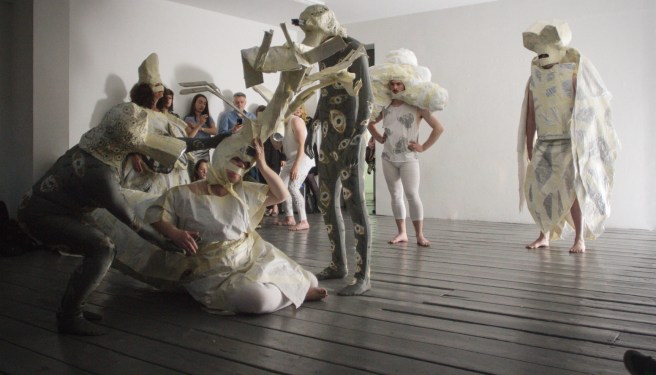
Celina Muldoon, 'Untitled' Live Installation-Performance, Temple Bar Gallery and Studios, May 2017, 3.jpg

There is a term in German — spielraum — that literally translates to “play room,” but it is used colloquially to describe if there is “wiggle room;” some space of discursive negotiation. Martin Heidegger (2008) uses the term in his essay “The Origin of the Work of Art” when he describes how truth is revealed in the strife and free space [Streit- und Spielraum] that art affords.  Art, therefore, opens a space for conceptual and sensory play. However, as Samuel Weber  (2004) emphasizes in his reading of Heidegger, this play in not harmonious, as it is accompanied by “irreducible and generative strife” (56). In her live installation, Muldoon takes advantage of the Streit- und Spielraum opened through the work of art, letting her imaginative negotiation of theatrical materiality and performed gestures present an awkward fantasy.

Watching Muldoon’s live installation also evokes Matthew Barney’s fantastical creatures and Thomas Hirschhorn’s consumerist spectacles, though what makes her vision distinctive is her feminist position. The creatures carry an androgynous air, as gestures play with a gender fluidity, which is most poignant in the tall insect-like creature, performed by Austin Hearne. Hearne’s tall and solid corporeal structure is amplified by his costume that looks like an intersection of a medieval knight with a winged arthropod. The sturdiness of his stature is contrasted with a graceful step—his feet delicately moving along the floor, as if he is wearing an invisible pair of stilettos. The plastic sheet that floats under his masking tape wings contribute to the daintiness of his appearance, providing a contrast of gendered behaviors that embrace the freedom of play that the scenario invites.

Celina Muldoon, 'Untitled', Live Installation - Performance, Temple Bar Gallery and Studios, May 2017, 21.jpg

At the same time, Muldoon presents herself as the focal point of the event, exuding a matriarchal force. As I watch the other performers assist her move around the room, countering the material weight of her costume, she asserts her role as the queen of this whimsical colony. Her sure and steady presence is affirmed through her unrelenting gaze. Muldoon’s reliance on others to catalyze her movements suggests Judith Butler’s (2004) observations of the body, which she describes as our own, but also not quite our own:

Although we struggle for rights over our own bodies, the very bodies for which we struggle are not quite ever our own. The body has its invariably public dimension. Constituted as a social phenomenon in the public sphere, my body is and is not mine. Given over from the start to the world of others, it bears their imprint, is formed within the crucible of social life; only later, and with some uncertainty, do I lay claim to my body as my own, if, in fact, I ever do (26).

The performers’ actions emphasize the human interconnectedness of bodies through the choreography of their movements, engagement with the audience with the gaze (and for one character, gestures of listening), and by providing necessary support to Muldoon as she manoeuvres the weight of cardboard and masking tape. Muldoon also manages to lay claim to her body, through the enunciating flick of her rear-end and punctuating hop of the roller skates.

In this work, Muldoon creates a mythological dreamscape, where bodies embrace the theatricality of material. The work opens a spielraum that is visually and sonically captivating, while also playing with notions of human interconnectedness that emerge from a feminist position. Delightfully subversive, Muldoon emphasizes the value of play.

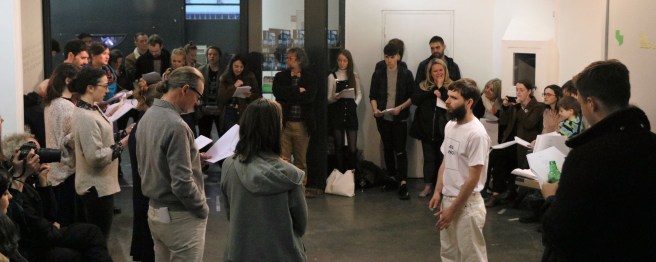
The untitled live installation/performance by Celina Muldoon took place 27 May 2017 at Temple Bar Gallery and Studios. Performers include: Terence Mc Eneaney, Susan Buttner, Elaine Grainger, Stephane Bena Hanly, Austin Hearne and William Murray. The event was curated by Roisin Bohan. Photographs are courtesy of the artist.

References

Butler, J., 2004. Precarious Life: The Powers of Mourning and Violence. Verso, London and New York.

Heidegger, M., 2008. The Origin of the Work of Art, in: Krell, D.F. (Ed.), Basic Writings. Harper Perennial Modern Thought, London, pp. 143–212.
Weber, S., 2004. Theatricality as Medium, Kindle. ed. Fordham University Press, New York.


Technological Translations

by EL Putnam

When watching performance mediated through the camera (either as a film, video, or photograph) means watching it through someone else’s eyes. The camera has a special relationship with performance art, commonly used to document the traces of ephemeral actions. However, this tool is not an objective observer. It is a machine capable of capturing time, which it can manipulate, frame, and modify, only to present it in another space. Such a mediation is referred to as post-phenomenological, which Don Ihde (2010) describes as the recognition that the perceivable extends beyond the bodily senses and thus can be mediated through instruments. I am fascinated by the relationship of the camera to the physicality of performance, not so much as a documentary tool, but how it extends the experience of a performance through the interplay of technological and corporeal gestures.

Coogan_Leah.jpg
Long exposure photograph of Leah Robinson performing Amanda Coogan’s You Told Me to Wash and Clean my Ears at I’ll Sing You a Song from Around the Town, 2015, Royal Hibernian Academy, Dublin, Ireland. Image by EL Putnam.

I recently watched Paddy Cahill’s film Amanda Coogan: Long Now, which contains footage from Coogan’s RHA exhibition, I’ll sing you a song from around the town. I had visited the exhibition regularly — at least once a week or sometimes more, staying several hours each time, as I let myself get sucked into the passing of durational performance. Therefore, I felt well versed in what the exhibition offered. However, as I watched the film flickering on the screen of the Triskel Arts Centre in Cork, I was captivated by what Cahill composed of these same experiences, and how his use of the camera brought new depth to performances I already thought I knew. The camera allowed him to obtain a closeness to the subject, presenting an intimacy I otherwise did not experience, emphasized by the caress of the camera lens as he shifted focus, presenting details just outside the limits of my ocular perception. With the camera maintaining a steady gaze, I took in the subtle details I previously overlooked, such as the wrinkles on Coogan’s fingers from being immersed in water for so long when performing Yellow. The camera elongates gestures, allowing them to linger beyond the threshold of live perception. The camera directs me where to see, valuing Cahill’s attention to details, which is difficult to focus on when witnessing multiple performances simultaneously within a gallery. Cahill also took the liberties to change the speed of documentation. For example, when presenting a time-lapse sequence, I am taken aback by the different pacing of the performers in contrast to gallery observers, who seem to be moving in distinctive timelines; passersby scurry about as the performer indulges in the present.

Such utilization of the camera in relation to performance exceeds the role of documentation, emphasizing what is possible when bringing together this technological machine with bodily action. The relationship of performance to the camera is one of translation — the live action and the captured trace are never quite the same. However, I do not qualify this relationship as one of loss, since the camera also opens new forms of perception and participation for a viewer while extending the space of creative potential for the artist. The camera produces something different than a live performance, but it also opens the membranes of engagement, drawing out the folds of experience into other times and other places.

Works Cited

Ihde, D., 2010. Heidegger’s Technologies: Postphenomenological Perspectives. Fordham University Press, New York.
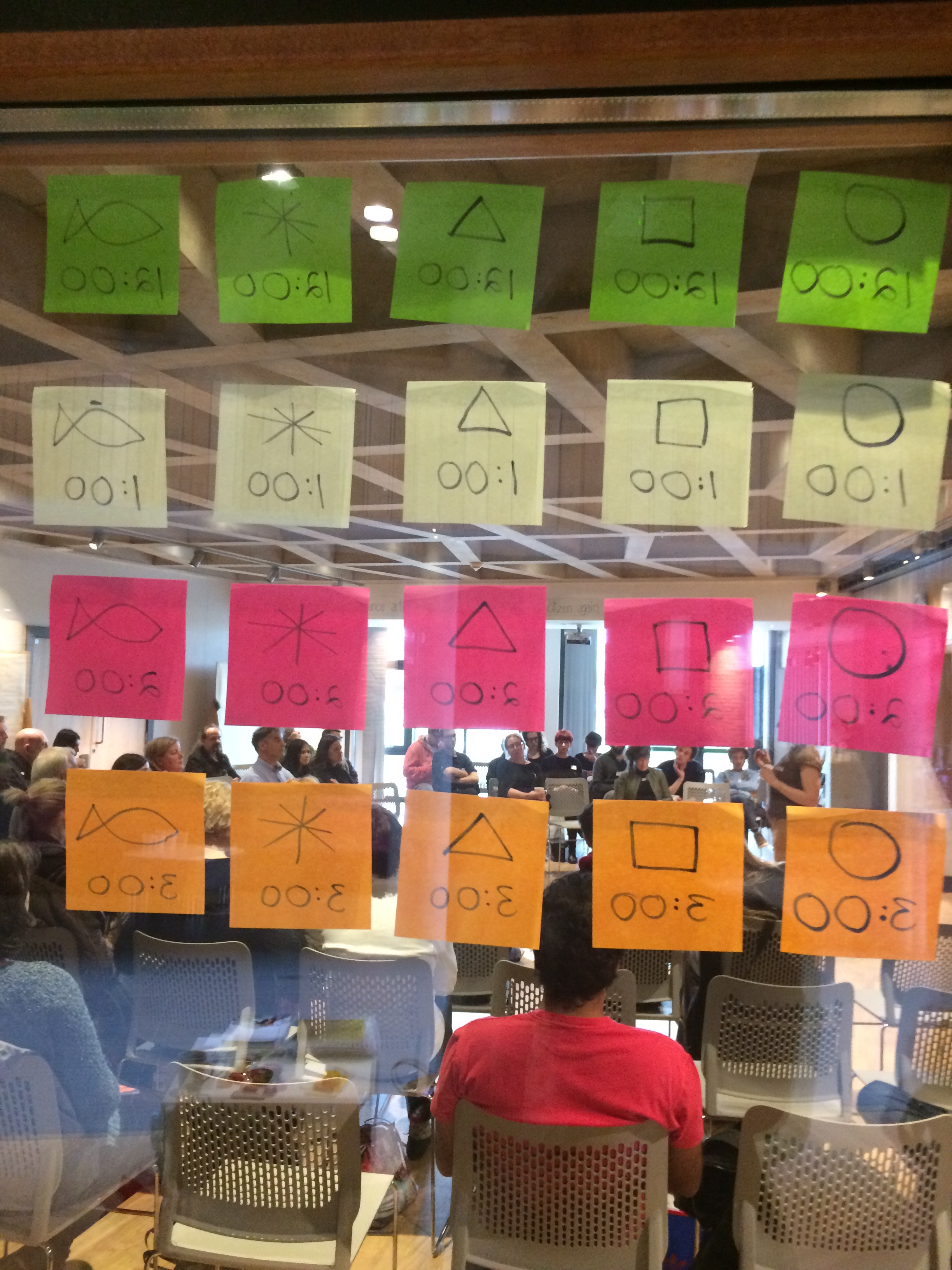
 

Paddy Cahill’s film Amanda Coogan: Long Now was screened at the Triskel Arts Centre on June 20 2017, as part of the Perforum Conference, “Body Activities,” organised by Inma Pavon and hosted by the Drama and Theatre Studies Department, University College Cork.

A Choir for All

by Sara Muthi

1.jpg

Primarily an all-inclusive singing group formed by Mark Buckeridge, ALL CHOIR aims to use the simple methodology of music to create a space free of elitism and pretension that is all too common within contemporary art today. Creating art that is accessible to a wider audience, an audience who may not have a formal art education, background or understanding is a common target in the artist’s practice.  ALL CHOIR is truly a choir for all.

A choir  open to people of all ages, ethnicities and vocal ability or professional background; a collaborative community led by Buckeridge and formed around lyrics written by the artist himself. Through multiple rehearsals, this collaboration between the artist and the choir formed the meat of the work. This process leads into a live performance, an intentionally designed booklet containing the lyrics in an almost structural fashion on the page, and a community of people. The process in which the choir was formed was an open call for anyone who wished to participate. This was reflective of the essence of the work: commonality through music.

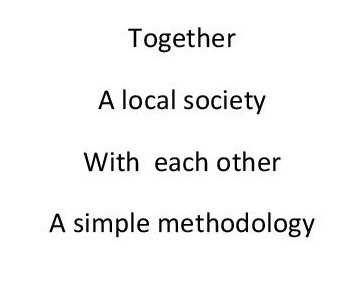
2, Together.jpg

Lyrics from song Together

In such a communal, almost purely human performance, audience and performer existed on the same plane, no stage or costume was required. There was no separation between singer and spectator. With the intention to break down as many boundaries between audience and performer, the sheet music was handed out to all audience members—some of which sang along, some of which didn’t. There was no pressure, no expectation. The simple vocals of Buckeridge, accompanied by the choir and the audience, created a simple yet powerful aura where all were equal. A sort of minimalist approach to sound echoed through the space, a simple organ complimented the softly ringing sounds of singing voices which wrapped the crowd, creating a most welcoming experience.

All was accessible, no lyric was out of reach of the listeners understanding or experience. There was virtually no difference in the space occupied by singer and spectator, with non-choir people standing directly behind, and beside all choir members, making it increasingly difficult to differentiate between any ‘function’ between any particular people who shared that room.

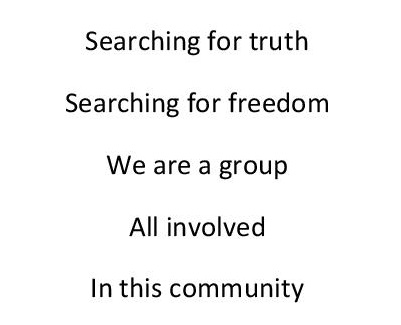
3, All

Lyrics from song All

A large portion of art falls within one of two categories, art that creates dialogue with other art, and art that is in conversation with life. ALL CHOIR is a work which embeds itself into life effortlessly. It does not look like art, it does not act like art, it does not sound like art—it just exists within the realm, without medium or classification, as all mediums and materials were used as tools and did not overwhelm the core message of the work. It did not preach but let itself be open to wonder and astonishment without any moral high ground.

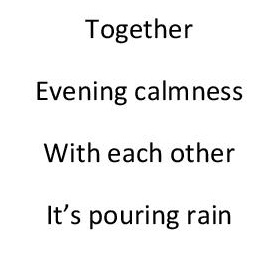
4, Together

Lyrics from song Together

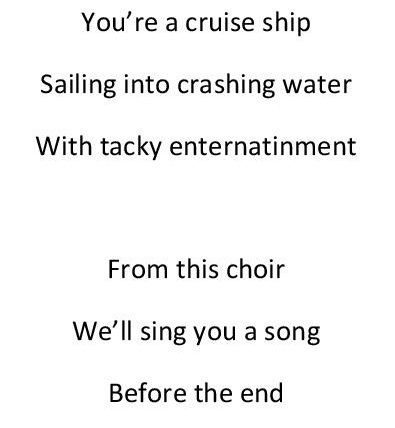
Its process was not intended to ‘polish’ the work, in which skill and ability would be of high importance; instead, it achieved a multi-diverse choir who simply performed in a gallery. It cultivated a much more instinctive and guttural creation. Even going so far as to providing a sense of comic relief, generating terms such as “tacky entertainment” and impromptu commentary from Buckeridge to the choir.

While the work wasn’t necessarily polished in the sense of musical excellence, it was very well versed and curated. There were particular rhythms and patterns; some of which the choir would sing every other line of a song, or collectively repeat a word for emphasis. These things, while subtle, must have been discussed at length at rehearsal and made for a more pleasant overall experience of the choir.

5, Our

Lyrics from song Our

This work, with its ambiguous mediums, succeeded not only in creating a more accessible space around art, but also with frustrating the definitions of art. It’s difficult to define a clear relationship between what we know as ‘performance art,’ and this work’s blatant disregard for mediums provides a raw energy, every so much nudging the line between art and life. This a practice which is valuable and necessary in relation to the state of current art practices and exhibitions

6, Sweet

Lyrics from song Sweet

A work as subtly human and experiential such as ALL CHOIR can challenge notions of art while simply by being a choir in a gallery; it is fresh and forward thinking. This shall be the type of work that continues to lead the way for the future attitude of medium within performance. A life-like-art which penetrates the social struggles of all members and communally puts at ease all who take part in the space shall be a beginning but certainly not the end for such effective practices. A subtle anthem of warmth, acceptance and perseverance through a simple Choir in a gallery creates a choir for all.

7, Struggles

Lyrics from song Struggles

ALL CHOIR, created by Mark Buckeridge and curated by Róisín Bohan, took place on April 29, 2017, at the Temple Bar Gallery + Studios. Photography by Misha Beglin.

A Reluctant Goddess

by Elaine McGinn

I missed registration. I had previously received emailed instructions on where to meet the other participants at 3 pm; I pushed my way through the heaving crowds at the main entrance to the Biennale and eventually located the empty dressing room. I was early, so I took a walk in and around the main gallery and located the Jelili Atiku installation space.

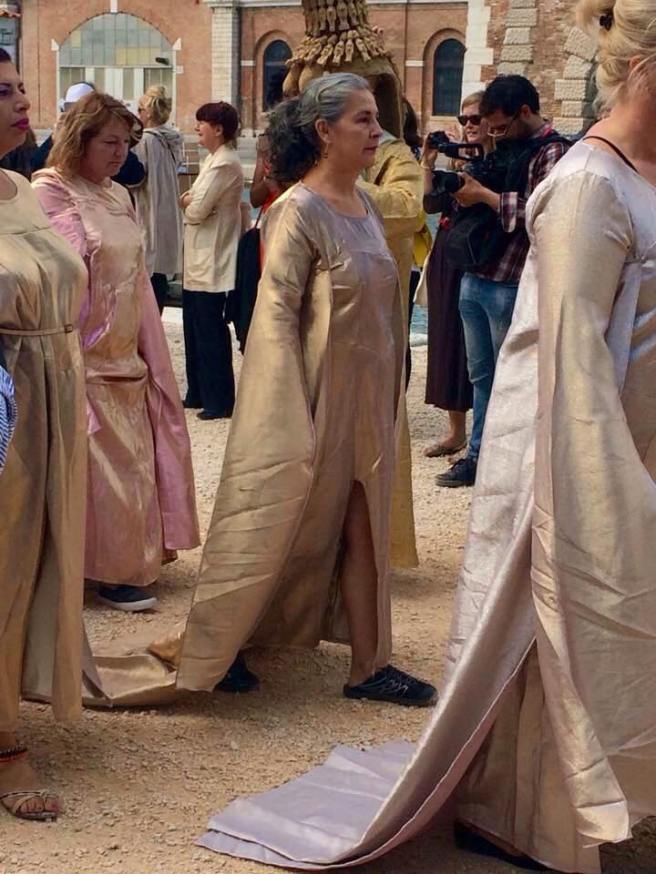
Returning to the dressing room, I noticed a heavy curtain drawn across an upstairs gallery space; I pulled back the curtain and there before me, like a modern W. Blake Vanitas scene: an explosion of shimmering fabrics and reflective surfaces, the female form in many shapes and sizes and at various stages of dress, gathered in groups around the walls and light filled windows. Some of the participants were already adorned in various shades of pink, some in silver and gold metallic gowns, complete with long flowing sleeves and trains.  Artiku’s description of the costume alluded to the Yoruba deity known as Yemoja, movement of sea and waters, so I had expected a Goddess style but the sumptuous vision before me, far exceeded my expectations.

Missing registration left me uncertain as to whether I would take part in the performance.  I was anxious to learn if my presence was needed so approached a group of women who were busily working with scissors and staple guns.  Two of the young women were adapting a smaller dress to fit the larger frame of a third, who stood upright with her arms outstretched between the fitters. Not put off by the fact that I hadn’t registered, they asked me to wait while they found a suitable dress. As I waited to be fitted, I began to consider the nature of the performance that I now knew I would be part of and it was about to begin in a matter of minutes; I was, excited by and grateful for the opportunity to Perform in such exquisite surroundings and with a successful Performance Artist. I consulted my received instructions again, and noted that “… direct attention was to the promotion and enhancement of feminine energy and freedom.” J.A.  It wasn’t long before two women were frantically cutting down the sleeves of a glittering pink costume, explaining that the dresses had been mixed up and there were only very small sizes available.

MAMA DEY GO 1.jpg

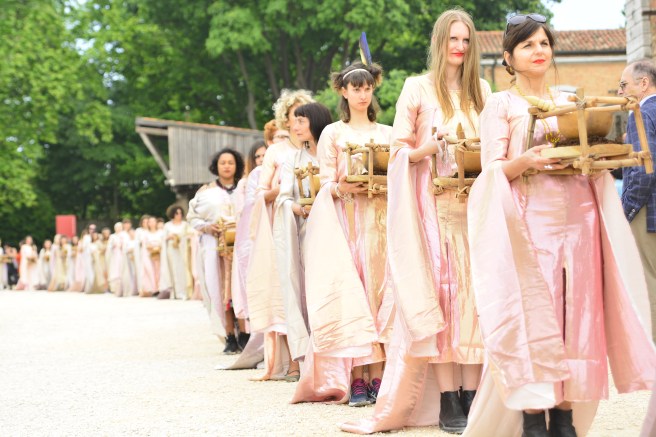
The performance began. Seventy-two women of many nationalities and ages began their performance, walking down a flight of stairs, straight into the Biennale crowds.  I made my way from the Cordererie area in Arsenale, Venezia towards my designated position.  My agitation was mounting, tripping over my dress and standing on he trains of others; I was pushed and shoved by members of the paying public vying for photographs:  the ‘Goddess’ had entered the lions’ den. I felt cold, irritated and detached.  I had arranged for my photographer to capture a few shots of the piece, but the performance was kept within the confines of the Biennale, and the prohibitive cost of the entrance fee made it impossible for photographers and others to view – there would be no personal record of the event.

Arriving at the Giardino delle Verini we found our designated number card and positioned ourselves, each in front of a cubic structure of cane and cord.  Inside the structure was a wooden plate, a layer of soil, a bowl and a carved wooden figure that we were to carry for the entire performance.

MAM DEY GO 4.jpg

Wearing a carved wooden headdress, a form of female attire influenced by the D’mba of Baga people of Guinea, Jelili Atiku navigated his way through the rows of women and distributed brass figurine necklaces to each of us.  An assistant carried a large wooden stump-like structure on his head.  The headdress, called The Universal Knowing Body, was studded with 72 long, rusty nails and its weight a noticeable heavy burden on the assistant whose face dripped beads of sweat onto the path at his feet.

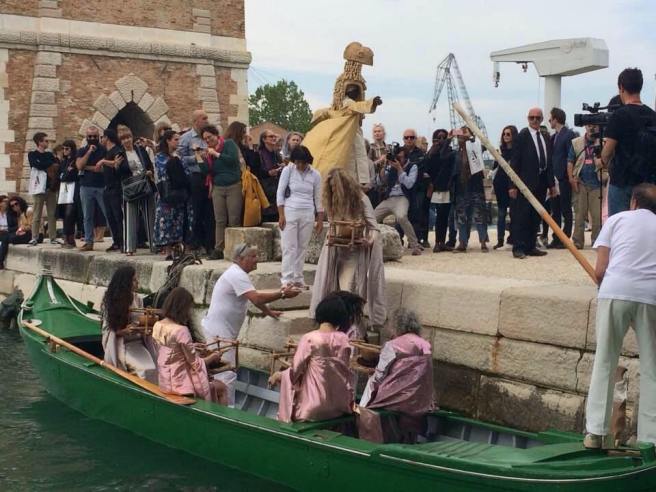
The next stage we would be led by Atiku to the edge of the Giardino delle Verini and at the steps of the canal we would board, 6 women to each boat, and taken 10-20 metres out to sea; we were to scoop a little of the sea water into the wooden bowl and return the water via canal to the other side of the garden. Suddenly I became aware of the many difficulties and dangers implicit in the proposed ritual:  slippery steps; hot sun and trying to maintain balance clambering in and out of the boats whilst using both hands to hold onto the cubic structure and its contents. My concern for the older women in our numbers was increasing but somehow, seventy-two Goddesses managed to escape injury and we found ourselves back on shore.

MAMA DEY GO 3. .jpg

The final stages of the performance proved to be as prescriptive as the opening. The artist, exalted on a white horse, resplendent in a shimmering gold suit, led us through the Biennale main building and into his installation space.  Assistants rushed to cattle ranch us into a disorderly queue where we were to “release our power of human development and creative energies”.  Some of us held hands in an attempt to muster up some sense of authenticity in the performance. At one stage, we wrapped our necklaces around the rusty nails on “The Universal Knowing Body” whilst the artist lashed together our cubic structures with rope, perhaps an offering to the female inspired wooden headdress maintained a solid presence in the centre of the space.

The aim of the performance, to promote and enhance feminine energies, had somehow fallen short. This Goddess felt cut-off, belligerent, obstructive, annoyed and sometimes fearful during the performance; perhaps not the artist’s intended emotional response but, at least it was honest and real.

The performance seemed to rip through my own sense of what it is to be a woman in the world today, making it difficult to find some emotional authenticity with which to fill the performance. My tenuous connection to the work was further lessened by the remoteness of the artist throughout; a lack of appreciation for all the women who had spent a great deal of time, money and energy – that feminine energy that made Akito’s project possible was completely overlooked.

In the days since, I have pondered on the original ethos of the work, the concept that proposed to deliver a powerful female experience and soon my thoughts were drawn to that moment I pulled back the curtain and saw the very pulse of femininity surging through the women in the dressing room.

It was in this nourishing creative arena that I was reminded of Julia Kristeva and her adoption of Plato’s idea of the chora, meaning “a nourishing maternal space” (Schippers, 2001).  The idea of the chora, with reference to the uterus and containing certain elements of symbiotic care, continuously presented itself in a place where real creative energies came to the fore.

The young women ‘dressmakers’, who had been plucked from the invisible team of administrative Staff at the Biennale, became the unlikely Goddess makers and embodied the role of the Mother.  A kind of doll play emerged: cutting, ripping, stitching, joining, and maintaining a quiet resilience throughout, brought seventy-one Goddesses to life. I was mesmerised by their blunt bladed scissors, ripping and slashing through the uneven fabric, like a kind of brutal re-enactment of a birthing scene; the idea of separation through the violence of shredding and rupturing actions reminiscent of Kristeva’s term “abjection”.

Thrust into a demanding situation: to turn seventy-two women into Goddesses, the dressmakers carefully attended to each of us, they were efficient and remained calm and dignified. They rose to, and exceeded the challenges with limited skills, tools and materials and yet produced many original garments. Now THAT was the real performance that promoted and enhanced feminine energy and freedom but unfortunately, there wasn’t a man on a horse to give it status.

MAMA DEY GO 2.jpg

Jelili Atiku’s Mama Say Make I Dey Go, She Dey My Back took place on 12 May 2017 at the preview of the 57th International Art Exhibition at the Venice Biennale in the Arsenale.

Through One Woman’s Eyes

by Roisin Jenkinson

My performance, “Mama Say Make I Dey Go, She Dey My Back” at La Biennale di Venezia 2017 integrated the intersection of processional rituals, fashion, mystical and abstract sound, and rituals with natural resources and objects. It is created to direct attention to the potency of feminine energy, body ritual and ontology so as to serve as a point of reasoning and catalysts to our utopia. The focus here is to create discourses on re-thinking on the essence of women to the wellbeing of humanity and activate a shift in consciousness towards the direction and adoption of the values of feminine energy. It believes that enhancement of feminine energy and freedom of women would release the power of human development, peace, harmony and creative energies in the world.

—Jelili Atiku


What could happen with 72 women in one room? In this social media crazed world, we read and hear a lot of gossip about grown women feuding with one another, for reasons that become irrelevant. This affects how we see the world and each other, convincing us that women can’t get along with other women. I have known this to be a falsehood, because I have grown up surrounded by incredible and inspiring women, whether they’re family, friends, work associates or even celebrities I see online, but even then a part of me expects the rumors of feuds to manifest out of some truth. Which is why it is beautiful to see young women today, such as in the pop industry, supporting one another, and when I walked into the ‘behind the scenes’ space where we prepared for Jelili Atiku’s performance Mama Say Make I Dey Go, She Dey My Back at this year’s La Biennale di Venezia, I immediately felt the warm energies of all of us.

After Jelili conveyed passionate words of encouragement and gratitude (among the technicalities of the performance), we began getting ready in beautiful purple-royal dresses that reflected light. We had some difficulty getting the dresses on, because the measurements weren’t exactly right, however we exchanged dresses and helped each other getting them on, and that support was extraordinarily beautiful to witness and experience. Wearing the dress, I felt like a princess and it brought out my child-like joy.

Before we headed outside to perform, all 72 of us held hands in a circle and made the ‘huuu’ sound which we would make towards the end of the performance; the first sound we all hear when we are in our mother’s womb. This circle of connection which was unseen by the public, I realised as the performance progressed, was essential to the feeling of connectivity I felt throughout.

At about 4pm we stepped outside, beginning our walk, beneath a blue sky with the sun beaming down on us and our dresses coruscating from it’s rays of light, towards our destination. I felt proud to be a woman, which manifested in the way I walked with chin level to the ground and a slight smile as I observed people observing us and capturing a shade us on their phones. That simple act of stepping out where others can see you, added a feeling of communion greater than 72 to that of connection. We were not just representing ourselves or even just women across the globe, but we were representing humanity as it should be; connected in communion with one another.

5.JPG

When we arrived at the official starting point of the performance, we each took our place while Jelili walked row by row (in full costume) handing us a necklace of a small brass figurine one by one, to which we would breathe into it 3 times, symbolising the transference of our energy like how God breathed life into Adam. As we waited for everyone to receive a necklace, I worshiped silently, thanking God for his perfect timing and marveling at how the Holy Spirit has been moving to bring me and all who’ve experienced the event to this moment of communion and connectivity. For instance, how the sea levels rose the previous night, flooding San Marco’s square, was evidence of nature responding to the feminine energy. In accordance to my faith, which is the core of my identity and being, it was the Holy Spirit working in nature with the tides to let us know this is the right time. I also observed our pathfinder, Babatunde Elufidipe, who lead the way the performance would take while carrying on his head the sculpture, entitled Universal Knowing Body, that represented the pain we (women) go through once a month. I could see him struggle under it’s weight with the heat of the sun beaming down on him, which gave me deep reverence and gratitude towards him that I projected a prayer of strength and endurance for him. Throughout the performance, I constantly looked all around me at the beauty and wonder of it all.

When we had all received the necklaces, we picked up the cubic structure in front of us – containing a Opon-Ifa (Yoruba divination tray) with earth, a Iroke-Ifa (Yoruba wooden female divinity figure), and a calabash (bowl) – and followed Jelili and Babatunde in single file to board the boats. This is the part I was most anxious about, because I cannot swim, but with careful steps, cautious measures and a helping hand, I got into the boat. I clung to the seat as we were paddled out, but the beauty around us comforted me, casting out most of my fear. We filled the calabash with water and after a few minutes on the water, we were brought back to shore. What I found interesting is how when we were on the water, the audience were back on land, creating a distance between us as if we were going away for a short time in order to reconnect with nature and regain some energy through rest to then return re-energised to re-connect with people on a stronger level. I cannot separate this from what I believe, so to me we were very much under the influence of the Holy Spirit within nature.

12

We waited for each boat to return to land one by one before continuing our journey of communion and connectivity. Some of the women forgot to fill up their bowls, but instead of being too proud to share, those with water gave some to others without. This is one such example of the support between each of us. I cannot think of a better word other than it was Beautiful to be a part of. It was really nice to have my sister performing with me, but as we were waiting for the rest of the boats, I found myself constantly looking behind me to see if she got off the boat yet, depicting the big-sister-worry and the bond between us of blood being thicker than water. While the connection between us as women was strong, the connection I had with my sister was stronger, adding another deeper level to the performance.

Jelili then rode a beautiful white mare and we followed them and Babatunde (who was still carrying the sculpture) to the final destination of the performance where we positioned the containers on the floor and one by one removed our necklaces to wind them on the nails of the sculpture, making ‘huuuuu’ sounds as we lined up. I do not know how to describe those final moments, but the whole performance was building to this feeling, this energy, this atmosphere the created an experience of Community, Connection and Beauty.

17.JPG

After the performance, when we were back in ordinary clothing, my sister and I returned to see Jelili connecting all of our containers and the Universal Knowing body with a string and my-oh-my, there it was.

It was such an incredible and empowering time to experience. My gratitude to Jelili Atiku goes deep for, on a personal level, giving me this opportunity to perform and be a part of this, and on a wide scale, for understanding and presenting the importance of women to the world. I also want to thank Babatunde Elufidipe for his strength and the 71 women I performed with for their support and the Holy Spirit for bringing us all together. Each one who performed, whether woman, man or horse, has their own story to tell of that day. I am but one of 74.

Jelili Atiku’s Mama Say Make I Dey Go, She Dey My Back took place on 12 May 2017 at the preview of the 57th International Art Exhibition at the Venice Biennale in the Arsenale. Photographs by Aderemi Adegbite.

New Interventions

by EL Putnam

Performance art can disrupt. Using the artist’s body as a starting point, expectations are shifted. The artist may occupy a familiar terrain, such as a main street, but they maneuver the space in an unfamiliar manner, rendering the mundane strange. Performances presented outside the gallery context, including the work of six artists that were part of the “What if?” performance festival in Cavan, have a way of drawing attention to the gestures and interactions taken for granted in the daily dwelling of public space. Sally O’Dowd decorated her figure in an excess of pink Lycra and reflective materials, becoming the manifestation of sparkling superabundance. Carrying an umbrella and golden, ribbon wand, O’Dowd strolled along Cavan’s main street, slipping in and out of shops, putting on the airs of a woman performing her Saturday shopping routine, though making such a ritual of materialist acquisition obsolete by not acquiring anything. Ever once and a while she struts and poses, breaking her acts of observation to draw attention to herself. As people browse the shiny packaging of store aisles, O’Dowd captures their line of sight like an eighties cartoon super hero whose power is evoking aesthetic experience.

It can be challenging to witness performances in this context. Part of the strength of this type of work is the ability to sneak up on unexpected spectators who become caught in the confusion of the spectacle in front of them. As someone aware of the context of presentation, I wanted to follow the performance, but inevitability a herd of us would gather around the artist, disrupting the seamless illusion of the artist maneuvering the environment. Attempts were made to remain discrete to allow the work’s dynamic foster, such as standing back at a distance or taking photographs unobtrusively. This negotiation implicates the witnesses in a different performance — that of our behaviour— as we avoid the construction of an unintentional fourth wall that introduces the gallery dynamic into the street.


What struck me about the performers taking part that day was the ranging strategies and tactics used for engaging with the audience and the many variables of performing outside the gallery. While O’Dowd avoided conversation with her audience, Christoff Gillen invited passersby to engage with him. Carrying a sign that read “Last night I dreamt I could change the world,” he wore a sandwich board with a mirrored surface while asking people to come and look at themselves. At a glance, he had the appearance of a street advertiser; someone trying to promote a local business and draw bodies into a shop. However, the utopian statement and reflective surface of the sandwich board invited human engagement. Nothing is being sold except a moment of interaction, a human-to-human exchange and the possibility of considering a better future. In the mirror, the viewer’s image was momentarily impressed onto the body of the artist, collapsed onto a single visual plane that emphasizes our interconnectedness.

NewInterventions-1

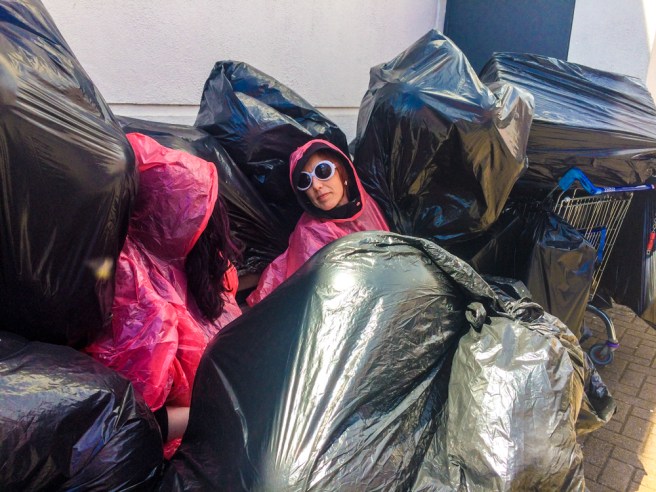
Áine Phillips also partook in verbal exchange with her audience, though the way she deployed this tactic was to draw attention to what people try to avoid: the presence of homelessness in the streets of Ireland. Dressed in a red plastic poncho and white sunglasses, Phillips pushed a Tesco shopping car overloaded with black plastic bags, maneouvering the narrow Cavan footpaths that at times forced her to move her load into the street. The bags fluttered in the breeze, filling the surrounding the space and making their presence unavoidable; drawing attention to the sight of homeless people that are commonly met with an aversion of the eyes. Instead of slipping in the periphery, Phillips brings homelessness into the line of vision, treating her encounters with passersby as opportunities for dialogue about the issue.

NewInterventions-4

Sinead and Hugh O’Donnell maintained a more muted presence in their performances. Hugh O’Donnell walked along the streets of Cavan, carrying a chair on his shoulder and pieces of paper with rhetorical questions on them, all starting with “What if” such as “WHAT IF THERE WAS NO DEPRESSION?” and “WHAT IF, WHEN YOU DIE THERE IS NOTHING?”  His presence is not pronounced — sometimes he stopped and put down the chair, sat upon it and undertook a series of simple gestures, such as holding the signs up. Other times he handed paper to passersby, unloading his burden of unrealized possibility. Overall, his presence blended with the occupants of the town, except for these minor gestures that subtly disturbed the flow of the street. Sinead O’Donnell inhabited a front lawn around the corner from Townhall Arts Space. Laying in the grass, it was easy to walk by her without a notice. Over the course of two hours, she uprooted clumps of grass, covering her body in an unsuccessful attempt to become one with the land. As the process progressed, an impression evocative of a snow angel appeared in the earth, capturing the traces of her actions. As I moved closer to her body, I heard distinctive noises of electronic static, creating a captivating interplay of sonic distortions with the organic messiness of her presence. For Sinead and Hugh O’Donnell, their subtlety was their strength, rounding out the possibilities of engagement that complemented the other artists.

NewInterventions-2.jpg

NewInterventions-3.jpg

Laura O’Connor occupied a different type of public space — the virtual realm of the Internet. In the gallery of the Townhall Arts Space, O’Connor set up a large scale green silhouette of Ireland, which she stood in front on slowly and methodically applying green paint. The room was brightly lit with studio lights, making present the apparatus of image creation that are typically found behind the scenes. Facing O’Connor was a projected image — a live stream of the scene, where the green silhouette of Ireland became a green screen, overlaid with video of ocean waves. As O’Connor applied to green paint to her body, her form melded into the oceanic scene, leaving only a pixelated silhouette. The process of application was uneven; at times the mix of green paint and waves became a dynamic camouflage pattern. As I watched the waves slowly consume her body, breaking the corporeal boundary, I received an uncanny sensation — an affect affiliated with surrealist plays with perception. The set-up of the performance dispelled the illusion of image-making while dispersing O’Connor’s presence and decentralizing perceptions of her body; a loaded statement regarding female bodily autonomy in Ireland.

NewInterventions-5.jpg

German theatre scholar Erika Fischer-Lichte describes how performance is transformative, altering both performers and spectators. As an event, performance can highlight routine aspects of our lives that slip beyond our scope of perception. The interventions of these performance artists invited an experiential detour; a welcome disruption to a Saturday afternoon in Cavan.

The “What if?” Performance Art Weekend was organised by the Townhall Art Space  in Cavan and took place 19 – 20 May 2017.  Photographs are by the author.


In the Name of the Father, In the Name of the Son, In the Name of the Mother

by Léann Herlihy

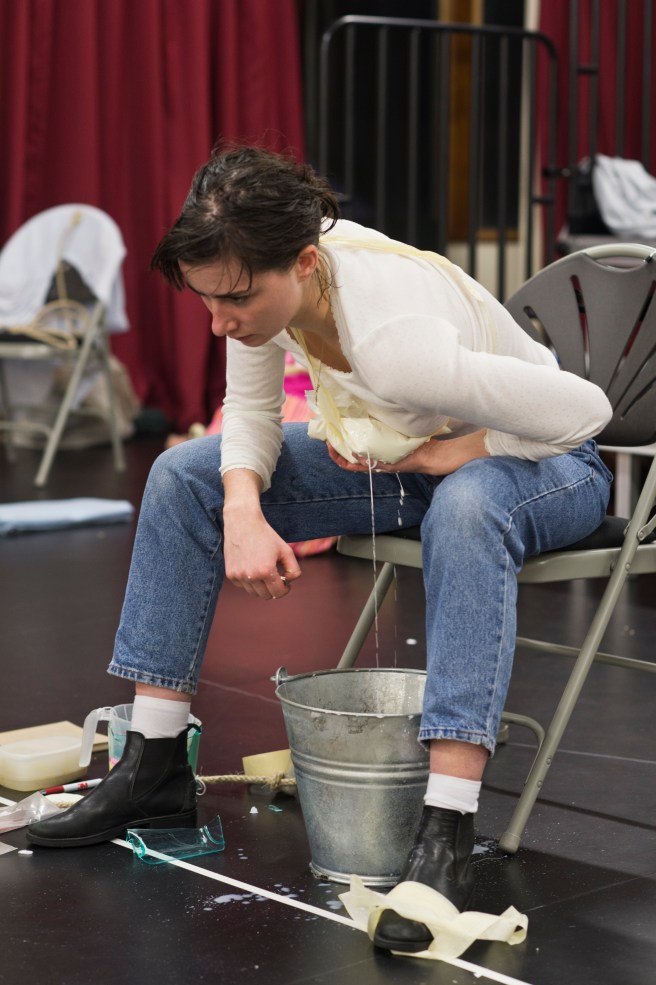
Approaching the final quarter, I sit.
Mentally exhausted; a plastic bag
full of milk
strapped to my breast;
a galvanised bucket
spreads my legs.

A group
enters the space;

a baby cradled in the arms of a woman.
Now seated to my left,
both conscious of the milk glands
at our breast.

Shoulders tall, she gives
her swollen breast
to the mouth of the child.

Mirroring, I raise
a needle to my breast;
puncture it.

We both drain the contents –
her’s into the mouth of a child,
mine into the mouth of a bucket.

In the name of the Father.jpg

In the name of the Mother.jpg

Inthe name of the Son.jpg

Léann Herlihy participated in both Cumulator 10 and Cumulator 12. Above, is a gestural extract from the final hours of Cumulator 12, performed on December 10 2016, at Echo Echo Dance Studios, Derry. Photographs courtesy of Jordan Hutchings.

The Persistence of Presence

by EL Putnam

The premise of Cowards, like many of Amanda Coogan’s performances, is simple — a woman, wearing a white dress, attempts to pull it over her hand, “she becomes tangled in the fabric; caught in the moment of taking it off.” She is joined by another woman, and another, and another… until six women become tangled in the white fabric of their dresses, caught in the moment of taking them off. The simple premise of the performance is deceitful, however, as over the course of six hours, these women occupy the entrance area and stairwell of the Project Arts Centre; caught in the fabric of their dresses, haunting the space with their presence.

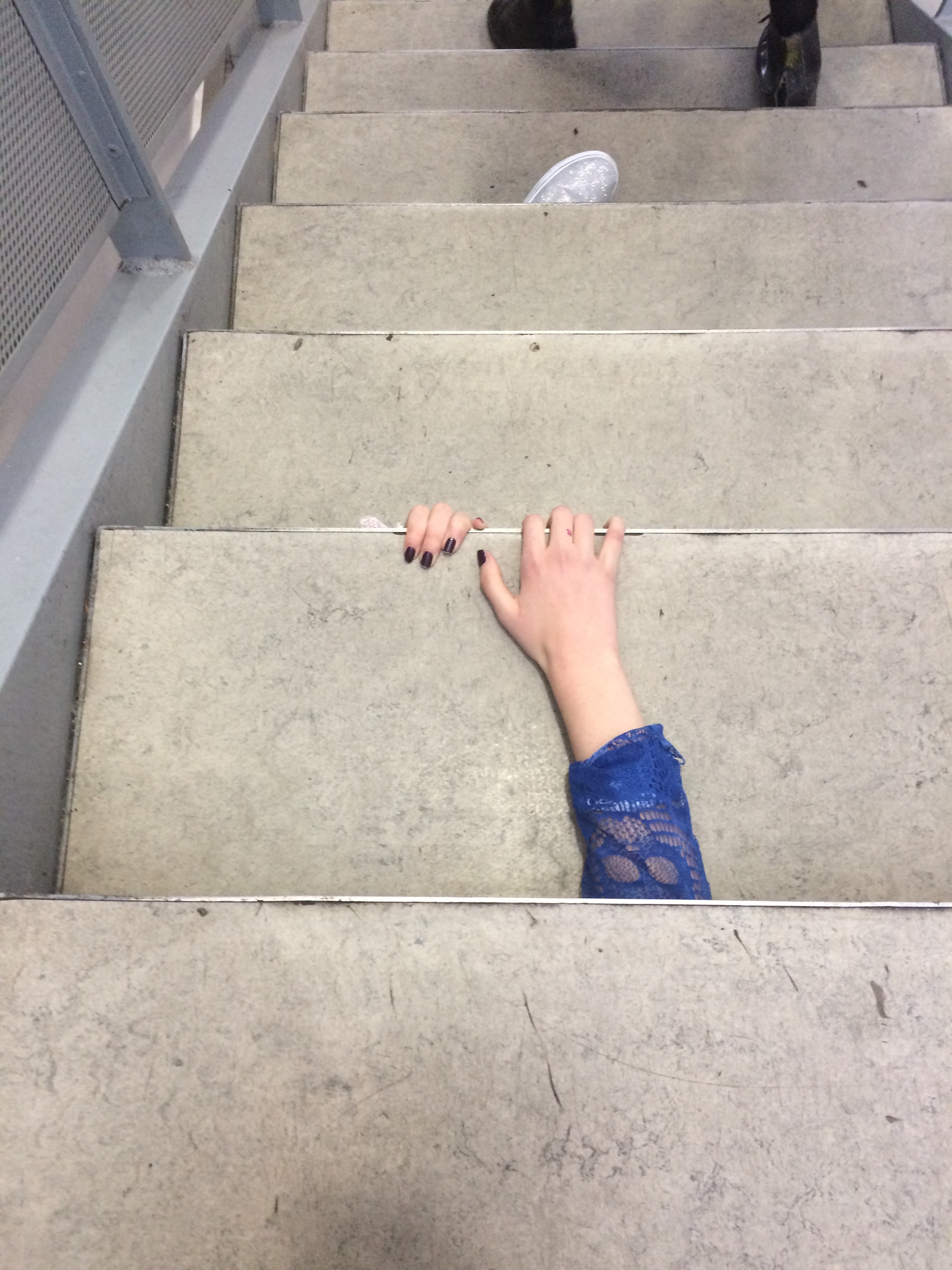
Witnessing durational performance takes time — to engage with the rich possibilities that this form of performance offers requires a commitment from the spectator to sit and stay with it. Time behaves as a medium, transforming the performers as they loop their actions and gestures, each iteration slightly different from the previous one. Time and repetition offer the witness a chance to let go of concentration; to allow thoughts to wander through acts of looking, listening, and being in the space. Despite the recurrence of the slow gestures—or perhaps because of the cycling of actions—there are moments of surprise. At one point, as I was walking down the stairwell, a hand of a performer slipped between the open steps, caressing the concrete as I gasped at the unexpected human presence. My attention is drawn to the particularities of the architecture; details that are overlooked in their utility as a thruway.

IMG_7146.JPG

The performers are splattered with a blue powder; each with a splotch here or there that contrasts the gray of their clothing under the white dress. At first, I don’t make much of it — I consider it an aesthetic choice to add visual interest. As I continue to watch, though, I spy a performer near the entrance door, where she is juxtaposed against the distinctive blue paint of the Project Art Centre’s exterior. I notice the blue splatter on her arm matches the color of the exterior; a color that gained notoriety when it was used to cover a mural that called for repealing the Eighth Amendment by Maser in July 2016. At this moment of realization, the gestures of the performers took on another level of meaning. These women are spectres who are regularly erased, yet persistently present. In Ireland, the female body is a palimpsest of ideological battles, political regulations, and religious dominance. As these women pull their dresses slowly over their head, wavering as they are caught in the fabric, drawn to each other yet noticeably silent; they become the ghosts of the body politic.

IMG_7149.JPG

Amanda Coogan presented Cowards as part of Live Collision on April 22, 12 pm to 6 pm, at the Project Arts Centre in Dublin Ireland. Performers, in addition to Coogan, include: Tara Carroll, Lisa Freeman, Róisín Owens, Natasha Carlin, and Ciamh Nooney. Images by EL Putnam.


MORE STRENGTH, MORE STAMINA, MORE ENERGY

by Sara Muthi

Become What You Rehearse. You Deserve It emerged from a mutual feeling of remorse, pain and pride felt by Irish nationals and many nations around the globe when thinking about our histories — notably, the nation of South Korea, a city named Gwangiu which was the site of a two-month residency for Ciara Lenihan and Lisa Freeman. Their immersive experience within the culture and political climate translated into a multi-layered performance event utilising the body, a large three story space, various materials, slapstick comedy and interestingly a sound piece as a key tool within the trek of the performance.

Image 1

The paralleling histories of Gwangju and that of the Republic of Ireland lie within the political turmoil undergone during Civil Wars on both sides. The inescapable residue lingering each nation is still echoing today. Lenihan and Freeman utilised the experience of one country’s turmoil, not to pass judgment upon, but to reflect on their own. While the research and influence was conjured during this period in Gwangju, it became a mirror in which the artists saw the state of our Republic within a different context. In a society in which oppression could be interpreted as heavier than our own, the artists were still able to point to the injustice and misrepresentation of the people of Ireland today.

Image 2

There is a fine line between the pleasure and pain one feels toward to their home country. The pleasure of pride in our freedom of speech and the rich history we share, as presented in the performance by Freeman’s empowering sensual groans, not to mention her nonchalant statements of “I feel great”. This contrasted with the pain of change, the seemingly fruitless efforts we take toward our evolution could not be more well described than through Lenihan’s deafening screams as she simulates childbirth, running, panting and releasing beads of sweat, unsure of which beads will facilitate change. However, one cannot become apathetic; as a mother in childbirth you push on in the hope of new life, a new hope and a brighter future. These two critical points depicted are happening simultaneously, within one space, as the performative relationship between Freeman and Lenihans performances was unfolding.

Image 3

Become What You Rehearse. You Deserve it has deep roots in its research within South Korea, and the reflection of the Republic of Ireland within it, yet the performance is not didactic. It does not push one agenda or one political stance over another. There is no ulterior motive or high ground that is being achieved. Lenihan and Freeman successfully managed to set up a dialectic with their audience. While one can acknowledge the context in which the work was conceived, contemporaneously the performance in many ways escapes it’s preceding context and becomes an autonomous work through its process.

image 4

Performance art, like conceptual art, is carried by its process and much of its meaning and richness happens within the process of making. While the performance was loosely choreographed with audio ques and patriotic gestures, it was also partially improvised. The choreographed movements alongside the improvisation came together under the sound piece which lead the performers and audience through its journey, even stating “So let’s begin”. Performance may only become through a process; no two performances may ever be the same. The performance does not simply end, one conclusion is not meet. The very best art remains open to interpretation and is continuously interrogated, as this piece shall continue to be.

Image 5.jpg

A work as rich in materials, context, reference and humour cannot be compressed or interpreted within one response or a piece of writing. What Lenihan and Freeman managed to achieve is a voice in an ongoing narrative subtly opening a dialogue about our place and reaction to the decisions being made on our behalf. The written word cannot explain the laborious screams of Lenihan, “SQUEEZE”. Nor can deep breaths and pure exertion of the artist be captured through a lens. Witnessing embodiments of pain and pleasure to instructions of “MORE STENGTH, MORE STAMINA, MORE ENERGY” as spoken by the condescending faceless voice surrounding the atrium is not something I will begin to try to convey. Neither may the text preceding the event, intended to provide context, explain what became of the performance as it unravelled. The expressions, empowerment and exertion by the artists can only be experienced by witnessing the performers within time and space. However, through these traces which are being contributed by myself, the photographers and all who took something from the project, Become What You Rehearse. You Deserve it manages to reach areas beyond its own ontology allowing a greater audience a taste of a dialectic that Lenihan and Freeman began far away from us in Gwangju.

Become What You Rehearse. You Deserve It took place on April 1st, 8 – 9 pm at the Atrium, Temple Bar Gallery + Studios. The work was performed by Ciara Lenihan and Lisa Freeman and curated by Roisin Bohan. Photography by Misha Beglin

Being (Together)

by EL Putnam

In early April, performance artists from different parts of the world gathered in Belfast to participate in workshops, engage in discussions, and collectively perform in public contexts during the Being in Public | Encounters | Outer Place / Inner Space symposium. These moments were fueled by a shared passion for creative production and the ephemeral rawness of communication that action-based art offers; art not driven by an incentive for entertainment, but to discover new ways of being in the world and being with each other. Throughout this symposium, organised by Bbeyond, there was a lingering question of how can performance actions transform citizens, all while emphasising the value of creative communities. As an artist, I treasure organisations like Bbeyond in Belfast and the Mobius Artists’ Group in Boston, which provide support for experimental art practitioners that also emphasise the value of embodied action as a means of creative expression. Mobius was formed in 1977 by Marilyn Arsem, encompassing a structure informed by radical strategies and tactics of the time that emerged from the anti-war movement. Bbeyond came about in 2001, with the Performance Monthly (which began in 2008), or monthly group improvisational performances taking place in public space, as a key activity of the group. I want to take a moment to highlight the significance of artist run organisations, especially those that foster a community-centric ethos in a market driven art world that thrives on the success of select individuals at the expense of other artists.

IMG_7059.JPG

IMG_7065

Groups such as these create a place to perform, a space where actions are valued as aesthetic experiences through the cultivation of a shared language and appreciation. They provide room for play, not unlike a creative incubator or a research and development space for the arts (thanks to Marilyn Arsem for this description). Instead of placing emphasis solely on the output, process has prominence. Through exchanges of ideas and gestures, trust builds between artists that cultivates a stable ground from which to create. Artists are accountable to their ideas, encouraged to pursue hair-brained schemes, find ways to work together in pursuits of the impossible, and receive invaluable feedback—not so much a critique in the traditional sense, but a means of honing ideas strengthening intentions.

I don’t want to get caught up in gushing too much praise; working with others has its challenges and tensions. With the formation of a group, there are inevitable exclusions—who is a member and who is not, who gets included in activities and who does not. As long as moments of conflict are treated as chances to learn from each other, it is possible to become comfortable with personal difference as we find ways to move forward together. In addition, these groups are not immune to the nuances of human behavior — artists are always at risk at reinscribing the systems and relations they claim to critique (even inadvertently). What I have come to value about artist-led organisations like Mobius and Bbeyond is the emphasis placed on the idea that the prosperity of the individual depends on the ability to look beyond the self towards the success of the group, which includes working through personal differences that includes, at times, uncomfortable processes of emotional negotiation. Such a form of human relation provides an alternative to the model where personal glory is made at the expense of making other artists invisible while exacerbating their precarity. Artist groups rooted in a community ethos offer ways of countering the many vulnerabilities associated with being an artist today, as it introduces a collective space that allows the individual to prosper. The process can be slow and the outcome not always obvious, but progressive revolutions that encompass long lasting change require patience.

IMG_7064

IMG_7069

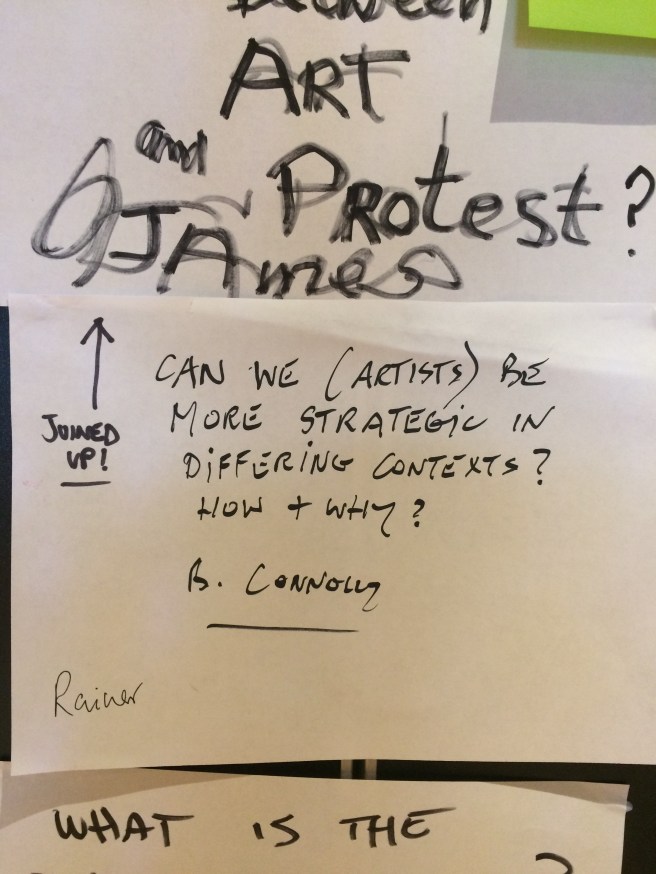
Images are questions posed during the Being in Public | Encounters | Outer Place / Inner Space symposium hosted by Bbeyond, April 3-8, 2017.