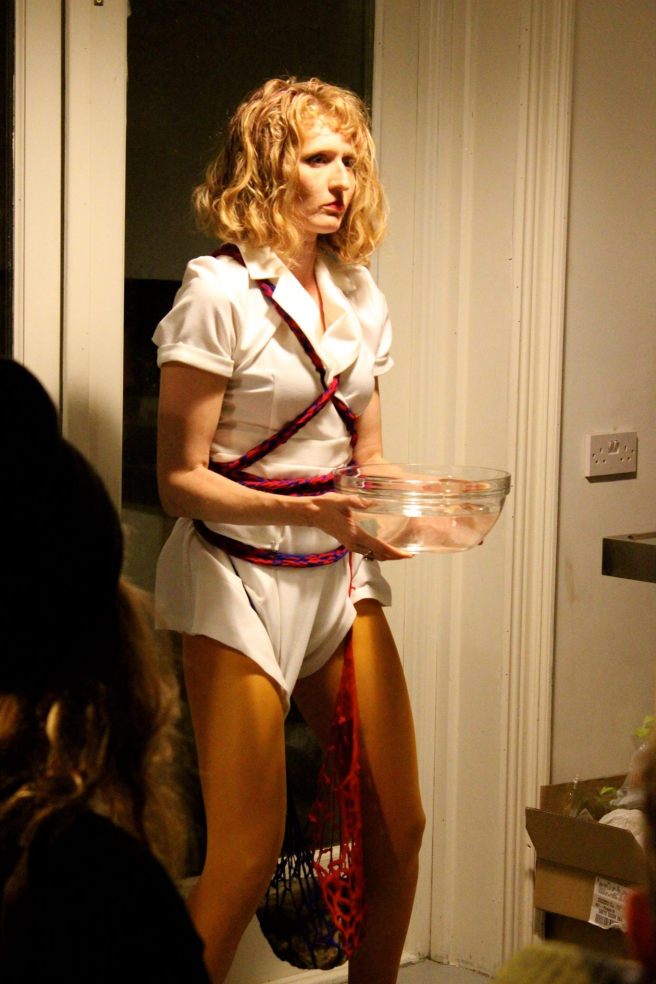
I am sitting on the ground, near the back of the room in front of a glass door. My legs are angled, heels on the floor, toes in the air. My hands touch the cold concrete below me, but my head is raised and I maintain an unfocused gaze. People enter the space — a kitchen in Arbour Hill, Dublin, Ireland. They chatter away, sipping on beers. A bowl of water sits between my legs and a metronome rests to my right. I turn on the metronome so it ticks at 42 beats per second — the regular clicking of the mechanical object draws the audience attention to my presence. I stare at them, scanning my gaze across the room. I slowly rise, letting my spinal cord unwind one vertebrae at a time. As I lift, it becomes apparent that a rock is suspended between my thighs, harnessed by a crocheted net and attached to a knit rope, created from red and blue yarn in a loose reference to the circulatory system. The rope wraps around my torso, chest, shoulders, allowing the weight to be distributed around me while melding its form to my body. I spread my legs in a subtle squat as I raise my back until my head is aligned with my pelvis. Then, I bend down, again at a leaden pace, even more slowly than the metronome in order to dilate time and allow my gestures to be pushed by the weight of the stone that enwraps me. I lift the bowl of water, though ensuring that the rock does not brush the ground.
Once the bowl is chest level, I recite from memory the first part of article 41, section 2 of the Irish constitution:
In particular, the State recognises that by her life within the home, woman gives to the State a support without which the common good cannot be achieved.
I submerge my face in the bowl of water and let out a guttural scream, liberating a pent up anger amalgamated from fragments of experience as a woman, a mother, a foreigner, an outsider. I last until my breath depletes, the water bubbling around my immersed features.
I lift my head, whipping my hair back, droplets releasing in sprinkled trajectories. I collect my composure, allowing the weight of the rock and the water to stabilise and ground me. I recite the second part of article 41, section 2 of the Irish constitution:
The State shall, therefore, endeavour to ensure that mothers shall not be obliged by economic necessity to engage in labour to the neglect of their duties in the home.
My memory fumbles; I am unable to dictate it exactly, though I let the words tumble from my lips without making an attempt to correct them. I let my body curve downwards, descending with the force of gravity as I replace the bowl on the ground. Pulling myself into an erect posture, I move towards the front of the room, placing down each foot with the beat of the metronome, letting the repetitive pulse carry me. I continue through the hallway and make my way up the stairs, maintaining my rhythm. Someone follows me to the bathroom. I can feel her presence behind me. I enter the bright tiled room, shifting my body as I grab the door, swinging it shut. Our eyes meet for a moment as it slams in her face. I end my actions alone, deep in the core of the house.
As an American living in Ireland, there is a part of me that always feels foreign — external and excluded. Stepping into this different cultural environment, my sense of familiarity is warped as I am forced to adapt to a new normal. Everything I thought I knew of the mundane is twisted as what I have taken for granted in the daily running and maintenance of my life turns alien. Becoming a mother in a foreign context amplified these sentiments as I am made vulnerable to a medical system and cultural understanding of the maternal that counters my expectations. In particular, the influence of the Catholic Church that has seeped to the core of the nation’s infrastructure during its formation and development remains an ideological spectre. While the culture takes a secular turn, there are elements that linger. I did not anticipate it to affect me so greatly, drawing up memories of discomfort from a faith I left behind long ago. Like a spiritual muscle memory, it remains engrained in my physiology. Caught in this context, with a reflexive bristle whenever I find the need to adjust, I test the limits of my malleability. My emotions simmer as I come to a new, negotiated state of being, all the while ushering a new human into the world.
EL Putnam performed Enough Rope at “Room,”organized by Angela McDonagh on September 30 2016. Photographs by Cathy Coughlan.
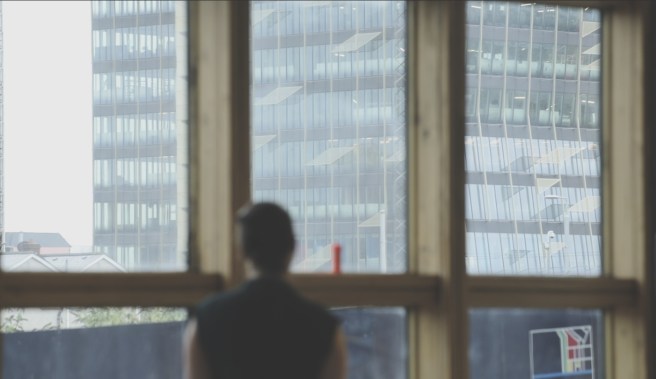
In 2016, eight years after the economy came to crashing halt and instigated the “Great Recession,” we have entered a state of intentional amnesia. Hence, Low Lying, developed by Ciara McKeon, Robbie Blake, and Jessie Keenan, is significant in that it draws our attention to the wreckage of the bubble bursting against the backdrop of a stilted recovery. The performance does not tell a story, but it asks spectators to consider the implications of our financial activities, pushed by massive overconsumption and claims of innovation. Dressed in articles of fast fashion clothing fresh from Penney’s rack, the performers blend musical composition with choreographed dance and performance action to create an eerily beautiful meditation. Located in the middle of the docklands, against a window that looks onto an incomplete building site claiming to be “Dublin’s new city centre,” emphasis is placed on the unfulfilled promises of growth. Voices echo through the chambers of the bare performance space, bouncing off the concrete structure at the corner of an apartment complex, serving as a cathedral to the free market. The harmony of voices is present yet fractured, as bodies move through the room like a herd of injured pigeons — an apt metaphor for the economic and urban infrastructure that has now overcome us, forcing us to adapt as we become the invasive species.
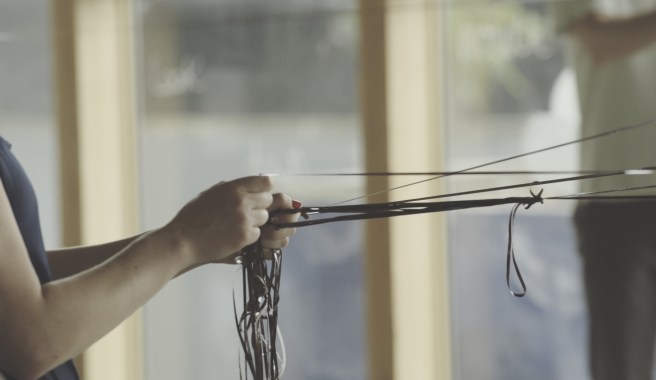
The performers claim to not do anything blatant and this restraint is their strength. Instead they sing ballads to the glory of the Liffey as performers decay under their own weight; create an interpersonal web with the tape of audio cassettes; and clean the windows with Cif Cream Cleaner, which instead of making the view clearer, only obscures perception of the scene while filling with the room with a distinctive lemony scent. Watching the performers interact through sound, movement, and material emphasizes the significance of human exchange in our increasingly dehumanizing system where people are alienated from each other and modes of experience, where work is contracted, made precarious and celluarized, where the bonds of friendship are replaced with profit-generating clicks on social networks.
It can perhaps be said that the performance presents a resigned position in its meditation on the economic crisis. Even in the tensions it provokes between beauty, the sublime of our collective economic fall from grace, and the decaying traces we leave in our wake, there are no claims to provide solution nor proclamations of hope. Right now, we don’t need a proclamation of hope — hope, while important, is not sufficient. We can proclaim hope as we spend our ways deeper into debt, fragment our job opportunities into unstainable precarious contracts, and sell off our public support systems. We can proclaim hope as we vote in politicians who perpetuate government actions that support the upper economic echelon at the expense of others. Hope is being privatized and commodified, entrenching us in modes of economic and social relations that ultimately disenfranchise us, and yet we keep doing it because despite perceptions of freedom of choice, our options are limited. Italian philosopher Franco “Bifo” Berdadi describes how we have traded our future for the comforts of a perpetual present as “corporate capitalism and neoliberalism have produced lasting damage in the material structure of the world and in the social, cultural, and nervous systems of humankind.”[1]Low Lying opens an aesthetic encounter within the wreckage of this collapse, emphasizing the significance of maintaining the human touch. As we wade through the social fabric that enshrouds us, we must maintain these human bonds, for it is with these interconnections that we can identify the structural weaknesses of society and capture the propensity for change.
Low Lying was presented as part of the 2016 Dublin Fringe Festival. Performed by the creators, visual artist Ciara McKeon, choreographer Jessie Keenan and composer Robbie Blake, along with singers Michelle O’Rourke and Rory Lynch, and dancers Sarah Ryan and Marion Cronin.
Photographs by Luca Truffarelli.
Works Cited
[1] Franco Berardi, After the Future, ed. Gary Genosko and Nicholas Thoburn, trans. Arianna Bove et al. (Edinburgh: AK Press, 2011), 11.
Vickey Curtis is a spoken word artist. Her performance A Rose By Any Other Name spoke the language of street harassment in the course of a walk from the Spire to Rathmines. Writing down words of violation on her white t-shirt, Curtis publically proclaimed the abuse of others. Her actions were matter-of-fact, her words true-to-life, and her purposeful gait acknowledged lives affected by the interference of strangers.
A Rose By Any Other Name began as an enactment of research. It was a walking declaration naming the harassment of twenty-one survey respondents. An audience of participants quickly formed into solidarity against street based harm. We reflected upon our own experiences, as we followed Vickey through a map of both intrusion and fortitude. Each story, once spoken through a survey, was no longer silent but shared amongst supporters. We honoured each location in relation to its statement of experience. This was living research and the art of testimony. It was a performance procession that followed a path of disclosure, reclaiming the significance of daily acts that spoke of not only harassment but resistance.
Vickey Curtis, A Rose By Any Other Name, Walking to Stop 4 Parliament Street. Photograph by Pamela Whitaker.
We followed Curtis to ten sites of unwanted comments. These were everyday places that became locations of violation. At every stop there emerged an experience, a tribute and a conversation. There was no audience at a distance, only a network of collaborators who identified with the accounts of verbal harassment. It felt like a pilgrimage, and a commemoration, but also a protest against silence. A Rose By Any Other Name enacted a therapeutic quest charged with politics and social action. We stood together as an intervention opposed to random acts of hurt and suffering, considered by most of those surveyed as all too common and by some the usual.
Vickey Curtis, A Rose By Any Other Name, Curtis speaking at the site of her attack. Photograph by Blue Print Photography.
Vickey’s research composed a line of relationship; it connected the dots bringing separate events into alignment. The act of writing words of harm, and wearing them, carried the experiences of others. This was spoken art as an antidote to denial. Vickey led the way, as both torch-bearer and opponent of street hate. This performance transformed aggressive surroundings into environments of protection. Secrets were aired with the conviction that they could help alter abusive realities. If A Rose By Any other Name had a departing message it was this: Don’t keep your head down, walk proud, and be who you are.
Words can do more harm than good, but on the other hand they can be our story of resistance, our way to claim rights, and distinctiveness. This was a performance that both talked the talk and walked the walk. It spoke and moved well, and most importantly did not take everyday insults for granted.
The forecast called for rain. However, in Ireland, that is not the whole story. Light misty rain? Sporadic rain? Steady beating rain? Rain. I can handle a little rain — or so I thought.
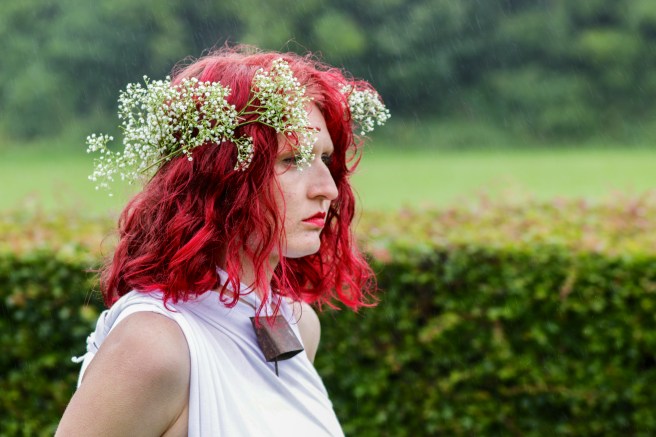
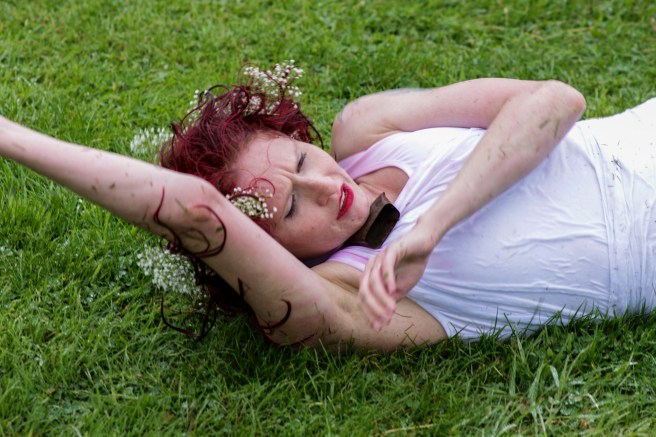
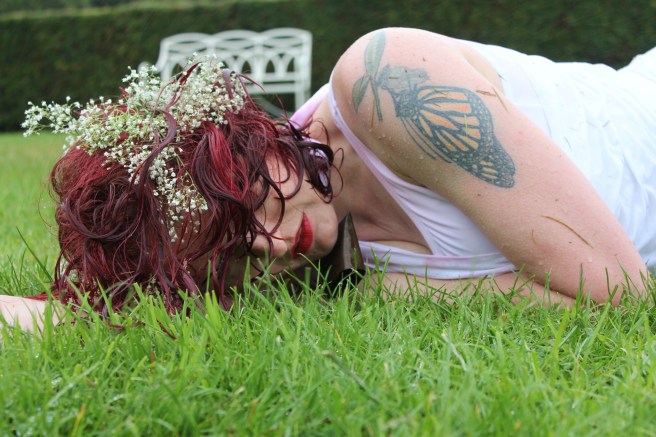
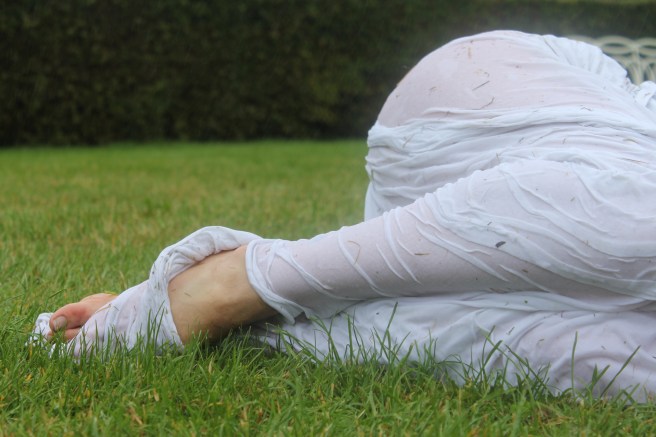
I was due to perform Landscape at the summer edition of the 2015 Dublin Live Art Festival. The parameters were simple: I would wear a white, neoclassical style dress and roll in the grass for the duration of the event (four hours). My intention was to create grass stains on the white cloth, creating an abstract image from my gestural interaction with the grounds of the Casino at Marino. In order to emphasize the frivolity of the work and introduce an element of fantasy, I dyed my hair a deep red color.
EL Putnam, Landscape, 2015 Dublin Live Art Festival (Summer), Casino at Marino. Photograph by David Stalling.
When I arrived at the Casino that day, the rain was relentless. Typically with such heavy downpour, the rain tends to let up after awhile, and so I tucked myself into our make shift shelter and waited. A number of us periodically checked radar reports, which gave indication of a break. However, the rain just persisted. I prepared for the performance as I intended — dressing only in a white leotard and wrapping myself in a sheet of white jersey material. I made no modifications. I assumed that since I would be moving throughout the performance, I would generate enough body heat to counteract the chill in the air.
EL Putnam, Landscape, 2015 Dublin Live Art Festival (Summer), Casino at Marino. Photograph by David Stalling.
I began the performance. I paced the grounds of the Casino barefoot, eyes trained ahead. A groundskeeper drove by me on a lawnmower, asking if I needed a coat. “No thank you,” I said through clenched teeth. Once I reached the far side of the building, I dropped to my knees and began to roll down the hill, letting gravity take over. As anticipated, my world spun around me. I took some moments to collect myself on the damp earth, and then continued my rolling action. At this point, the cold, wetness of the day was not bothering me, but the repetition of aggressive rolling was making me nauseous. I persisted, however, attempting to alter my pace so my body could keep up. I tried to prolong periods of stasis, though I could only last so long lying on the wet cold ground in nothing but a piece of white jersey. I was trapped between actions: maintain stillness and be cold or continue rolling and vomit. Neither was part of the plan.
EL Putnam, Landscape, 2015 Dublin Live Art Festival (Summer), Casino at Marino. Photograph by David Stalling
After about forty minutes, I felt as though I lost control of the performance. I lost trust in myself and trust in my actions. As an embodied performer, I am in the middle of the work. I have little sense of the scene I create. The corporeal sensations I experienced while performing Landscape evoked physical memories, making me think that I looked like a party girl at the end of a long night out. While a provocative image, this was not my intention when I was developing the piece. I needed to take a step back, mentally and physically. I was cold, nauseous and in the midst of a performance that was rolling away from me (bad pun intended). I stood and walked with my head held high into the tent. Once I entered the shelter, I realized that I would not be able to warm up until I took off the soaking white dress that was clinging to my body. My stomach continued its turbulent dance as I sat down, covered myself in blankets, and dropped my face into my hands. It was over. My anticipated durational performance lasted forty minutes. I was devastated. And to top it all off, even after the repeated acts of rolling, my white dress remained as white as when I first put it on. No grass stains. The piece was a failure.
EL Putnam, Landscape, 2015 Dublin Live Art Festival (Summer), Casino at Marino. Photographs by Blue Print Photography.
It took me a while to come to terms with this performance. I spent a great deal of time pouring over documentation. At least I created some strong images, but I had no idea what the piece meant anymore. I like to invite beauty into my work, though I want it to be tinged with discomfort, the cause of which remains inexpressible. I detected this in the documentation, but it wasn’t enough. The performance was now in the world, but I could not tell you its significance; is it necessary to know what every performance is about? I talked to other people who performed that day who were also impacted by the inclement weather. I felt comfort in the fact that the incessant rain put a damper on everyone’s plans — at least I was not alone. I managed to get a hold of some video and got a sense of how extreme the weather was that day. It’s amazing that I managed to last the time I did out in the field. Bit by bit, I managed to overcome the sense of disappointment, and even came to appreciate the performance to a degree. Despite this, it remained amorphous in my mind.
It was not until early January 2016 — almost six months after I originally performed Landscape —that I gained a sense of what the piece constituted. I was walking in St. Anne’s Park with my daughter and Níamh Murphy, director and curator of DLAF. We spent the afternoon catching up on life and other such things. Our conversation turned to DLAF at the Casino. In response to my performance, Níamh described how she saw a muse wrestling with the humus of the earth. The image of a creative spirit struggling with the mess of empirical reality, with the latter winning in the end, allowed me to reconsider the work in a new way. Through its enactment, the performance was about failure, cold and dirty failure, but also persistence. Unintentionally, this piece that I carefully designed to meet its environmental context became a reflection of my current experiences as an artist struggling with grand plans and limited financial resources, time, energy, and opportunities. It may have failed according to my original plan, but that is because it became something else.
It is not unusual for an artwork to change meaning in the process of creation or reception. Very rarely does an artist leave the studio having created a piece that perfectly matches what she conjures up in her imagination before starting. The audience do not always receive it as intended. The funny thing about performance is that this process of transformation may not happen in the privacy of the studio, but can take place in full view of a live audience. Production and reception are simultaneous. These elements of chance are what make performance both exciting and terrifying. An artist can never have a full sense as to how a work will unfold until it occurs, no matter how well prepared she may be. The trick is to remain open to these changes and trust the process. I can’t say this happened when I performed Landscape, but at least I can look back at the performance now without considering it a failure. Rather, it was just art unfolding in the present tense.
I think we can all relate to the feeling of ‘what is next?’ as artists. This pause after completing a body of work, the pause after studying; this pause is necessary. It is not an empty space—it is a loaded in between. In my own research I had considered the many spaces that are possible, which one was I trying to find, that made sense to the Phenomenological experience I had encountered in the presence of loved ones passing away. After much making and consideration of other defining words and concepts, such as liminal space and nowhere, it was eventually the Japanese aesthetic principle MA that made sense to that experience—the pause, the space between two structured parts, where the light shines in and through.
Michelle Hall, Room April 2016
It was in one of these moments I found myself sitting in my front room at home. I had just completed my MFA and wanted to make something happen. The idea of waiting for potential grants to find the right space sat too heavy for me as I wanted to act now. I must add that keeping a practice going as a mother can be challenging. I have watched friends juggle, all the roles that we carry as women, managing childcare and passionate to make work all at the same time. Opening up my home made this possible for me to address with ease, as I am basing myself at home.
Atom Tick (aka Stéphane Bena Hanley and James Moran), Room, April 2016
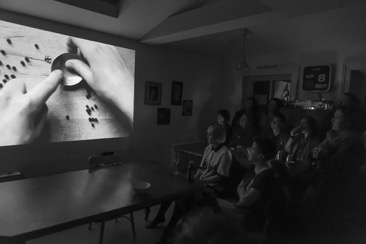
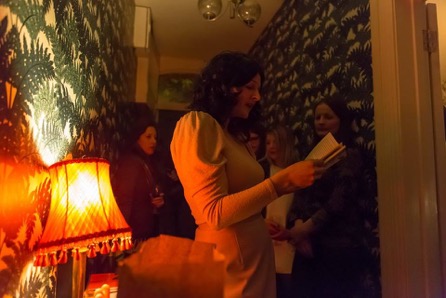
It now seems obvious if I consider my art practice, based on the experience of space and place, facilitating flow within the built structure. I considered using the front room, then, why stop there, the whole house could be used, and so as a needs must, a space for live performance evolved. I began to invite people over for tea, and this built into each artist being drawn to different areas of the house. Everyone brought something unique from the walls, to the bathroom, staircase and the kitchen. Perhaps it is that the space is a home, that the work presented was beautifully sincere, and personal, along with the bizarre and funny, and we all identify with these experiences in houses, be they our family homes, or a short term rental in a room. We carry these memories and feelings, sometimes never putting shape or form on them, but I see that Room has become a space to allow for that flow.
Sorcha Kenny, Room, April 2016Ciara McKeon, Room, April 2016
It is also important to consider that existing as a community of artists we need to find ways to support each other. This can start local and spiral outwards. Room is activated by artists and friends coming to engage as both performer and audience, in fact this lines becomes blurred as we move from room to room, I’ve had a few moments where it feels like a house party, also a familiar feeling. To offer food is another way to add a layer of comfort, and welcome people around the table creating more dialogue.
As long as I’m here, I will continue to open up this space and feel privileged to see artist bring these bricks and mortar to life.
Actions flow in and out of the fractured white cube. Audience murmurs create a buzz that permeates the air. There is liveness to the space; an amorphous energy that hums at its limits. It is the first night that Livestock has occupied the Complex in its new site over the Keeling’s Fruit Distributor. When I exit the shaky industrial elevator, I come upon a pulsating scene.
A woman is giving a lecture to a seated audience. Her clothing is a merger of two outfits, split down the middle. She glides in and out the audience, moving them in rhythm with her observations in her act of poetic anthropology. At the corner of my eye, I catch two bodies melding though the space. Caught in a perpetual embrace, a man and woman, evoke an image of malleable decay. These actions are mirrored by my one-year-old daughter, who clings hesitantly to my legs.
Celina Muldoon and Austin Hearne performing Exodus, 2016. Photograph by Amber Baruch.
There is a whiff of metamorphosis in the air, where the ordinary is defamiliarized in a swipe of Brechtian Verfremsdungseffekt. A body in white, with no head nor tail, is passed between four figures in black; a flexible sculpture. Niamh Murphy stands erect, singing along to a hip hop beat that only she can hear. The pubic region of her pants have been cut out in a nod to VALIE EXPORT’s Action Pants: Genital Panic. Enunciating the misogynistic statements of UFC fighter Conor McGregor and Ireland’s Eighth Amendment, Murphy adapts EXPORT’s legendary piece to the present cultural context in a performance that is both comical and jarring. When the applause subsides, a young woman, Roisin Jenkinson, sits comfortably in an arm chair. She seems to have appeared from nowhere, holding a journal, reading poetry at a decibel level just below the murmurs of the room. People chatter around her unaware, though my daughter tunes in attentively, transforming the moment into a private reading in a boisterous crowd. Eleanor Lawlor and Katherine Nolan move to the centre of the room. Their eyes open and close, pulling in and out of an uncomfortable embrace; clinging for life while drowning in thin air. Such is the flow of the evening.
Eleanor Lawlor performing We Are Bodied with Katherine Nolan (not pictured), 2016. Photograph by Amber Baruch.Rachel Rankin performing Paradise (Yellow), 2016. Photograph by Amber Baruch.
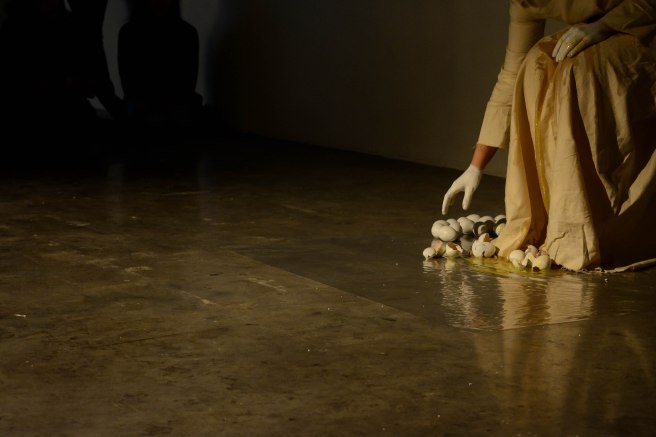
The performances continue through the night: a chorus of bees; a virtual reality experience; a solo dance with a projected image of the self. Beginnings and endings blur into what becomes an ocean of gestural activity. It is impossible to capture it all, but affords glimpses into artistic encounters. There is little linking the works conceptually or in regards to technique and style. Rachel Rankin’s delicate yet methodical handling of egg yolks is juxtaposed to Paul King’s frantic, deconstruction of the sculptural process. Rather, the axis is the common desire to express through the body and action. Corporality becomes manifest as the activity rolls through the evening, contributing to an ongoing energy. Instead of considering these as discrete performances, the night as a whole becomes an aesthetic event with audience joviality and considerate contemplation uniting the amorphous sequence. Awash in celebratory energy, Livestock feels right at home in this first-storey walk up.
Livestock: Performance Art Platform presented its debut at the Complex on Friday 4 March. Participating artists included: Suzi Coombs, Sara French, Amy Guilfoyle, Elaine Hoey, Roisin Jenkinson, Richard Knightly, Paul King, Eleanor Lawlor, Craig Lawlor, Andi McGarry, Sara Munti, Niamh Murphy, Celina Muldoon, Katherine Nolan, Grainne O’Carroll, Tobi Ometeso, and Rachael Rankin.
A murmuration is a flock of starlings — individual birds that temporarily coalesce as they migrate in formation.
On a cool day in October, Jed Speare performed with Strange Attractor on the balcony of the Sirius Arts Centre in Cobh, Ireland. This was the last time I saw him perform live. Live in this context does not just relate to the act of presenting art in real time, but concerns shared sentient existence.
The performance is four hours; a flexible coherence where artists occasionally slip out for a cup of tea to counter the chill in the air.
The sounds merge with the those emitting from the harbour: a crinkle of paper; the strum of a guitar; the rumbling bass of a boat horn; the crackle of cassette tape; an electronic pulse; the subsonic drones of a passing cargo ship.
A familiar rhythm gathers through improvisation as experiences collide, forming a temporary conglomerate where for a moment everything comes together.
Hands of the makers, crafting sounds; an ephemeral soundscape that slips into the environment.
The occasional babble of a baby unknowingly wandering through the scene.
Whispers of an organic unity with forms colliding; a sound close to my soul.
Postscript — in memorium of Jed Speare (1954 – 2016)
Jed taught us a lot about being an artist through his words and actions, lessons that I hold dearly and remind myself of regularly in order to counter the difficulties of this precarious path. He taught us that art brings people together, navigating a creative terrain that opens up worlds. He taught us the importance of kindness, generosity, honesty, and sincerity. He taught us the importance of taking practice seriously and thoughtfully through all stages of experimental play in order to allow a work to reach it’s full potential. He taught us the significance of art’s radical nature. He taught us to pay attention to details and to speak up when something is not right. He taught us to be careful with language. He taught us to historicize practice, to know predecessors and influences, to embrace and to learn from them. He still teaches us to keep going, no matter what. I feel honored and grateful to have had the opportunity to know and work with Jed Speare.
With just 10 days to go to the event Future Histories, Niamh Murphy and I, the curators, are full of anticipation as to how all the elements involved in this show will work together. The entire group of 16 performance/live artists including one media artist and a historical archeologist will be creating performances and presentations (some 12 hours long, some shorter and episodic) responding to the 1916 Rising and the building of Kilmainham Gaol as a monument to the Rising. The artists will haunt the edifice like spectres from the past embodied in the present. It has been said that a ghost is unfinished business and I think the 1916 Rising promised a republic that was never fully realised; it initiated social, cultural and economic business that is still left incomplete. Future Histories will look at these issues, complicating and troubling them through works that use the real to represent the real.
Communicating with languages of the body, space and materials, the artists will transform action, gesture and objects into metaphors revealing new ideas and meanings, confronting the narratives of national identity and heroism associated with the Rising. The general public who are booked to visit the museum and the Gaol will witness the performances by default alongside special audiences that will come just to see the event. The intersection of all these elements—past and present, general public and art audience, diverse artists doing their individual things—collectively will make for a multi-layered experience for everyone.
Courtesy of Pauline Cummins.
The staging of a large public performance event with many artists simultaneously creating live work is ubiquitous in performance art worlds. The format generates a collective space of interweaving action and presence, crossovers of representation and symbolism that are unpredictable but often strangely revelatory. The beautiful can be juxtaposed with the mournful, the reflective with the comedic. The viewer always seeks to make connection between disparate things. It is our human tendency to make relationships between things, so we generate new parallels and analogies in a creative, symbiotic engagement with the art works we are viewing. Our hope is that this interconnective exchange of meaning and experience will happen at Future Histories.
In a previous Kilmainham Gaol event in 2011, 20 artists performed together for 4 hours (Right Here Right Now, also curated by Murphy along with Dominic Thorpe and Amanda Coogan) in a similar format. There is something intense, sensual and gripping about watching or participating in such group happenings. In general, people love watching each other and in performance art this formalised encounter with another is real, not fictionalised. It is mutual: the artist and viewer are very aware of each other and the artist offers themselves as an object to be gazed at, an image to be watched and interpreted. This presents a new type of relationship for us to engage with possibilities for connection and communication outside of convention.
Courtesy of Fergus Bryne.
We humans also have a desire for collective witness, ceremony and ritual. Performance art gives us new rituals to observe along with contemporary, secular ceremony to reflect our culture and society. When Murphy and I initially proposed Future Histories at Kilmainham Gaol for the Arts Council Open Call 2016, we thought about how the 1916 Rising has been acknowledged as an act of performance. The insurgents knew how hopeless their actions were at the time. Historians believe it was a symbolic revolt and was intended to generate an aftermath of political and social change in its wake. Historian Peter Hart, (quoted in Fearghal McGarry, The Rising, Ireland: Easter 1916, 2010) describes the insurrection as “performance art.” McGarry argues that as an attempt to seize power it was woefully unsuccessful but as a symbol – a resurrection of the idea of a Republic fighting an historical oppressor – it was, and remains, stunningly successful. In Future Histories we as artists now present performance as a form of ‘Rising’ with the aim of to creating new symbols and metaphors with which we can view our past, process it and imagine new futures which can be creative and transformational.
The Triumph of Failure, that astonishing idea associated with the Rising (it was the title of Patrick Pearse’s biography by Ruth Dudley Edwards, 1979) also manifests in the idea that performance art tempts failure. It is the potential and enchantment of failure always existent in performance that often holds artists and audiences alike with such a grip. Emotionally, intellectually, imaginatively we are mesmerised by the cliff-edge of actions that are unstructured and extemporaneous. In theatre there is some assurance that a show will ‘succeed’. In performance and live art an expectation that the work will resolve in a predictable or even comfortable way is groundless. That is its beauty and fascination, I believe. Maybe that is also why the 1916 Rising holds us still with a sense of strange beauty and enchantment. Enticing failure is fearful but offers the possibility of transcendence. We hope Future Histories will engage these notions and cede such experiences to all who take part — artists and audiences — in the 12 hour event on the 21st May.
Courtesy of Dominic Thorpe
Artists: Michelle Browne, Fergus Byrne, Brian Connolly, Pauline Cummins, Francis Fay, Debbie Guinnane, Sandra Johnston, Dr. Laura McAtackney, Danny McCarthy, Ciara McKeon, Alastair McLennan, Níamh Murphy, Katherine Nolan, Sinéad O’Donnell, Méabh Redmond, Dominic Thorpe and Helena Walsh.
Future Histories is curated by Níamh Murphy and Áine Phillips (Performance Art Live Foundation)
The following text was part of a performative lecture at the DLAF 2015 seminar on live art and crossing disciplines. Some amendments have been made for presentation in this context.
‘Adhere to your discipline; that which you follow’. (Write in charcoal while walking ledge)
The text discusses sculpture, movement and dance from the perspective of the modalities pertinent to each, principally – touch, proprioception and kinaesthesia. I hope to give a sense of how thinking and acting through one discipline can inform practice in another. Both my own work and that of other artists will be referenced. Throughout this discussion I will refer to the body and grant subjective experience a primary role as a means to understanding. It is in this sense a phenomenological viewpoint on the disparate subjects raised.
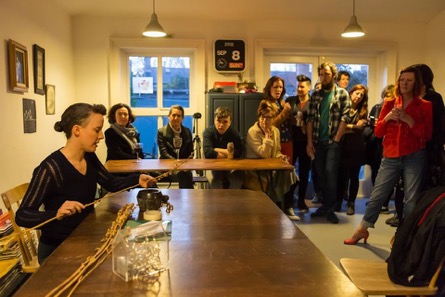
Observations on The Performance Collective during their two weeks at Galway Arts Centre.
There is much taping of the room’s peripheries and lines being inscribed on the wall. It seems like a delimiting of the space yet it reiterates what the walls already do. The group all hail from sculpture origins and marking the wall seems somehow innate. It prompts me to reflect on how the extremities of the body’s kinesphere precede those of the room. The hands, our most immediate tool, reach the kinesphere’s edge. By making contact with the walls the sense of space is reduced and that of touch emphasised. 1
Without friction it would be very difficult to move.
Articulate space requires joints. But these very words seem in conflict; the multisyllabic ‘articulate’ punctuates the gaping [sp]’Ace’. Vowels breathe. Consonants tongue forth. Space is unarticulated until it meets the edge of matter.
Have you ever felt that you’re not really saying anything when vocalising vowel sounds? Try it. (At this point some audience members choose to join in this vocalisation)
It is imperative to warm up your foot in the morning by rotating the joint of the big toe to the foot. This joint first experiences the impact of the ground before that resonates through the rest of the body. The warm up prepares the walking body for its encounter with the day.
Message from Julie Short (via Facebook)
“I´ve only come across your message now…. it´s weird I´ve been wearing these flat ballet shoes for about 2 months now, not really appropriate attire for this time of year, well any time of year due to the lack of cushioning they afford, and well, as I was walking up the escalator this evening I was thinking about meeting the floor/ground in a less impacting way, trying to see if I could meet it with my feet obviously, they´re really like walking barefoot, to see if it was possible to spend less time impacting & therefore walk lighter and well I noticed how joints absorb the shock of meeting the ground by melding in a way and then releasing….think of all that energy we´re releasing…. anyway and then I found your message, interesting.”
I am walking on a gravel path with Cyntia. She asks whose steps are loudest. I listen to our feet, differentiating the sound. Hers are lighter. (July 2015)
But before we hit the ground, before the body reaches the exterior, there are many fulcrums of movement inside, in the dynamic interiority of the skeleton.
(I move to various parts of the gallery space, small spaces, high spaces in which I can reorient my body. The gallery supports me as a crutch for my contortions.)
To leave the support of this architecture and take the centre of the room independent of all physical and visual supports initiates dance. Even if it begins with only the small dance of Steve Paxton,
(Introduction of the small dance2) – Find yourself a bit of space, enough to stand in without contact with your neighbour. You do not need room to spread your arms. I invite you to close your eyes. Inside there are numerous grounds off of which movement occurs. I will begin to feel the friction within my own body that allows me to move.
‘You may keep your eyes closed’. This suggestion was for the audience. The reader may behave otherwise.
“I’m standing listening to the Quiet Club play at the RHA.3 They play sounds and respond to each other with the concentration of chess players. Each responsive sound crucially weighted so as to maintain the quiet that they enter their sound upon. I want to listen with my body and do so standing. There is thus only one joint, that of feet to floor. And relax as much as possible so that I can feel the sound and not be disturbed by any tensions in the body or superfluous points of touch with wall or chair. Perhaps I can fool the sound by being this quiet and it will pass through me unaware of my presence. I become space, bar the grinning ear, cousin of the Cheshire cat.”
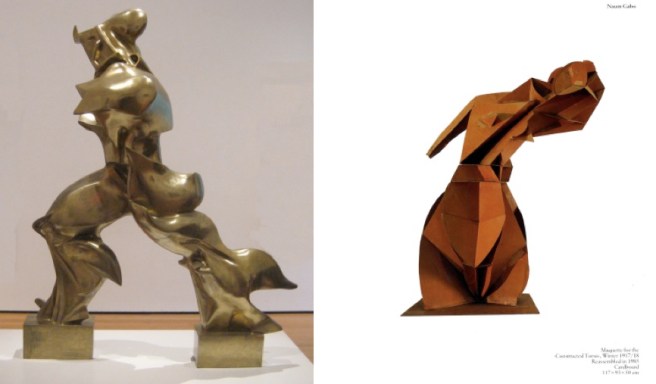
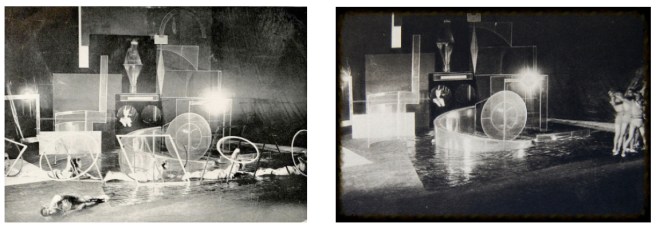
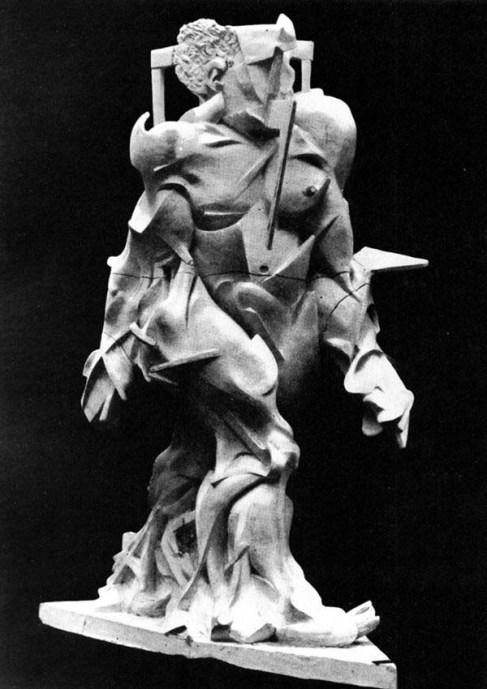
Right image source: Barbara Dawson, Berlin!: the Berlinsche Galerie art collection visits Dublin, Berinsche Galerie, 1991.
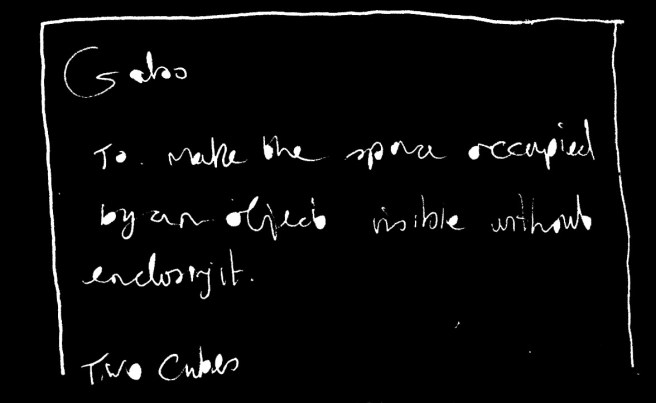
Above is the work of two sculptors from early Modernism – Boccioni and Gabo. These works are a constant reference point in early Modernist sculptural treatment of movement. I use them frequently as references for life drawing. The work of the futurist Boccioni, despite his attempts to represent a ‘universal dynamism’ was rooted in traditional bronze casting. The figure is strident though weighted in its materiality. Naum Gabo, a Russian Constructivist, here uses cardboard to make a maquette describing a body through planes emerging from its centre. He also used transparent plastic materials in his work to describe volume thus moving his work beyond the representation of mass. In a note accompanying the work Two Cubes(Demonstrating the Stereometric Method) 1930 Gabo eloquently expressed his intention.
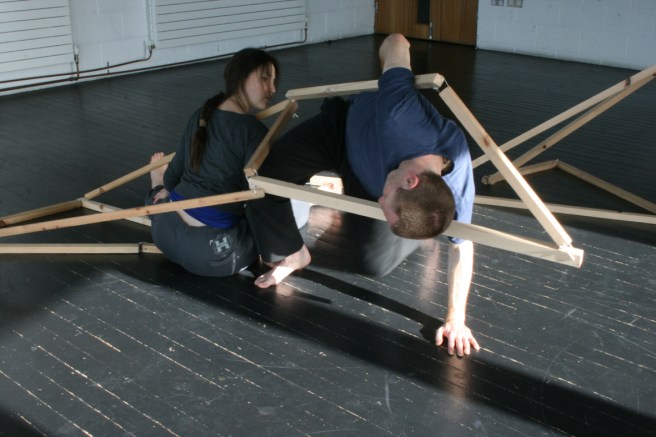
The statement ‘to make the space occupied by an object visible without enclosing it’ has quite an affinity with the visual effect of my current choreosculpture work. Originally a sculpture with fused joints, Angel, it behaved like much other sculpture since it was static. But in making the joints mobile it invited a movement with it that draws upon techniques of contact improvisation dance.
Marion Cronin and Fergus Byrne. Studio work with choreoscultpure, 2015. Photo: Annette Moloney.
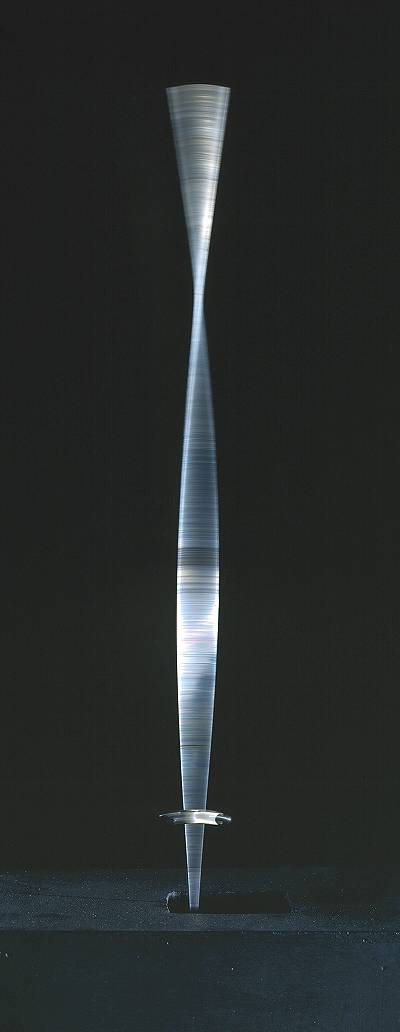
Gabo pioneered kinetic sculpture, an exemplar of which is ‘Standing wave’.
Standing wave vibrates in space when a button is pushed. It might be interesting to drop rings of varying sizes onto this rod and see if they would stay in motion like a hula hoop.
(At this point an audience member of some skill in hula hooping kindly takes up the invitation to demonstrate while the talk continues.) We could use as a guideline the mathematics of how a hoop actually is sustained upon a moving body. For this please see the following link – http://arxiv.org/ftp/arxiv/papers/1101/1101.0072.pdf. But it might be as interesting to take a hoop and develop one’s kinetic awareness in flesh and bone.
At this point the printed word as a record of the talk becomes quite limited. Its most recent iteration involved an audience member hula hooping while two others read a dialogue via emails between the artist and an engineer on the equations for hooping relative to embodied knowledge.
And so we return to Gabo, who interestingly designed the set, costume and sculptural props for the 1927 Ballet, la Chatte, by Balanchine for Les Ballets Russes.
So we can consider two polarities – Density and the visible space of the void. Yves Klein leaped into the void in 1960 eschewing all supportive aids to his body. It exists only as a photo. Before leaping he, like all of us, was supported by an external ground. An external surface adheres to the body, an accretion that while necessary, also limits the body’s autonomy. This necessary friction allows us to move. But an excess binds us to an encumbering materiality; A bit like the hoop. Without it the body might not gyrate to the same extent. So there is interdependence. Certainly the hula hoop is reliant on the body to move it but it gives the body a force against which to work and a frame in which to exist.
Let us return to Boccioni and his Synthesis of Human Dynamism, 1913.
The attempt to fuse multiple moments of motion in a frozen spatio-temporal continuum leaves the figure constricted by its prior movements. Futurists held the view that objects in reality were not separate from one another or from their surroundings. The statue’s movements are sedimented within it. The histories of our movements are embedded within us. Our body evolves to move in accord with the objects within its world. It evolves its posture based on its daily life; gestures develop according to the things and the people with which we engage.
So to dance in one’s body is perhaps to attempt to be without accretions and supports; to quarry what remains in the body after the experience of the external world. This is an approach used within contemporary dance forms – recreation of movements with someone or something without that accompaniment.
Consider in practice what it is to push downward and move upward; handstand press.
I am forever intrigued by how, in a life drawing practice, people often ignore the feet. It seems not just forgetfulness or lack of space but a lack of consciousness of the connection to the ground. An acrobat model performed a handstand one day and only two people drew his hands.
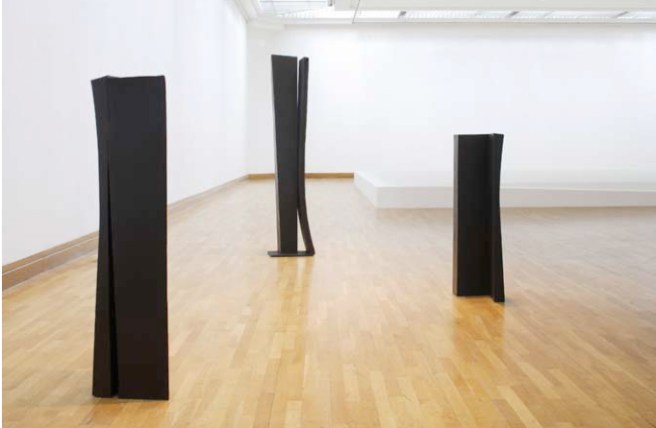
Yet our interrelation with the external is inarguable. The final words will be those of the sculptor Michael Warren who speaks of his sculptural matter in a way that can also be applied to the body.
‘Matter bespeaks limit. Limit implies the ideas of equilibrium. Downward movement is the condition of elevation and all movement upwards. The pivot or fulcrum is an awakened attention’. 4
2. The ‘small dance’ is a term used by Steve Paxton, pioneer of contact improvisation. He refers to the movement that is happening inside us that may not be externally visible. My conception of this was that it referred to the feet and the adjustment of balance through the soles. However upon research I found the following website which takes one through an inner scanning of the entire body; a sensing of the small dance. http://myriadicity.net/ci36/satellite-events/the-small-dance-the-stand.html
Eleanor Lawler, one of the co-curators of the Livestock — Performance Art Platform, provides insights into her experiences of facilitating these events.
When curating live art events, proper planning and experience, one could suggest, are basics. But what does that mean and how can you possibly have proper planning for a live art event? Something might and frequently does require last minute adjustment, like the performer who does something not discussed or planned for, the performer who gets cold feet and doesn’t turn up, or the one who turns up two hours late. What about the performer who forgot to tell you that they need an amp, a mic and lighting? How can proper planning possibly avert what, for a curator of 2D work, might seem an impossible task? With every live art event curated, another layer is added to that great big onion that is curating a live art event. (The onion metaphor is useful as onions are useful vegetables that need compost to grow but depend on many layers to make them what they are, adding to their flavour and size. Not too big as to be tasteless, (excellent metaphor), great for a stew too).
Livestock began in 2008 at The Market Studios and was established and run by Francis Fay, Joan Healy and Louise Ward. I had attended my first Livestock and loved it so I took a studio at The Market Studios. Joan and Louise moved on to other work and new places so I volunteered my services. Myself and Francis Fay have been working on Livestock together since 2011, the rest is still unfolding.
Performance by Valerie Joyce, Livestock at Market Studios, 2010.
Livestock is about facilitating and providing a platform. The curation happens with selection of appropriate works and timing of performances. Administration and clean up, the usual delights of curating, are augmented by decisions to be made on the night like the ones of a last minute nature, unpredicted, unplanned for and hopefully none serious enough that the audience will notice (the smell of raw onions seeping into the performance area perhaps?). Proper planning, that’s what needed and perhaps experience, actually experience counts for a largest proportion of compost that helps the onion to grow.
There are, of course, moments of panic, but maybe that’s just me — but it’s not just me who sees the moments, minutes, and sometimes hours that are the pure magic of performance art. The realness, the shared experience, the subversion of an economically titled society, the pleasure and the pain of that shared visceral reality, the experience of the moment; how can that be ignored, negated and devalued by heavy handed curation? I don’t curate, I facilitate: good, bad, and occasionally awful performances (purely subjective). However, I will fight for facilitation for every last one of them. Facilitating space for real, exciting, vital, embodied voices is not an option for me, it’s an absolute essential.
Paul King performing Action Sculpture at Livestock at the Complex Dublin, March 2016. Photograph by Amber Baruch.
Facilitating Livestock is one type of curation (read onion farming). As with all curation, some artists are such a pleasure to work with, clear in what they want or need from you, turn up on time ready to perform—a level of independence that is professional and admirable —while others require a tad more looking after. Without doubt, curating live art is by far and away the best experience, compost or not. There are some artists who are so very nervous before their performances, dancing and singing afterwards with delight at having their voice heard. There are also the experienced practitioners who exude happiness at a performance going well or simply embracing the performance however they felt it went. Either way, delighting in the experience of being “heard” is something that speaks loudly to me: “I hear it in the deep heart’s core.” Curation (of live performance art) rocks! If you get the whiff of raw onions when you attend your next live art event, just think of it as compost helping to make a bigger, better and more full-bodied onion.

















 in:Action