There’s art that challenges you, and art that’s simply not for you

By Sara Muthi

There’s those who see art as an externalisation of the human experience, people who see art as something beautiful or impressive. Some see it as pompous, pretentious and nothing more than an attempt to extract a reaction from the public. Alternatively, there’s those who see art as a branch of academics, who attempt to make connections externally from themselves about the world, politics, art of previous generations and consider it as legitimate a study as history or physics. The “visual academics” is a term I often use.

Personally, I don’t care for art’s aesthetic or emotion. I tend to only share or take seriously educated opinions. That’s just me. Before I respond to any work by an artist, I comb through as much research as I can get my hands on. If possible, interview the artists or curators, plan and re-plan every article and essay, beginning middle and end. Every time. I most importantly refrain from using the word “I”, which makes writing this all the more strange to me. This is a method I developed through my BA, and gives me peace of mind that I am representing every work as objectively  as I can, removing the margin of error known I’ve come to know as ignorance. However, I was recently confronted with a performance by Martin O’Brien at the Dublin Live Art Festival that shattered my conventional working methods.
20988275_10155493767410586_1305846975235788755_o.jpg

Ample warning was given to the audience prior to entering this performance. Blood, flesh and self harm were the three terms of caution used by the organisers that had instantly tied a knot in my stomach. Nonetheless, as a writer I figured I ought to put my personal reservations aside and attempt to see the work objectively. I was struck by the scent of sanitiser as I reasoned with myself to go up the stairs of the Complex, however I could not force myself into a place of emotional distress for long.

O’Brien slowly makes his way down the stairs into the room, a plastic bag covers his face as he attempts to breath heavily into his stomach. Inhaling deeply and desperately; his ribs become increasingly evident. A tray of surgical equipment occupied the direction the suffocating O’Brien was going. The overwhelming instinct of flight flooded my body, the anticipation of witnessing self harm had already become too much to bare. I quickly and discretely left the room and gasped for air, ironically mimicking the actions of O’Brien.

20988215_10155493767420586_7746926928702790213_o.jpg

Part of what makes the work of Martin O’Brien so remarkable is how his work relates to his terminal illness, Cystic Fibrosis. The strain and levels of endurance O’Brien subjects on his body for his durational performances is uniquely tied to the stress his body is constantly in living with C.F. Bob Flanagn is a highly influential performer who also suffered from the same illness and used the endurance of pain within his work as a way of prolonging his life and was subsequently the longest survivor of Cystic Fibrosis, dying at 44. There are no doubt ties between these two practices, however unique in their execution and use of the sick body. O’Brien’s work is highly relevant and influential to today’s performance art landscape and should not be clouded by my own inability to stomach the work.

I cannot express why my body reacted to the way it did to the anticipation surrounding this performance. Guttural is the only word that comes to mind. No doubt there are answers to what prevented me from witnessing an almost fully nude, Cystic Fibrosis suffer from cutting himself. However, I’m not about to go down that road.
20900819_10155493769365586_1067375273542239423_o.jpg

At fifteen my art teacher nominated me to shadow a third year sculpture student at the National College of Art and Design. Never had I felt more at home than among artists and academics, all talking about one thing, contemporary art. I hadn’t thought of anything ever since. Nothing could pull my curiosity away from studying the works of Sol LeWitt, Amanda Coogan, Michaël Borremans or the writing of Roland Barthes, Lucy Lippard, Susan Sontag and my person favourite, Peggy Phelan. Now in my MA I am more enthusiast than ever to respond and envelop myself into the contemporary art world, particularly that of the study of performance art. As seriously as I take my work, for most of us, art is not life or death. If you feel challenged by the work of an artist, make it your mission to learn more, be uncomfortable and you will gain so much from it. However, if you simply can’t stomach a work, maybe it’s not for you. At the end of the day, art is just art. There’s art that challenges you and art that’s simply not for you.

Martin O’Brien performed It’s Good to Breath In (This Dublin Air) at the The Complex on 19 August 2017 as part of the Dublin Live Art Festival, curated by Niamh Murphy and Francis Fay. Photographs by Francis Fay.

Fleeting Breath

By Dr. Kate Antosik-Parsons

Martin O’Brien’s two-hour intensely embodied live art work, It’s Good to Breath In (This Dublin Air), was performed at The Complex for the Dublin Live Art Festival (August 2017). Two large metal doors opened to reveal the artist seated atop metal stairs. Wearing a white jockstrap and a black PVC fetish mask with an expandable latex face piece, he took deep, controlled breaths, the translucent latex inflating when he exhaled. Alarmingly, the suction of breath inwards formed a seal over his mouth, his face temporarily arresting in a wordless scream. The recycling of oxygen in the mask and its tightness around his neck left his upper body flushed from the exertion. He descended the stairs and moved through the crowd, at times crawling. As he moved towards a small metal table that held various surgical implements and medical supplies, I wondered, with a mix of fascination and slight horror, how the performance would unfold.

IMG_5672 copy

O’Brien has Cystic Fibrosis, a chronic and fatal genetic disease of the mucus glands that affects the respiratory, digestive and reproductive systems and sweat glands.[1] It’s Good to Breath In (This Dublin Air) was based on series of actions that recalled the specifics of Cystic Fibrosis; coughing, shortness of breath, the expulsion of phlegm, stimulation of thirst and need to protect the body from infection. These engaged with his personal familial history, with its origins in Dublin, and his queer identity. The use of different latex masks and the performative self-mutilation body practices evoked pain, and, at times pleasure, associated with Cystic Fibrosis and the erotic, interpersonal role playing BDSM practices. O’Brien’s performance drew parallels with American performance artist Bob Flanagan (1952-1996) whose personal motto ‘fight sickness with sickness’ located his work in the intersections of Cystic Fibrosis and BDSM.[2]

The intensity and intimacy maintained throughout the performance was demanding for the viewer. After urinating into a metal bowl, O’Brien vigorously whisked warm piss with traces of bubble liquid from a small plastic bubble wand. Moving slowly and deliberately, he had a series of fascinating interactions with the crowd gathered as he blew piss bubbles at individual viewers. Each person encountered gauged their level of discomfort and indeed, engagement with this action. I stood opposite the artist and we shared an intense connection. His gaze challenged me, was he asking for my consent? By remaining still had I given it? He seemed aware of my uncertainty and smiled mischievously. As he pursed his lips to blow, I had but seconds to decide, would I allow his excretions to land on my face? The bubble released from the wand and gently floated towards me. Genuine laughter broke out as I cleverly avoided it using my own breath to blow it back towards him, the force of which caused it to pop in mid-air. As it burst it was symbolic of the fleetingness of breath.

IMG_5712 copy

The presence of the respiratory system, specifically the lungs, loomed throughout the performance, not only in the guise of the inhalation and expulsion of breath, but there were numerous allusions to their anatomical shape in the artist’s different actions. Cutting his skin with a scalpel, O’Brien traced the outline the organ onto the exterior of his body. Later, when he stood in a black trough cleansing himself and gargling with water mixed with urine, his body was lit from two spotlights that cast a double shadow behind him. Remarkably, it appeared to be a spectre of the lungs. Seated on the cold, concrete floor, he stuck white cotton balls to his chest in the outline of the lungs and trachea with white, tacky glue, it’s dripping, sticky qualities referenced both phlegm and male ejaculation. In the final part of the performance, and not coincidentally, one of its most compelling moments, O’Brien fit a flat, square makeshift device with a hole in the centre, reminiscent of a cock ring, around his scrotum and penis. Using needles, he splayed and pinned different parts of his flesh to its black background, manipulating his anatomy into the shape of the lungs. The frame around his genitalia provoked consideration of the ways in which sick bodies, like queer bodies, can be stigmatized and objectified. These disconcerting actions were both provocative and defiant as O’Brien sought to push his body, and the audience, to the limit, in turn highlighting the fragility of life and his struggle for survival.

Martin O’Brien performed It’s Good to Breath In (This Dublin Air) at the The Complex on 19 August 2017 as part of the Dublin Live Art Festival, curated by Niamh Murphy and Francis Fay. Photographs by Fiona Killeen (www.blueprintphotography.ie).


[1] Ireland has the highest incidences of Cystic Fibrosis with approximately 1 in 19 Irish people carrying one copy of the altered gene. https://www.cfireland.ie/about-cf/carrier-testing-for-cf

[2] Dominic Johnson, The Art of Living: An Oral History of Performance Art, Basingstoke: Palgrave Macmillan, 2015, p.115. Interestingly, O’Brien collaborated with Sheree Rose, Flanagan’s partner, on several performances between 2012 – 2016.

Eyes on the Prize

by EL Putnam

It’s 2004 — the year of a presidential election. I am disillusioned from protesting a war that happened anyway. I just began a class on Interventions at the Museum School with Jamie McMurry. We are shown different ways of disruption through performance, which includes the actions of Reverend Billy and the Stop Shopping Choir in the Disney Store. First thing I remember thinking is “you can do that?!” then “I want to do that” and my spirit of protest was reborn.

IMG_6146 copy.JPG

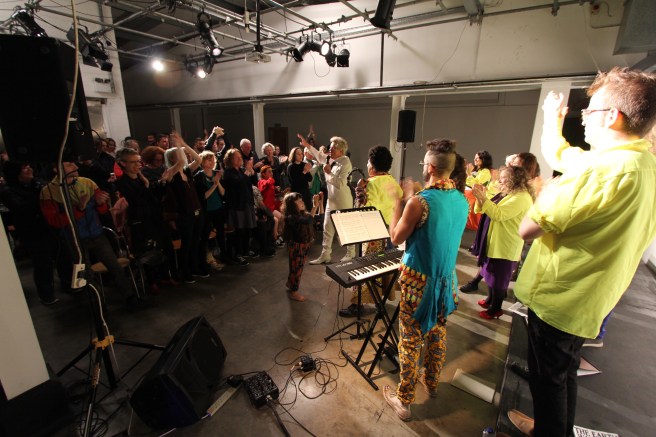
The scenario takes the form of a Christian revival, led by a charismatic preacher. However, the energetic ambiance of the experience is created by the choir, whose songs take inspiration from gospel and Civil Rights protest songs, appropriated for the twenty-first century context. The energy in the room is contagious — as the songs roll out, more and more people in the audience rise to their feet and sing along.  Instead of trying to draw followers of faith, Reverend Billy and the Church of Stop Shopping attempts to use the strength and comfort of song to draw our attention of the many injustices that humans currently face, calling us to action. Without isolating specific issues of discrimination or oppression, the choir’s repertoire and Rev. Billy weave together different aspects of our consumer-led destruction that increasingly alienates our relations to each other. The messages are not accusatory, though at one point Rev. Billy refers to my toddler daughter, who watches Netflix on an iPhone, as a sinner. The comment is made in good humor, though I realise that it functions as an apt illustration of an increasingly screen-reliant society whose impact we have yet to fully experience and comprehend.

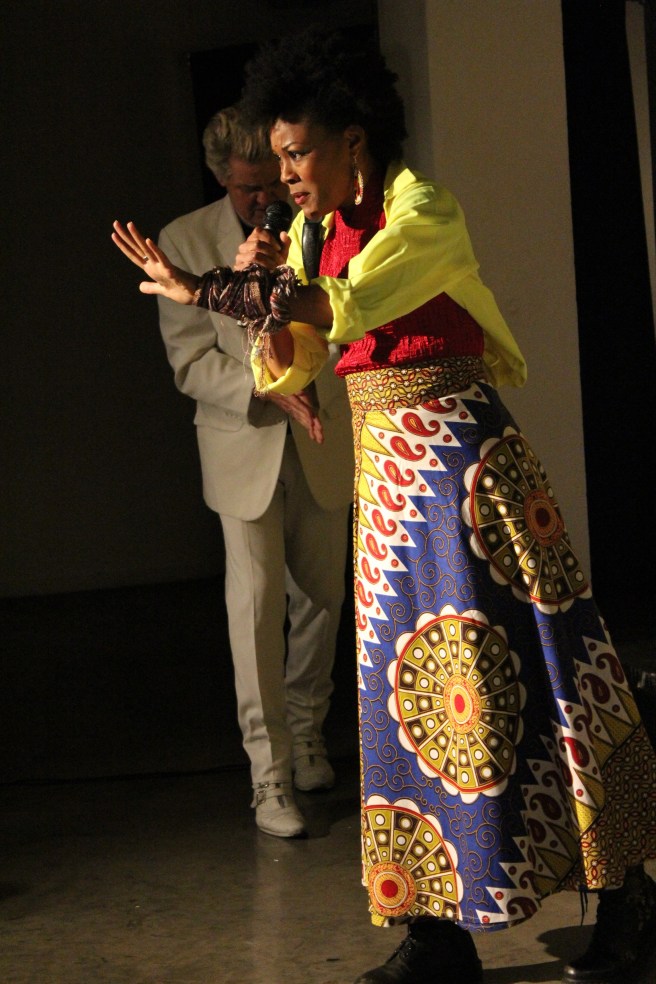
As I listen to the songs unfold in this theatre space in Dublin with the international choir, I am struck with its American characteristics, including the references to the rise of Trump’s America, recent events in Charlottesville, as well as the protests in Ferguson. As an American living in Ireland since 2013, many of these events occurred after I left, meaning that I experienced them, and their fall out, through glimpses of social media on foreign soil. I felt a strong emotional connection in these moments, particularly during Sister Dragonfly’s solos in their rendition of “Eyes on the Prize,” a quintessential Civil Rights anthem. Through the beauty and love of her voice, I felt the pain of recent tensions.

IMG_6042 copy

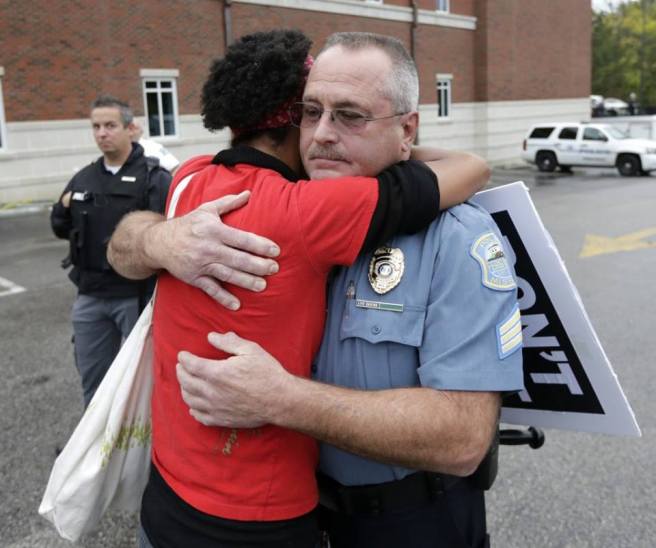
The day before this event, I hosted a seminar about art in public space, with Reverend Billy, Savitri D (director of the Stop Shopping Choir), London-based artist and DLAF performer Rhinnon Armstrong, and Bbeyond Belfast member Brian Connolly. During the seminars, these artists shared their various experiences of working in public, revealing some vital strategies for venturing as performers outside the confines of the gallery. One key point that Savatri and Rev. Billy discussed is how the work the space of potential confrontation — how to diffuse interactions with authority figures and treat the relation with this other person as a site of performance. Savatri emphasized how this is a wide space, and thus unpredictable, but also a great site for growth and change. At the end of the seminar, Sister Dragonfly shared an experience from the protests in Ferguson when she found herself face-to-face with a police officer. She described how at this point, she wanted to launch into a tirade at the officer, but instead just asks him: “Why do you all hate us so much?” The officer said he did not, to which she responds, “I don’t want to hate you, I’d rather hug you.” A moment of human connection in the embittered fury of injustice, it provided a powerful instance of working in the space of interrelation, even with figures of authorities in charged situations. The act blurs the line of performance, protest, and raw humanity, which can be sensed in the performance of the Choir itself, though not to such an extreme degree. Dragonfly’s retelling of this experience sits in my mind as I listen to her sing from her depths of her soul, where her actions are not just about performance or activism, but she sings a song of survival.

10711005_10152318469240974_2681708337121433161_n.jpg

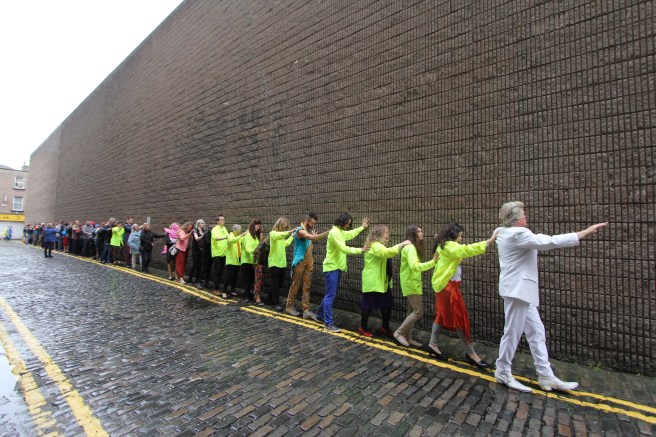
The performance ends with us leaving the gallery space, moving into the streets of Dublin. We are directed to touch the wall of the building, silently move our hands along the concrete of this structure. After we make it to the end of the façade, Rev. Billy draws our attention to a young tree that managed to grow through the cracks of the concrete edifice — pointing out how walls don’t work. Walls don’t stop the growth of nature; walls won’t stop the flow of people or ideas. Wendy Brown (2010) describes how walls are not just ineffective, but function futile symbols of nations whose strength is in decline; these “elaborate theatres of construction” are desperate, visual attempt to cling onto waning sovereignty. Despite the ineffectiveness, the desire for walls proliferate.

At this point in the performance, we turn to each other in the form of a circle and sing one more song. A local kid on his bike gets caught in our formation, looking with a front of cool detachment as we sing out our determination to keep working for a better future. He retains a poise of disinterest, but he stays in the centre of our circle until the end. Perhaps this is just a strange spectacle for him — a disruption to the flow of urban life, but the potency of our human connections cannot be denied.

IMG_6169 copy.JPG


Sources

Brown, W., 2010. Walled States, Waning Sovereignty. Zone Books, New York.


Reverend Billy and the Stop Shopping Choir performed as part of the 2017 Dublin Live Art Festival, curated by Niamh Murphy and Francis Fay. Photo from Ferguson by Charles Rex Arbogast for AP. Other photos by Fiona Killeen (www.blueprintphotography.ie)


Reading Gesture

By Jack Beglin

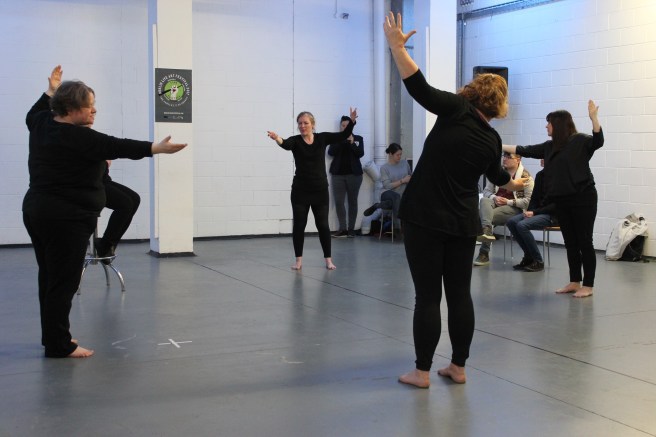
Four women dressed in black stand in a circle. A fifth woman with blond hair and black glasses sits on the circumference of the circle on a high stool. The women are performing a series of choreographed hand gestures while a dramatic sound score plays from a large speaker in the corner of the room. Audience members file into the performance space, standing or sitting on chairs around the circle of women. These are ensemble members of The Dublin Theatre of The Deaf performing at the 2017 Dublin Live Art Festival at The Complex.

Picture1

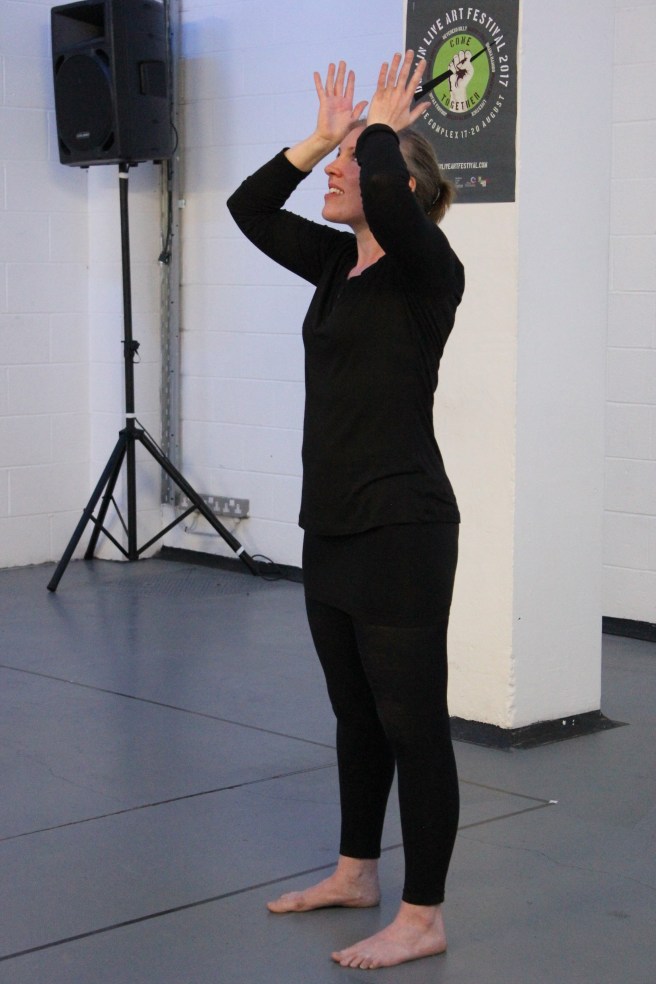
A conversation of hand and facial gestures is taking place between the woman sitting on the stool and the women standing, who resemble a chorus. Their hands on their heads resemble crowns. United by performing the synchronised mudras, the gestural score becomes clearer with every repetition.

With a whipping action, the sitting woman points towards each of the standing women; she then presses her finger to her temple and points to the ceiling with shifting eyes.

The chorus move their hands from their heads as their arms lower towards the ground in a Tai Chi like motion. The ensemble raise their forearms at the elbow and in a wave-like motion alternate their palms from facing the ground to the ceiling.

IMG_5917 copy

The woman on the stool observes this gesture with a slow rotation of her head.

The chorus make a gesture resembling that of picking tea leaves in the field. Next they look at one another knowingly,  hovering  their index and middle finger over their eyes. They pull their  fingers down in a slow, scratching gesture. They raise their hands and shake their fingers as the sound score builds to a climax.

The woman sitting on the stool looks on, worried.

The standing women smash a clenched fist on each palm, alternating from left to right in a powerful motion. A gesture resembling Michelangelo’s Creation of Adam is made before the ensemble adopts  postures resembling Greek statues that bow in reverence. The women then place their hands on their heads as if donning a crown.

IMG_5943 copy

With a whip- like action, the sitting woman on the bar stool points to the chorus as their arms lower towards the ground in a Tai Chi like motion. This score is repeated over and over, complimented by the epic sound score.

The sound score is for the audience. It is an additional dramaturgical element that allows us to build associations with the gestures. The performers, however, are inhabiting a world of touch and kinaesthetic response devoid of sound.

This performance of ensemble gesture and music didn’t have an obvious dramaturgy for audience members to read. It illustrated the basic elements necessary for the making performance: a  precise and repeated structure of actions These abstract actions were structured into a pattern of repeated gestures for the audience to interpret in its own way.

My personal interpretation follows:

The throned monarch sits while the workers toil in factories and fields.

The tyrant surveys the surfs as they plough.

Conspiring eyes meet in vigilance and preparation.

Sisters take up arms and sisters revolt.

The touch of divine justice is realised and Greek statues bow in reverence.

New queens are crowned and savour a fleeting feeling of victory.

The tyrant cracks her whip and the crowns break.

The throned monarch sits while the workers toil in factories and fields.

Sisters take up arms and sisters revolt.

The touch of divine justice is realised and Greek statues bow in reverence

New queens are crowned and savour a fleeting feeling of victory.

The cycle continues and the wheel turns again and again.

Sisters toil, sisters conspire, sisters take up arms.

Devine justice reigns,  the gods bow and new queens are crowned.

The tyrant cracks the whips. Broken crowns.

The throned monarch sits while the workers toil in factories and fields.


The Dublin Theatre of the Deaf performed excerpts from Talk Real Fine, Just Like A Lady, created in collaboration with Amanda Coogan, as part of the 2017 Dublin Live Art Festival, curated by Niamh Murphy and Francis Fay. Photos by Jack Beglin and Fiona Killeen (www.blueprintphotography.ie).

“It’s nothing more than a situation”

by Sara Muthi

Performance art cannot escape it’s undoubtable dependence on space and spectators. The location, audience, cultural and political climate are just a few of the uncontrollable aspects that are intertwined in the reading and interpretation of every performance. It would be a difficult and labours effort to attempt to think about a performance as a self contained, automatous event absent of any influence prior to viewing. With this in mind, Livestock brings together a fresh, diverse group of the most forward thinking performance artists in Ireland, in an accessible yet thought provoking scenario. Livestock: Fresh Cuts kicked off what promised to be a thrilling Dublin Live Art Festival 2017.

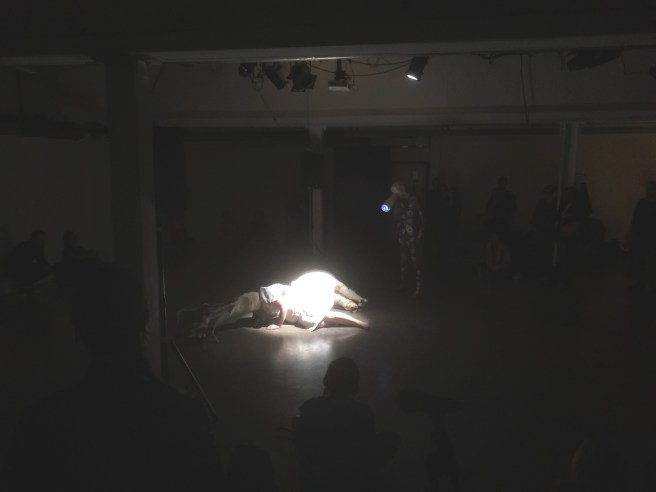
A distorted, fallen creature is laying down, hopeless and un-helped in the centre of a large vacant space, as if lying in the middle of the street as crowds gather simulating actions of pedestrians being drawn to an accident. All are curious, but there is no help for this white fallen beast. The only saving grace seems to be a wandering lighthouse, upon the head of a man as he circles the space between spectators and the fallen antlered creature. This is the work of Celina Muldoon who announces the tone of the night with drama and intrigue.

Celina.JPG
Celina Muldoon

The audience are not left to the creeping guilt of their curiosity as they stare at the seemingly wounded creature. In a series of intense moments the light draws itself onto the face of the creature and the face of the artist is revealed as it is helped up from its weakened condition. It faces the crowd in a majestic strut of victory with the light by her side. The Dublin Live Art Festival has officially begun.

An audience is seldom able to separate the lingering effect that one performance has from a sequence of works as Livestock curates. It would have to be a conscious effort on the part of the viewer to compartmentalise the experience of each performance from the previous. Livestock minimises this through intermissions between performances, a chance for the audience to chew on what they had experienced and anticipate what happens next. Nevertheless, this only minimises the carry-on effect on the part of the audience. While this is persistent in similarly structured events, this is not a negative effect and can add a multi-layered, thought provoking element to every performance. Even though I would usually refrain from calling performance art ‘enjoyable’ as it is not entertainment, but rather a branch of the visual academics we know as contemporary art, a light hearted spirt to performance will not be unwelcomed.

Darren Yorke.JPG
Darren Yorke

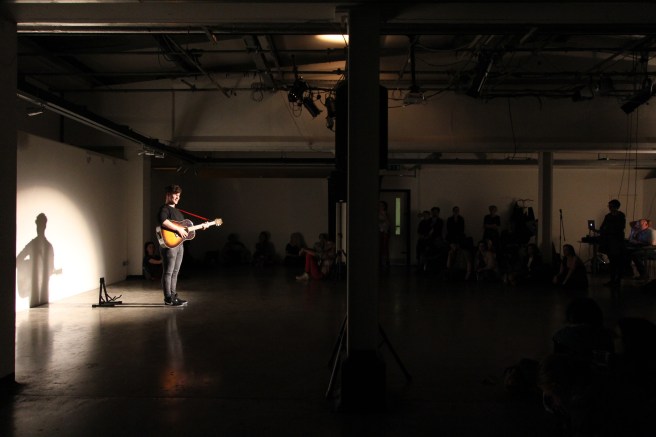
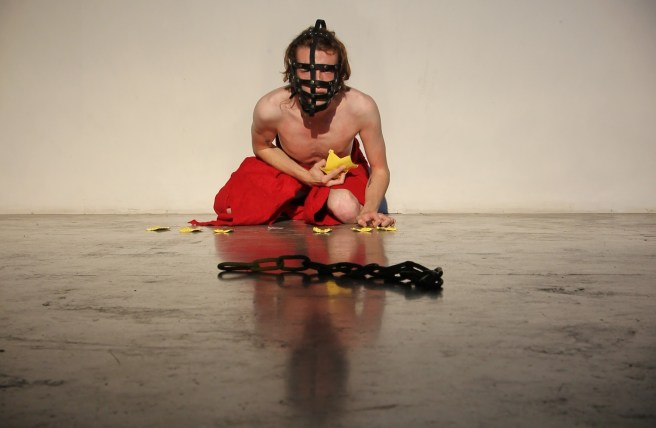
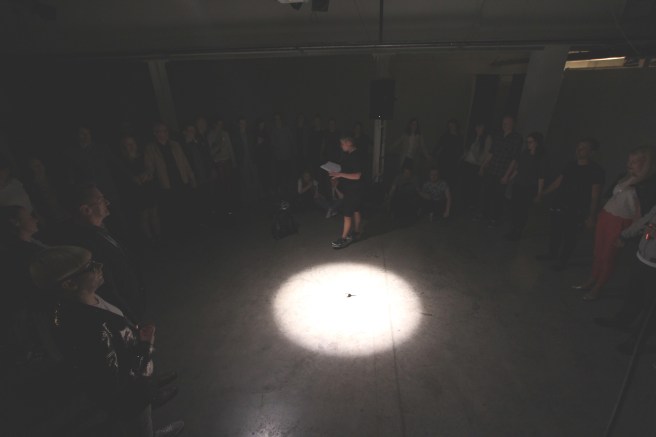
Beginning with Muldoon’s intense performance, we are then brought into the work of Darren Yorke. As the spotlight shifts from the centre of the Complex to the right white wall of the space we hear a familiar melody ring through the space, beginning with Disney’s “When You Wish Upon a Star” and following with Snow White’s “Heigh Ho!”. A young singer with a guitar joins the audience in the space and steps into his spotlight. A warm, light-hearted development from the subtly eerie work of Muldoon. An other-worldly ambiance that filled the space initially shifts and the viewers are brought back to reality as Yorke develops his almost twenty minute acoustic song expressing the effects that the political climate has on the artist and subsequently each of us. A relatable work in the context of everyday suffering in contrast to Muldoon, the tone shifts yet again as Day Magee brings a mixture of expressive trauma and the subtly surreal. Before the audience there is the half nude figure of the artist, sporting a black caged mask, and a blood red saree slung around the artist’s waist and a yellow chain in hand as they perform to an echoing voice, speaking a narrative of past trauma.

Day Magee.JPG
Day Magee

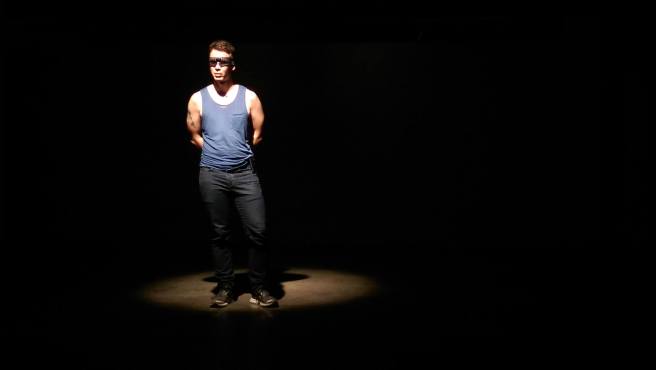
To wind down from an emotionally stirring and slightly disturbing narrative of trauma as presented by Magee we are given to the performance of Paul Francis Quinn. A light enjoyable interlude to the night, as the artist sings into a microphone as if on stage, his presence attempting to bridge the gap between performance art and the performing arts. Nonetheless, Quinn’s performance lifted the spirits of the crowd and lead into the final two performances of the night.

French 1.JPG
Sara French

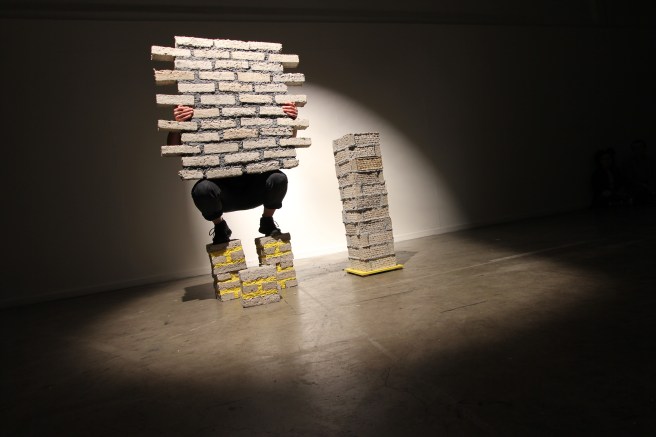
French is a frequent performer within Livestock, and in the trademark style of the artist she recites a compelling narrative alongside significant gestures and actions that make the performance intriguing with moments of comic relief. She tells a story of a woman suffering with the loss of her husband and a “contagious environmental illness” who bumps into a man who was running naked on a dare. This strange narrative is recited along side actions by French which can only be described as acrobatic. The artist disclaims “this is not a wall at all, it’s a situation”. This statement not only puts this story into perspective, it also puts the rest of performances into perspective for the audience. While what the audience at Livestock may have experienced a multi-layered string of performances, each performance is still nothing more than a situation that you are presented with, and you take what you may from it.

French 2.JPG
Sara French

French’s actions were particularly significant as she divided, broke down and rebuilt walls with her body at the centre. The body was balanced upon broken walls, and rebuilt like a puzzle enclosing her body and built upon what she calls “a situation”. The significance of these simple yet impressive actions by the artist was enough to take away and ponder on long after the performance was finished.

Vicky Curtis brought down the night with a performance in which we were given the opportunity to particupate and connect with audience members that we’ve shared the night with. Holding hands in a circle while Curtis recites words of encouragement to the room, we are asked to pass around a candle and have a moment of silence. Each person had opportunity to have a moment with themselves and with the others in the room, showing patience and unity in the human experience as the night came to a close.

Curtis.JPG
Vicky Curtis

Performance cannot escape its context, however Livestock: Fresh Cuts happened to be the right context for every  one of these performances. These bite-sized performances created a meal of an event which was both satisfying and celebratory of diverse contemporary performance practice happening in Ireland today.

Livestock: Fresh Cuts, featuring Celina Muldoon, Darren Yorke, Day Magee, Paul Francis Quinn, Sara French and Vicky Curtis took place on August 17th, 2017. Curated by Eleanor Lawler and Francis Fay, this iteration of Livestock was part of the Dublin Live Art Festival at the Complex, curated by Niamh Murphy and Francis Fay. Photographs by Fiona Killeen (www.blueprintphotography.ie).


On the Brink

by EL Putnam

Sometimes the allusion to force is more potent that the explicit expression of power.

Gareth Cutter starts his performance by standing slightly off to the side of the room with a slack posture. Once the audience takes their places, he moves to a open space and wires himself with a microphone. The device is sensitive — I can hear the subtle sounds of him wetting his lips with his tongue; tensing and releasing the muscles of his jaw. He puts on a pair of rubber gloves, then shifting his body to an assertive stillness. Muscles quiver from stasis. He carefully manipulates the rubber of his gloves, so there is subtle note of the erotic, complimented by his gestures that evoke a sexual tension; a sensuality of bondage that provides the underscore his actions. When he speaks, his voice is distorted. It is digitized and deepened. He is domineering yet lonely. Such connotations contrast his clean-cut hair and street clothes.

21460016_10159237018775585_47733819_o
Gareth Cutter performing Load. Photo by Julieann O’Malley.

Throughout the performance he tells a story — a strange journey that slips into the explicit without going over the edge, just like his actions that evoke rich eroticism without falling into orgasmic pleasure. He pulls his audience to the brink, but never climaxes. It is within this tension of sensuality, that he draws into relations of authority where submission or dominance are never clearly articulated. Instead he carefully allows glimpses into his erotic mind, using light, sound, and carefully controlled gestures to provide minimally staged evocations of the potential of force. I am drawn into this flirtation, left wondering what is beyond the allusion. The mystery shroudinh this sensuality evokes a complex desire that is left unsated and not understood, but it is the power of potential that leaves me wanting more.

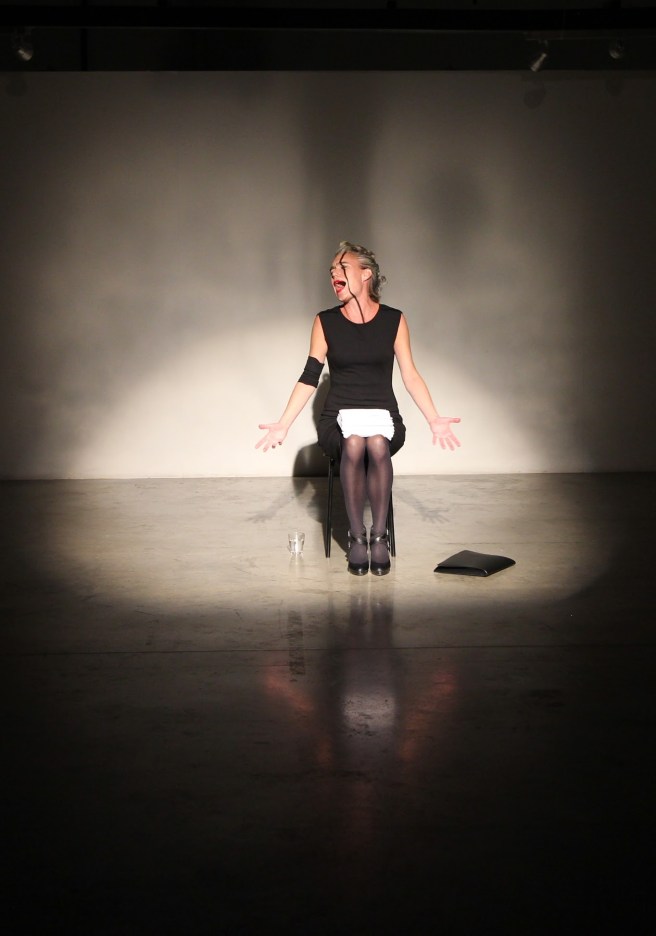
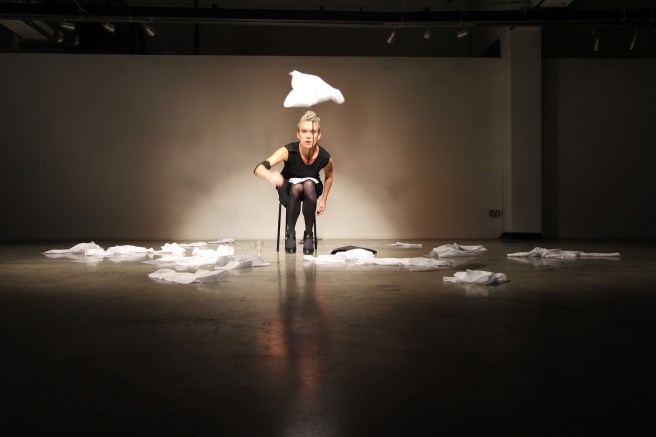
I am pondering the challenges of relating to this complex expression of eroticism when I enter Johanna Zwaig’s performance. She is dressed in black, carrying a simple office portfolio. She appears stoic, cleaved by  a black stripe that runs down the left side of her face. She sits on a chair under the spotlight and opens her portfolio, which is filled with folded white handkerchiefs. She beings to sing.

IMG_5487 copy
Johanna Zwaig performing Sounds Through the Wall. Photo by Fiona Killeen www.blueprintphotography.ie

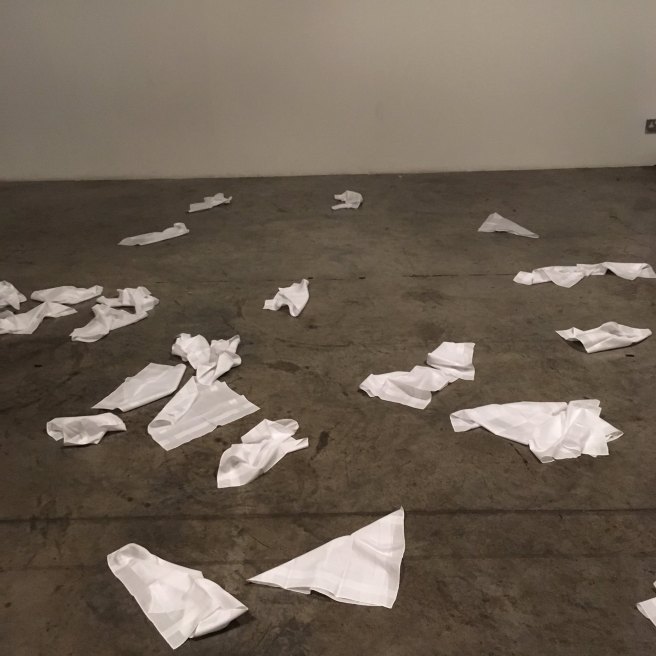
Her voice fills the room with an echo of strength — it is a voice fit for the Opera stage, though we sit around her in a semi-circle, in position of closeness and intimacy that would not occur in the more formal context. The Spanish words flow to us as her voice drips with melancholy. Her impression evokes images of David Lynch, though I am filled with her energy that can only be transferred through live exchange. She breaks from her singing and lifts a handkerchief from the pile on her lap. Raising her hand into the air, she discards the square of white fabric, like a half-hearted flag of surrender. The lighting brightens slightly when it hits the ground. She again begins to sing.

While her voice and face convey a forceful embodiment of power, Zwaig remains seated, recollecting her poise between songs to once again release a handkerchief. I am enraptured by the tension she cultivates in her action; the strength of her voice, the melancholic beauty of the song, and the carefully maintained poise of her body that resists from being fully captured in the force of her excursion. I am again brought to the brink, but never pulled over.

IMG_5586 copy
Johanna Zwaig performing Sounds Through the Wall. Photo by Fiona Killeen www.blueprintphotography.ie

The tension that both Cutter and Zwaig craft emerges from the play of exuberant force and resistance — allowing the body to carry strength and power, but never fully releasing it. As such, tension builds in my body as a witness, and I am left to hold myself at the brink of an abyss.

20861860_10155490761380586_648282454912087741_o
Photo by Francis Fay.
Gareth Cutter performed Load and Johanna Zwaig performed Sounds Through the Wall on Friday 18 August as part of the Dublin Live Art Fesitval, organised and curated by Niamh Murphy and Francis Fay.
It’s ok we’re just resting

by Jack Beglin

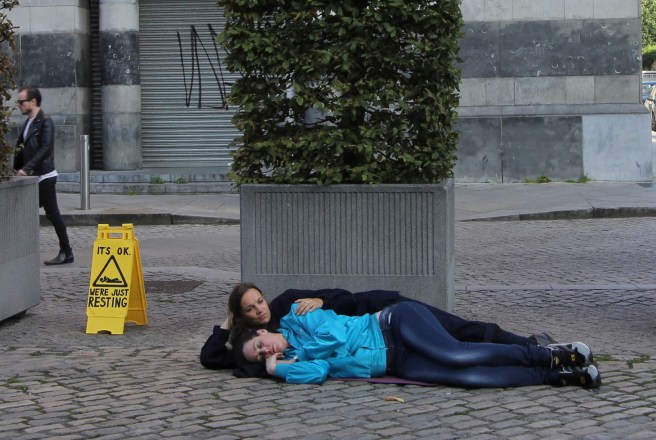
I meet Rhiannon Armstrong on the Corner of Mary’s Lane and Bow Street. She is wearing navy blue overalls and is with her minder, Jacky. She carries two yellow caution signs with the logo of a sleeping stick figure and the caption ‘It’s ok we’re just resting’ printed on either side of the plaques. This is Public Selfcare System at the 2017 Dublin Live Art Festival.

As we turn the corner onto New Church Street and into Smithfield Square, Rhiannon explains that she has been suffering from chronic migraines for the last three years. She describes herself as ‘an expert at the durational performance of thriving in a world geared against our survival’ . She has developed a strategy in order to ensure a better quality of life. This strategy she shares with me on our one-to-one encounter.

First we will lay together in a public space, at which point Rhiannon will ask for permission to touch me on the shoulder. She will then whisper into my ear and then ask if it is ok to leave me to rest alone in the public space for fifteen minutes. We make our way to Smithfield Square opposite the Light House Cinema and stand between two large flower pots. Rhiannon leads a personal ritual.

‘On the count of three we will sit down together’ Rhiannon says as we look out at the derelict building in the distance.

‘One, two, three.’ We are now sitting together. I feel the cold of the ground creep up my spine.

‘I will now place this mat on the ground for you to lay on and you can rest your head on this’ Rhiannon explains, as she uncoils a pair of blue pants from her neck and places it at the top of the small purple yoga mat.

‘One, two, three.’ I am now looking up at the blue sky framed by a sliver arc shaped street lamp.

‘On the count of three we will turn to our left side. One, two, three.’ My vision is now horizontal as I see a pair of Adidas tracksuit bottoms creep their way towards me from the distance. I take shelter behind the darkness of my eyelids.

‘May I touch you on your shoulder?’ Rhiannon asks.

IMG_5367 copy

I agree. The man in the Adidas tracksuit bottoms is now intercepted by Jacky and gently directed away from me.

‘This is your time to rest. It is ok to rest, you deserve this time to rest,’ Rhiannon whispers as I am lulled into a daydream. Time passes, the sounds of children playing pass and people come and go as I seek refuge behind my eyes.

‘Jack, may I leave you now?’ Rhiannon asks.

I agree and as I feel her touch release from my shoulder a sense of vulnerability passes over my body. Time passes, the sound of the Luas Tram signals in the air as a flock of pigeons scuttle from one side of the square to the other. I mark time by the sound of passing footsteps.

IMG_5397 copy

Rhiannon gently touches me on the shoulder; ‘it’s time’ she says as I slowly rise to standing. Jacky is in conversation with a man in a flat cap. I approach the man. Tears well in his eyes as he rolls a cigarette with grubby fingers. Rhiannon asks me how my experience was. I say that it was nurturing to be resting with her, but then I felt a sudden venerability being alone. In a small way I could understand what it is like to be homeless. The man in the flat cap places the cigarette in his mouth. He shakes my hand. ‘I’ll say a prayer for ya’ he says. I say goodbye to Rhiannon, Jacky and the man in the flat cap as I make my way towards Bow Street.

Public Self-Care system is a site specific one to one performance that draws attention to the relationship between the body and public space. The ‘costume’ Rhiannon wears and the ‘set design’ of the yellow caution plaques are theatrical. They draw the attention of the spectator and frame the interaction between Rhiannon and the participant ‘as performance’. Framing this interaction in such a way creates an ‘extra -daily’ space where the spectator’s habitual to and fro is temporarily suspended. In Brechtian terms a verfremdungseffekt, or alienation effect, is created. The spectator double takes and as a result has the opportunity to consider the implications of what is happening in the space – the private act of resting in a public area.

I had the opportunity to empathise with Rhiannon. I understood though my body the implications of her illness and the strategy she employs to combat it. In a small way the experience illustrated to me the kind of vulnerability that homeless people may feel by exposing their private and intimate acts in public. I can’t for a minute say that I understand the full embodied and existential experience of homelessness, but Public Self Care System brought me one baby step closer to the experience of vulnerability in public space.

IMG_5404 copy

Rhinnon Armstrong performed Public Selfcare System on 18 August as part of the 2017 Dublin Live Art Festival, curated and organised by Niamh Murphy and Francis Fay. Images by Fiona Killeen (www.blueprintphotography.ie)

The Community Carries

by Sara Muthi

1.jpg

Time and space based art work carries a quality that separates it from all other work. It can only be experienced at one time, in one space and only ever by the amount of bodies the venue can take. The documentation of the work, as in the photographs that may surface after, including the texts published and conversations surrounding the event, are all just traces of something that has passed. It is not often that you can experience live art twice, but once in a while you are privileged to be faced again with the familiar atmosphere of community based art such as ALL CHOIR.

2.jpg

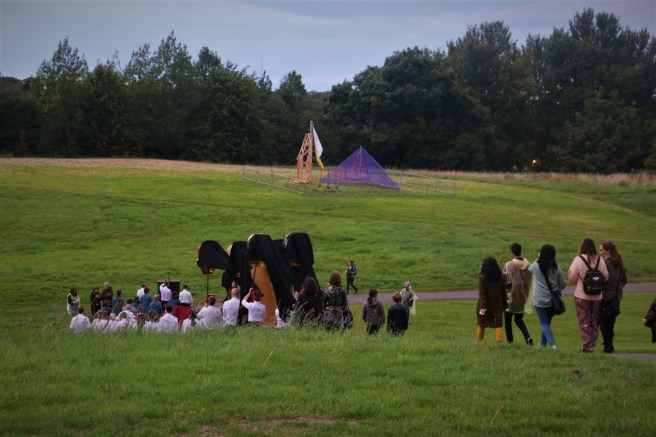
The intention of ALL CHOIR has always been to use the commonality of music as a starting point for social engagement and discussion. While ALL CHOIR’s performance at Temple Bar Gallery + Studios back in April was successful in its goal, part two takes it further. Abandoning the comfortable and familiar setting of the gallery space, ALL CHOIR takes itself to Liberty Park, located in north Dublin’s inner city as part of the Treeline Project, created by Oonagh Young and Mary Cremin. This facilitated the perfect collaboration between a work such as ALL CHOIR whose objective is to break down barriers between the everyday and the art world, and the object of the Treeline Project, which strives for social engagement after the community was divided due to reconstruction in the area. The aim to use art to activate the social engagement of a community was beautifully complimented by each others artistic and local intentions.

As stated in the first response to ALL CHOIR, a large portion of art falls within one of two categories, art that creates dialogue with other art, and art that is in conversation with life. ALL CHOIR is a work which embeds itself into life effortlessly, and its change of scenery from the gallery to the inner city has made this ring ever more true.

3.jpg
Lyrics from song “All”

Lifelike art often reimagines the media of art, but more often than not avoids specific categorization entirely, making it difficult to speak of the work as simply performance. Unlike conceptual art in which the work is carried by the concept, a broad term used to encompass much of contemporary art and performance, ALL CHOIR  is carried by the community. The community is the concept, it is the point of the work. The scheduled rehearsals were just as important for the work, and part of the work as the final event was.

The instinctual and raw nature of the vocals used by Buckeridge along with the unpolished, unprofessional voices of the singing audience concocted an aura of oneness and comfort for all involved. The simple nature of a choir in a gallery became a choir in a park, surrounded by pedestrians and locals increasingly blurred the lines between art and life. We all experience life in different degrees, in different context, at different ages, however any degree of life experience would enable you to understand and relate to the lyrics of Buckeridge. Encompassing all walks of life, the lyrics are inspired by life and simply translated to us by a keyboard, our voices and each other.

4.jpg
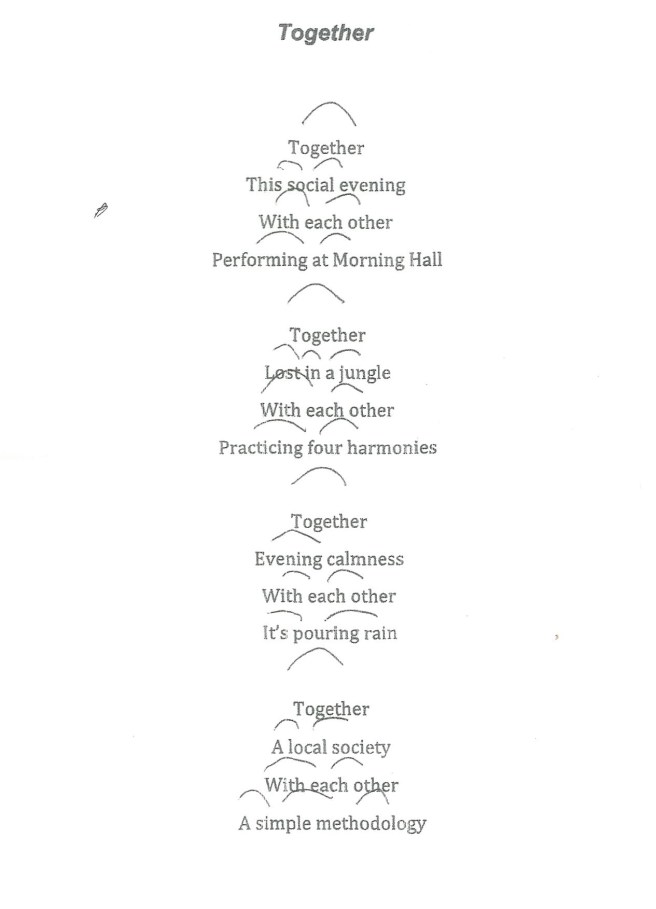
Lyrics for the song “Together”

While live art can never be presented in the same way twice, that was not the aim of the second Dublin based ALL CHOIR event. It was simply to continue its mission, continue its vision in creating a wider community of engagement, with each other as human beings but also as creatives, individuals with their own struggles and questions, coming together in vocal harmony around life inspired lyrics.

5.jpg

The ALL CHOIR, created by Mark Buckeridge, was presented as part of the Treeline Project, an arts initiative by Oonagh Young and Mary Cremin, on 5 August 2017. Images are extracts from lyrics by Mark Buckeridge.


The sacrificed calf feeds from the swollen udder

by Léann Herlihy

What was my purpose?
To sit; to swaddle; to remain silent.
The elephant in the room – a woman
cradling a pail of milk to her womb.
Which one will fall to the foot of the cross,
the fifty litres of milk or sixty kilos
of woman?

I fall to the ground – a stigma;
it falls to the ground – a crime;
we both fall to the ground – a tragedy.

Assistance arrives;
two midwives from the crowd.
Their knees bend,
my legs spread.
A growing discomfort;
a ripening malaise;
out comes the fruits of my labour.

The deed is done, the doers undone.[1]
I stare around for reassurance, which is
neither met nor denied, but rather, uncertified.

– An extract from the artists notebook following the performance, The sacrificed calf feeds from the swollen udder.

The sacrificed calf feeds from the swollen udder, photo. Marcus Cassidy

The sacrificed calf feeds from the swollen udder addresses the position of the female body as a focal point of repressed histories and political desires in Ireland. The performance stemmed from the group exhibition, SANDMAN, held in the Complex, Dublin (27 July to 1 August, 2017), in accordance with STREAM. The show’s undertone was influenced by Verse 32 from the Book of Exodus in the Old Testament:

“They have made for themselves a golden calf and have worshipped it and sacrificed it […]”

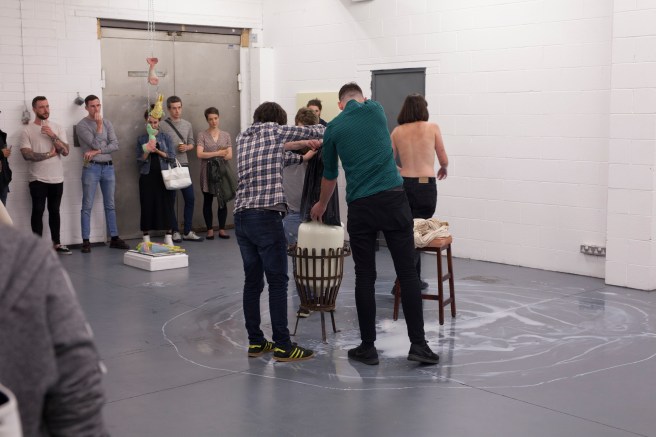
I – a young Irish woman – sat, swaddling a glass pail of milk; an undeniable burden protruding from my stomach. My objective was to abstain from assistance; to carry this load in solitude, a task which became insurmountable.

The sacrificed calf feeds from the swollen udder, audience members; Jill Abbot and Ciara O' Brien, photo. Marcus Cassidy

An hour passed, when two female audience members came to my aid. Removing a refuse bag from my pocket, they held it between my legs, while I pulled the plug from the vessel’s nether side. Out chugged the contents, relieving me from my seated position; a weight lifted.

A glass pail with no capacity, I loosen the umbilical chord of what tethered me to the vessel. I now stand fully exposed – yet, free. Taking the bag of milk, I drag it in circles, building momentum as the contents slowly begins to leak out. Suddenly, I stop – am I the person left to carry this weight around?

I reach out to three men, to help lift this encumbrance over the mouth of the glass pail. With difficulty, they grasp the delicate plastic between their fingers, while I caress it’s underbelly; we share responsibility. I see the struggle in their arms, the discomfort on their faces – I withdraw my hand from the growth and thrust it forward with force, breaking the bulge’s seal. The contents drains into its former place; waiting for the cycle to commence again.

The sacrificed calf feeds from the swollen udder, photo. Marcus Cassidy.

[1] “The deed is done, the doers undone” alludes to the story of Macbeth; that both Macbeth and Lady Macbeth plotted and committed murders “the deed is done”, and subsequently became mentally tormented by their evil deeds “the doers undone”.

Photographs by Marcus Cassidy

We have no answers to your problems

by Sara Muthi

1. CVLTO DO FVTVRVHandout image
CVTO DO FVTVRV, Manifesto print out, 2017

Wilder Being Command was a performance event that stemmed from an ambitious exhibition titled As Above, So Below. Featuring modern masters and landmark contemporary art works, the exhibition explores “how the spiritual endures in our everyday lives”.

Rather than creating a detailed report on the relationship between art and spirituality over the last hundred years, it brought the audience a selection of perspectives into art and spirituality by significant figures in both modern and contemporary art. The success of this exhibition was due to its approach in allowing for wonder and astonishment on the part of the audience, and this carried over into its accompanying performance seamlessly.

2. Greath Anton Averill
Gareth Anton Averill, The Harvest Swarm, 2017

Golden flowing robes on bicycles, chimes echoing through the wind, emerging yellow-dressed figures performing rituals in wide open spaces and marching with a devil-masked parade were a select few of mystical moments that flooded the night. There was no hidden motive within the various performances, no agenda or recruitment that was being pushed, as is the case with many spiritually centred events. Instead, there was a communal energy as visitors lounged and communicated on picnic blankets which reinforced, according to the description of the event on IMMA’s website, “an organic connection to the earth, to the present and to one another”. Intentionally curated as a night of overlapping performances engaging the audience at different stages of astonishment and socialisation, the night took form in performances that happen around you, along with performances that  demanded to be followed, or gave instruction.  Visitors were even asked to stand lightly as to not make a dent in the historic grounds, also known as “the meadows, adjacent to the Royal Hospital Kilmainham, drawing no. 12 – 005 provision 2, that is to say the grounds of the unexcavated heritage site of St. Maniums Monastery” as repeated during one of the evening’s performance by the group Barry on site of Camping on the undertow.

3. Barry
Barry, Camping on the undertow, 2017

There were few single performing bodies, apart from the of the compelling work of Isadora Epstein titled Presentation on Mesmerise (2017) and Christopher Mahon’s piece (performed by Oona Doherty) titled The Longest Arms in The History of Pugilism (2017). Overwhelmingly there was a myriad of concepts and rituals performed by groups that filled the space, creating a sense in which the absence of the single performing body was a near relief. The concept and ritual of the work Experiment in Falling by Emily Mast overcame the urge to analyse one body but appreciate a collective, ritual of people that emerged from the very audience watching. Not only that, but the communal energy that surrounds people when music wraps a group is no cheap trick, but a powerful force to gathers consciousness together.

4. Emily Mast
Emily Mast, Experiments in Falling, 2017

Wilder Being Command did not simply give a single view of spirituality in today’s ever increasing secular society, but offered a comprehensive sample of spirituality through the lens of contemporary practitioners, allowing a thirst for more. While each event acknowledged its immediate context and became borderline site-specific, every artist had an important autonomous point of view worth sharing. Although dealing with spiritual subject matter, no answers were given, either directly or indirectly. As with other, but not all spiritual encounters, the experience of the here and now is paramount over answers and that is what we were given.


5. Stephen Doitschinoff
Stephan Doitschnioff, CVLTO DO FVTVRV, 2017

The evening orchestrated a blend of light hearted enjoyable works, as well as thoroughly enchanting and thought provoking pieces, which accumulated to the build up of the final act of the night. The first point of the manifesto CVLTO DO FVTVRV states: “we have no answers to your problems”. This statement and the procession of the CVLTO DO FVTVRV is what finalised Wilder Beings Command. The manifesto of this group gives us insight into the motive of the near thirty-minute march that concluded the evening.  Leading the audience all around the historical grounds of the Irish Museum of Modern Art the third statement of the manifesto reads “We believe in the immediate data of consciousness and we march for the improvement of its content”. The simple marching alongside other invested witnesses on historic grounds with a near hundred drumming beats echoing the space is an experience you could not help but be wholly absorbed in. While no answers were found in this spiritually charged journey of overlapping moments within this event, we are reminded that the spiritual takes many forms, many perspectives and “endures in our everyday lives”.

6. Stephen Doitschinoff
Stephan Doitschnioff, CVLTO DO FVTVRV, 2017

Wilder Beings Command, featuring Gareth Anton Averill, Stephan Doitschnioff, Stephen Dunne, Mark Titchner, Daniel O’Sullivam, Isadora Epstein, Christopher Mahon, Emily Mast and Barry (Edward Clydsdale Thomas, Sjoerd Westbroek and Frans-Willem Koresten)  curated by Rachel Gilbourne and Janice Hough. took place on July 29th, 2017, at the Irish Museum of Modern Art. Images by Misha Beglin.