Roisin Jenkinson, a fourth year student at the Dublin Institute of Technology, describes her first experience participating in Livestock — Performance Art Platform. She made her debut during “Sacred Space” as part of the winter 2015 Dublin Live Art Festival at DIT Grangegorman.
by Roisin Jenkinson
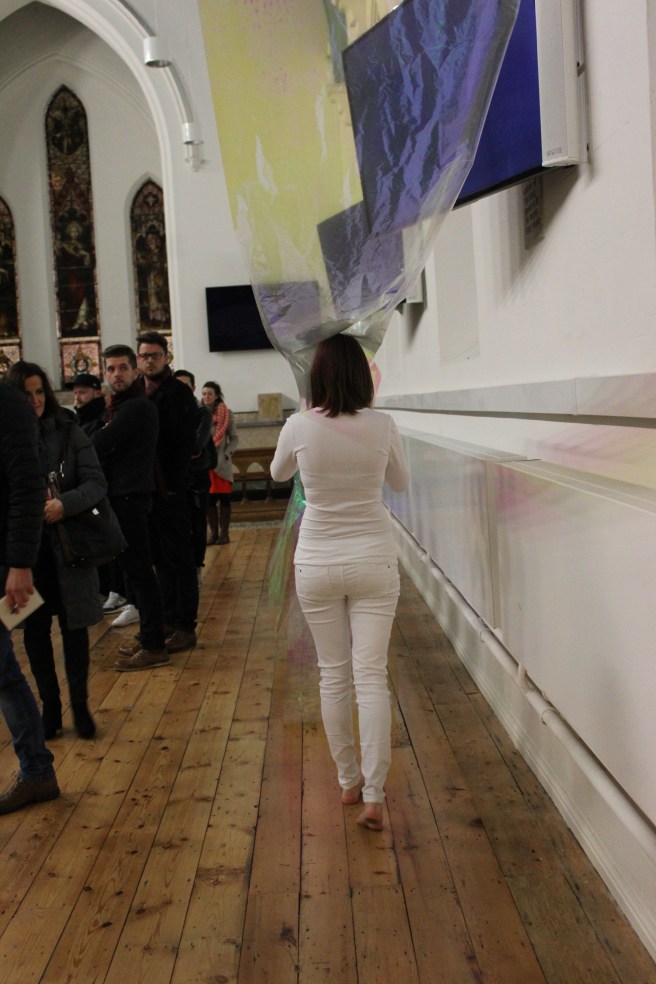
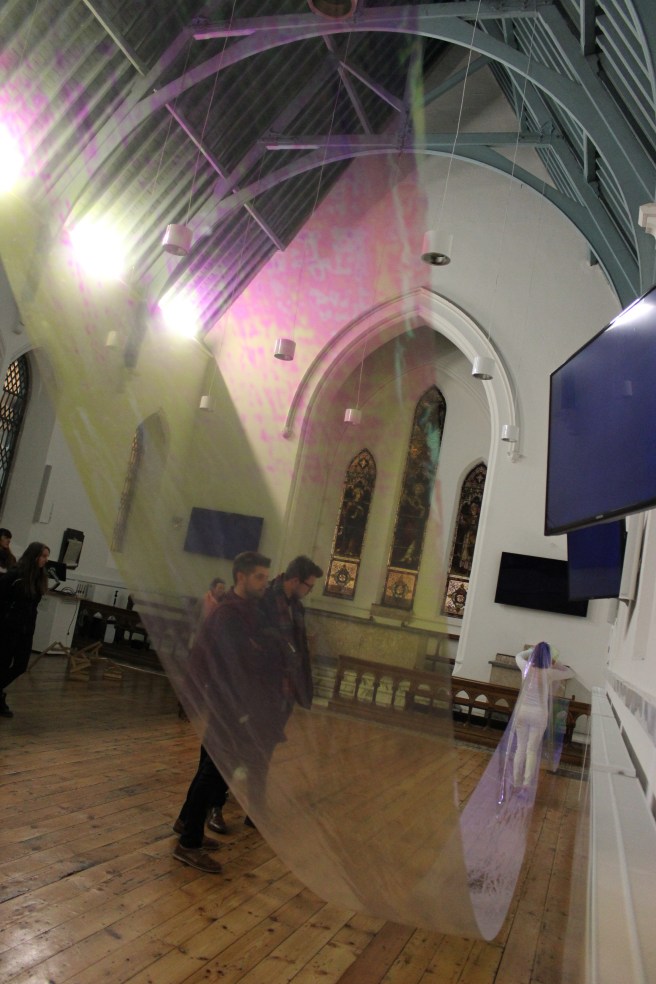
I could feel my nerves begin to bubble up in my stomach as I took those first few steps towards the twenty meters of iridescent film I installed to hang down from the balcony of St. Laurence Church at DIT Grangegorman to stretch across the length of the floor like an iridescent pathway. I walked slowly head first into the film to then walk underneath, using my hands to control it from falling beside me rather than being above me. I walked from one end of the installation to the other, where I exited a door only to re-enter the building from another door at the beginning of the iridescent pathway, where I recommenced my walk. I did this several times for approximately twenty minutes, creating a loop of presence and absence, presence and absence. As the performance progressed, my nerves dissipated and adrenaline coursed through me instead. The light that cast through and reflected off the iridescent film was delicate and subtle, creating light pinks, greens and blues. In my absence from the installation, the film was silent, but when I entered the space and began interacting with the film by walking beneath it, my presence activated it in light and sound.While I was still aware that people were watching me, I put them in the background of my mind and as a result became more comfortable.
Roisin Jenkinson begins her performance at “Sacred Space.” Photograph by Blueprint Photography.
During preparation for the event, I received so much support and encouragement from Eleanor Lawler, Francis Fay and Katherine Nolan. Other than organising the event, they gave me feedback that helped me realise my ideas. The entire atmosphere of “Sacred Space” was easy and enjoyable. I performed at the beginning of the event, so after that I just sat back, relaxed and enjoyed the show as part of the audience. Because I was not just an audience member, but also one of the performers, I had two roles as it were, which brings me back to the notion of presence and absence. While in my performance I was either present or absent, my role in the full event was neither and both. It was a strange and intriguing experience of feeling both present and absent as both a performer and viewer. It is somewhat similar to how Nick Carraway, the narrator of The Great Gatsby, describes the feeling of being within and without. He was present in the narrative of those peoples’ lives, yet he was also just a witness. During ‘Sacred Space’ I was present as a performer while disconnected with the audience and present as a witness to the performances that followed me while also having had performed myself. It is difficult to explain this ‘inbetween’ space, however I can say it was a positive experience that also brought me out of my comfort zone.
Jenkinson continues her loop of presence and absence in St. Laurence Church. Photograph by Blueprint Photography.
It is January 29th, 2015. Today marks the opening in the High Court of the case of a woman who endured a symphysiotomy. Symphysiotomy, an experimental and brutal surgical intervention practised on Irish women, severed the joint of the pelvis, supposedly to ease the delivery of a child. It is snowing in Dublin. The court’s first session commences at 11am. This is when I begin as well, on Holles Street. I came to the National Maternity Hospital to act in solidarity with a group of women who have been denied justice by their state, and whose bodies were altered for pro-life, nationalist purposes. They have since been denied access to restitution. The redress scheme presented to these women by the Department of Health requires them to indemnify and ‘hold harmless’ all bodies and people in respect to the carrying out of symphysiotomy, in direct contradiction to the recommendations for independent inquiry and prosecution of perpetrators laid out by the UN Human Rights Committee.
I hold an object that alters my body’s movements in a way that echoes the harm done to survivors but does not replicate it. This harm is held, suspended, endured, witnessed.
Máiréad Delaney performing Hold Harmless I in front of the National Maternity Hospital, Dublin, Ireland. Photograph by Joseph Carr.
My gait is wide, rolling around the crown of thorns stuck between my legs. The thorns have found purchase in my skin, each is snug and I feel more than anything else the cold— my body quakes with it. Tremors run along my arms and through my chest. There is a rushing wind and the noise of traffic is swallowed or magnified in that rush. My skin is a bluish white, my garments old cream silk. As undergarments they hold no appeal but modesty and fine fabric. The snow is grey. Layers of small socks have widened my feet, they sidle with every step. The little sacs of warming chemicals I placed under my arches have burst. Swollen cloth. With every step I see my distended feet, and the wet snowy cobbles, and the detritus of the street. I stop and crouch. Squatting, I hold tighter the tunnel between my legs, all it seems to be when I look down. A tunnel of thorns, a dangerous and jarring passage. I feel only heat and the lack of heat. My shivering stops after an hour. I look down at the cobbles and up at the sun, for the sun. My legs go numb, most numb around the thorns they grip. I cannot tell if I will drop them and so bear down, holding tighter. This will make them harder to extract. I grip the iron bars of the hospital’s railings. One bar, a few steps, the next, another step, I pull myself along.
Máiréad Delaney performing Hold Harmless I in front of the National Maternity Hospital, Dublin, Ireland. Photograph by Joseph Carr.
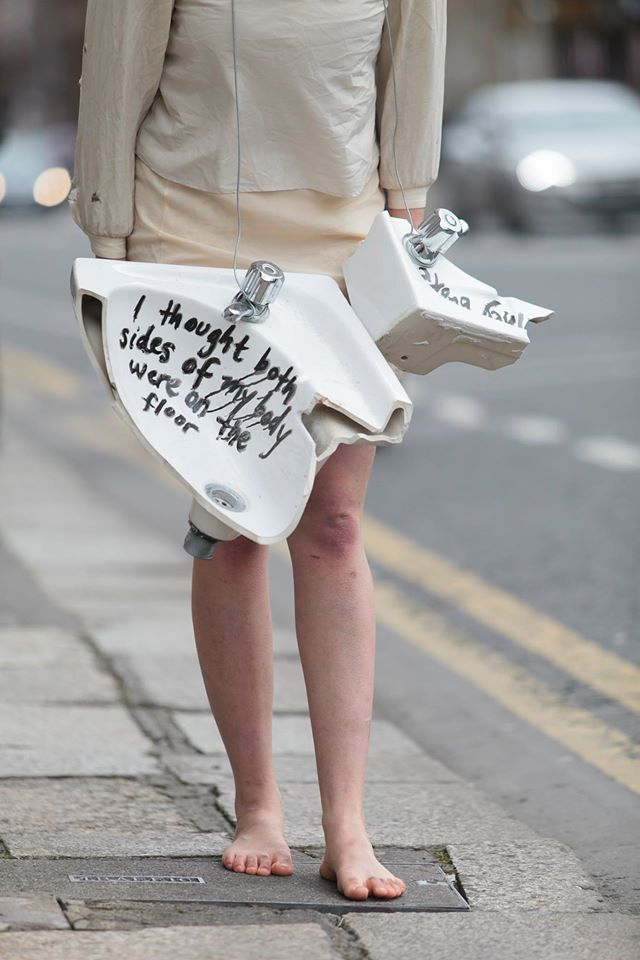
On February 27th, the second case is running in the High Court. This time my presence mirrors the second session of the court’s day, I begin at 2pm. I hang a large, industrial sink around my neck from heavy wire, like a yoke. I wear the same clothes. The sink is broken, the wire is wrapped around each tap. The two halves of the sink are unevenly sized, one much smaller than the other. They pull me off-balance. I have to pull the wire on the left down intermittently, to bring the smaller half back in line with my hips. It travels up. The porcelain is written with the testimony of the survivor whose case is running now, who will lose her case on May 1st. The larger half of the sink reads, “I thought both sides of my body were on the floor.” The smaller simply states “They broke the bone.” The inked words run down the broken bowl, on either side. With this object, too, I walk back and forth in front of the hospital. It is warmer today, the cobbles are dry, cool and dirty. The wire is cutting heavy on the nape of my neck. Part-way down the street I start to bend, I ever-so-slowly lower the sink to the ground and let the wire rise an inch from my neck, for a moment. The split porcelain basin makes a hollow, not-bell noise on the stones. Then I bear it up again and rise, slowly. I walk under its weight, I bend and lay it down, I duck underneath it and carry it again. I walk. Dusk falls, the air turns blue.
Máiréad Delaney performing Hold Harmless II in front of the National Maternity Hospital, Dublin, Ireland. Photograph by Joseph Carr.
Many survivors were forced to walk immediately after their symphysiotomies and then sent home without post-operative care, including antibiotics and pain management. The damage inflicted by these surgeries was catastrophic and lifelong, as might be expected at the destruction of the seat of the spine, the cradle of the digestive and reproductive organs; one of the most integral structural components of the body. The emotional, psychic and social toll is less measurable yet no less devastating.
The first survivor of symphysiotomy I met in Dublin was a tiny woman in her late eighties, she still had red hair. She put lipstick on for her portrait. She made scissoring motions with her hands down her body, describing how they had to cut her clothes from her body as she hemorrhaged uncontrollably from the procedure. She had picked the hospital because it was Catholic. She pushed back her sleeves to show me the series of dark marks up and down the insides of her forearms, scars from the many transfusions she’d required. This woman was in a coma for three weeks. She remembers coming in and out of consciousness. The first time she was on a table, with a crowd of students and a doctor at the end of the bed. Another doctor stood at her shoulder, teaching. The second time she remembers waking again in what she thought was a black tent. She asked the nurse if she had caught something contagious and was being quarantined. Finally she remembers waking up on a black slab. She later found out she had been put in a body bag and taken to the morgue. It seems her botched operation needed to be hidden from sight. She remembered asking “Have I any stitches?”and being informed she had twenty eight. Eighteen inside, ten outside.
She described her year afterwards, how every night she’d have flashbacks, nightmares. “During the night I’d scream and go mad.” She returned home to her parents house. The only thing that would alleviate her nightmares was sleeping in her parent’s bed, with pillows packed around her, partly to soothe her terror and partly to relieve the pain in her pelvis and spine. She spoke quietly, with downcast eyes, softly twisting her hands in her lap. “That was my first birth,” she said. “Caesarean wasn’t accepted by these bloody men.”
Practised through the 1990’s, symphysiotomy was a pro-life operation. C-section, standard in Western medical care at the time, was seen by prominent Irish physicians as unnatural, possibly limiting the number of future births. Symphysiotomy was considered as natural because it remained vaginal. Also, as it “widened” the pelvis to prepare a woman for future prolific childbearing, it ensured a laboring mother experienced the pains of childbirth in accordance with her Catholic duty. I have witnessed survivors describe the agony of delivering a child through broken bones. The pelvis was not merely widened; it was unhinged.
The official history of this surgery remains unwritten. Medical records claimed by the state are now in danger of being destroyed. By refusing to admit to widespread medical negligence in the most recent ruling, the Irish state refused to acknowledge the memory and testimony of survivors. Erasing them as subjects, the state persists in dehumanizing these women decades after the initial intervention. When individual voices are silenced in this way, we are left with lived violence. This violence resonates on a collective level. The nature of my Hold Harmless works are affective, visceral.
I convey the story of a survivor as I witnessed it. I write from a sensory perspective because it is the position I held. Both stories engage with strain, burden, resilience and pain. We cannot conflate two, but we cannot overlook the place of compassion and empathy and hence responsibility in witnessing. Why do you need to know that I was cold? That the sink was heavy? Because some transmission needs to happen around these experiences. They have been marginalized. Some knowledge of embodiment needs to reach beyond the definition of victim and the dead-end-to-life it portrays. We need to see how power inscribes bodies and creates burdens, and how these new bodies feel, endure and articulate agency.
Máiréad Delaney performing Hold Harmless II in front of the National Maternity Hospital, Dublin, Ireland. Photograph by Joseph Carr.
Steps are taken. Altered steps, perhaps. The sun comes out, it vanishes. The wind rises. Traffic passes, people pass, taking notice, expressing concern. The Gardai come and leave again. The environment around me changes, I move while hampered. I make adjustments. I rest and begin again. Time passes, the state does its best to erase, and the burden does not ease. I hope these works will help people realize their connection to these women.
In fairy-tales, and in the work of Kafka, we encounter helpers or assistants who offer clues to the protagonist on their journey. Walter Benjamin claimed that these assistants are easily forgotten but they linger on as hazy figures that we know are important in some way. They represent a complementary world, a world beyond language. Assistants are often tricksters who can laze away time without guilt. They are dreamers whose ambitious plans never seem to reach fruition like friends we know, our maybe ourselves. But only because the journey is not seen as valuable, only the happy ending which of course is never achieved in Kafka’s world. We ignore the assistants at our peril because they represent our unfulfilled desires and are the hoarders of our fears. They translate back to us, in gestures and offerings, all that we seek to forget. But if we forget then we are in danger of losing ourselves along the way.
12 Henrietta Street on Friday 8th May. A cold and wet summer’s day with a sky grey as pewter. People file in through the front door and all conversation hushes as if entering a chapel. This is a Georgian building, once home to the wealthy, then a tenement, then derelict. Now a home for the arts, and photo shoots, and for today it hosts Influence @ Livestock.
A woman upstairs, naked save for black boots and two saddlebags of water. People follow her, silent, watching. She ignores them, shameless, absorbed. The naked woman sits in front of the fire, hugging a huge glass jar like it’s her lover. She drinks from a tube that supplies her with water from her saddlebags, then spits and retches into her jar. It’s painful to watch. I want to comfort her but her self-containment refuses help. The jar, a glass stomach, fills up slowly with fluids, some essence of her.
Katherine Nolan performing Hold in, Hold on, Let out, Let go, 2015. Photograph by David Stalling
In the same drawing-room, before a window, half of a boat rests on a plinth. A man rows towards the window but never makes any progress. He oars steadily, eyes fixed on some other world invisible to us.
Spit of fire in the grate. The audience stands along the walls and in doorways translating strange gestures into personal meaning.
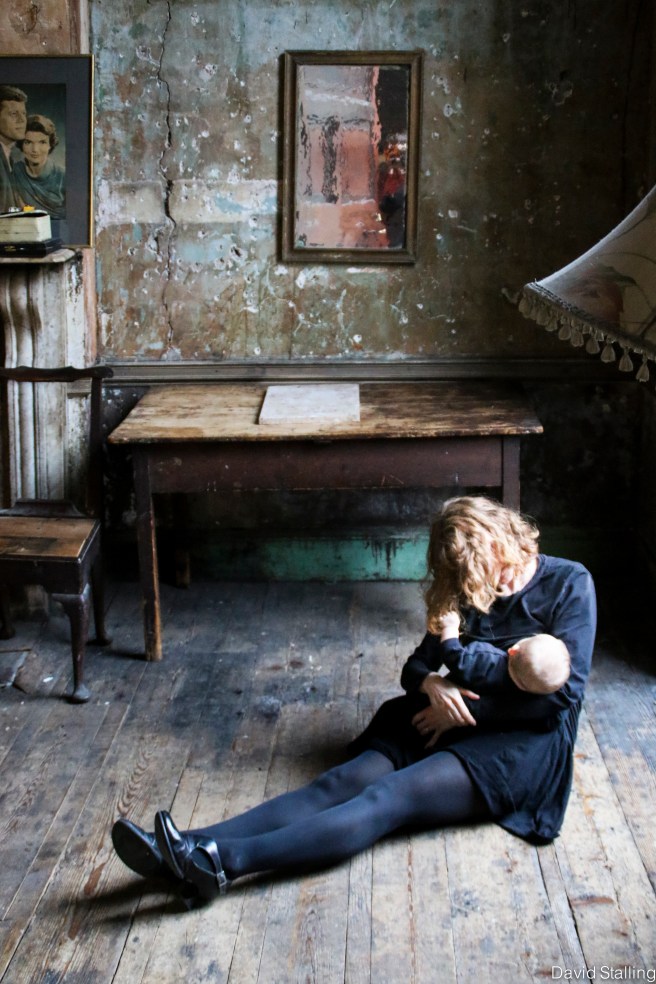
A baby dressed in black. Her mother also in black with red hair. Mother and child mirror each other, echoing sounds and gestures, an exchange on the borders of language. Identities and bodies merging and pulling apart at the same time. I, you, us. An elemental story in the making.
EL Putnam and Sonja Stalling performing Mamädchen, 2015. Photograph by David Stalling.
A girl in an apron, rocks peacefully on a chair. She stands and mashes potatoes in a pot. She is barefoot, smiling, and wants to tell us a story about a mother who could not bear to feed her family anymore. A woman who slowly disappeared from her family and herself.
A bell rings somewhere. A woman draped in a white sheet descends the stairs, a statue come to life. Her mouth moves, soundlessly. She disrobes until she is half naked. Spreads her white sheet out on the floor and rubs at invisible strains on the cloth, her arse cocked in the air. Like an Irish caganer, a profanation of the po-faced, sacred spaces that censor and silence.
And the man in the window rows without pause towards the darkening window.
I wander through the house, trying to make sense of gestures that challenge logic.
At the foot of the stairs, in the twilit hallway, a woman in a long black dress, her face wrapped in a sheer black veil. She holds tiny egg-shaped pebbles in her hands. As people pass her, she offers them as talismans for their journey. She ascends the stairs, dropping pebbles that clatter down the stairs, heavy with sorrow because they have been refused.
Upstairs, a man in a white shirt and no trousers sits before a cake, a bottle of red wine at his elbow. A feast for one, a sacramental gluttony. At intervals he eats and drinks, belches loudly. He finishes his feast by smashing his face into the cake. He climbs onto the table and gathers the white tablecloth around his head, a heavy shroud. Then he is on his hands and knees, crawling on the floor, the tablecloth hiding his shame. He crawls, groaning and sighing his remorse, a warning to all of us.
Francis Fay performing The Divil on Your Shoulder, 2015. First performed at ID ENGAGER, curated by John Freeman at Occupy Space, Limerick. Photograph by David Stalling.
The front door opens. A woman in a short white dress with a crown of thorns between her thighs enters the hallway. She can barely walk but no one assists her. The crown has scratched her thighs red raw because she has shuffled all the way from the High Court, in allegiance with the women who had their pubic bones sawn in half by Catholicism. She goes to the fire, looking for warmth and love in a loveless state.
Bare feet dance on bare floorboards. A flame-haired woman in a long white dress dances to silent music. She uncovers a marble bust and tries to love it back to life. Her body dips and arches as if dancing against her own will. Finally she breaks free but all that she can do is dance to her own heartbreak.
A woman at the very top of the stairs shows only women pornographic film clips, like a cheeky friend at school. She assists you by holding your hand as you realise that she is showing you the neglected spaces between female desires and the male gaze.
It’s dark now, and cold in the house. The fires are almost burned out. A woman with grey hair, dressed in black trousers, polishes a tray on the stairs. Places a pair of black boots on the tray, carries them downstairs. She is busy polishing boots and sweeping the stairs, cleaning up. Someone has to clear up the mess after the assistants, after us.
The rower stops rowing but there is no way to tell if he has reached his desired destination.
Livestock: Influence was curated by John Conway. It took place at 12 Henrietta Street on 8 May 2015. Participating artists included: Sandra Breathnach, Mairead Delaney, Francis Fay, Liadian Herriott, Josh Joyce, Eleanor Lawlor, Katherine Nolan, Áine O’Hare, EL Putnam, Lynda Phelan, and Hilary Williams.
Justine McDonnell reflects on performing Spit Spit, Scrub Scrub as part of Amanda Coogan’s recent exhibition, I’ll Sing You a Song from Around the Town, at the Royal Hibernian Academy in Dublin, Ireland.
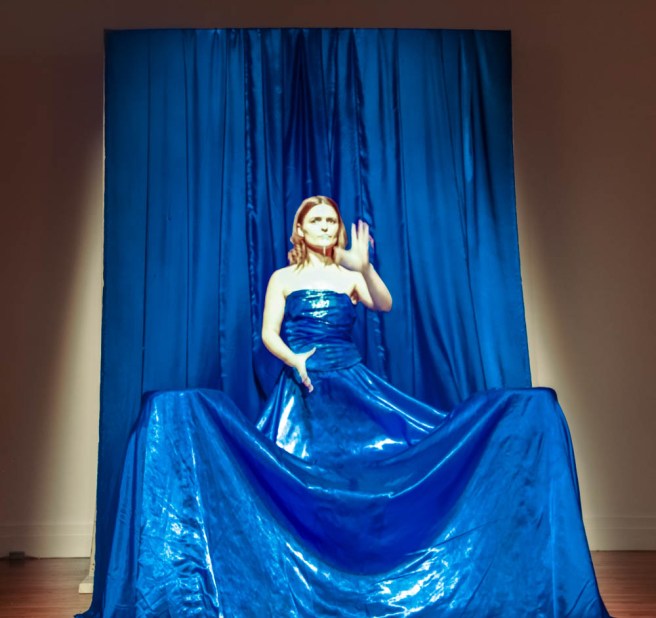
It was 2011 in Dublin Contemporary when I stood at the entrance of a small doorway, fascinated by the large blue silk material that filled the room. The blue silk was stained, right down to the floor. The sound of music would rise, changing volume with sounds of birds, a child, a train and silence, but not a speaker in sight. I followed the stains of the blue silk, leading my gaze to direct eye contact with three women. Their lips were bright with red lipstick, drawing my eyes to their mouths, which were oozing saliva, producing large suds, which dripped from their chins and gently flowed down the front of the material. The three women seemed disembodied from the waist down with the top of their bodies enveloped in strapless blue silk. Their movements appeared slow, deliberate and interactive, becoming more intense as the music swelled throughout the space, confronting their audience in non-verbal communication.
Five years later, on October 7th 2015, I listened to the noise of my shoes on the cobblestones of Grafton Street, as I nervously walked to the Royal Hibernian Academy to perform Spit Spit, Scrub Scrub. Walking up the stairs of the RHA building, I made my way through the large wooden doors, met by bright spot lights and The Mountain which appeared so tall and beautiful, its sound filling the room. I stroked the three blue silk bodices that lay on the floor, each one still stained and scented with saliva residue. It was 11am, an hour before the doors opened to the public and the space began to fill with performers. All I could hear were voices, as I applied my red lipstick and brushed my curled hair, no reconciliation of any conversation, only heavy breathing and fast heart beats. I walked over to the large blue structure and crawled under the blue silk, to be strapped in. This was it. Voices were rising in from outside as people impatiently paced up and down waiting for the doors to open. “One, two, three, four”, I said in my head, as I continued to count the feet tip tapping outside, wondering how many people waited, whilst also trying to distract myself from my nervousness and anxiety filled chest. Standing up straight I dazed at the door. A bright light hit me. There were people, the doors were opened and so it began.
Watching each person enter the room, I then closed my eyes listening to their footsteps growing louder as they eventually got closer. My eyes opened to catch their gaze whilst my hands moved slowly and eloquently. As my saliva started to ooze down my chin, I stared at each individual: so many colours, brown shoes, red shoes, blue coats, grey coats, green eyes, blue eyes, blonde hair, brown hair. ‘Who were they?’ I thought, as they gazed back at me. I watched their movements, moments of sitting, standing uncomfortably, impatiently, turning with awkwardness from the directness of their gaze, stepping closer, making faces, loud conversation in disgust, as my saliva continued to seep. There was one girl who stood by my right hand side. She looked directly, with a twinkle of what almost seemed like fear or sadness, her mouth slightly open as if in shock. She had wavy blonde hair, her eyes covered with large snakeskin glasses, her black coat draped down to meet her doc martin shoes and a silver satchel rested on her shoulder with a giant yellow smiling emoticon on it. She gave me comfort. Her eye contact bringing me back to life. She stood for what seemed like hours, whilst my body constantly shifted, my mouth opening and closing like a fish. My mouth was numb and my chin itched. My stomach and chest were wet, as I watched my saliva drip, missing the bodice and roll underneath the silk. I think she is trying to say something. She whispered to the person next to her. ‘Can she understand me?’, I thought. ‘Can she feel what I feel?’; ‘Why is she here?‘; ‘Why is she watching?’; ‘What does she want from this?’ I couldn’t say anything, my mouth only opening to reveal silence, my hands clenching in frustration, running the silk material in between my fingers that incarcerated my body.
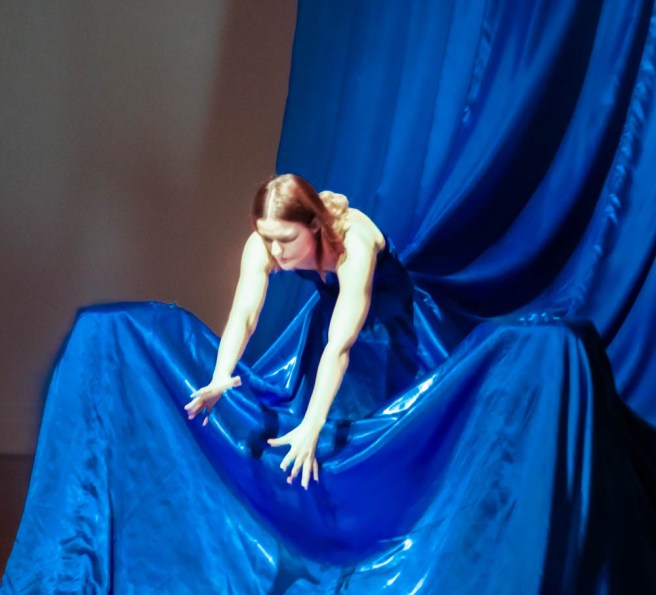
Justine McDonnell re-performing Amanda Coogan’s Spit Spit, Scrub Scrub (2010), at the Royal Hibernian Academy, Dublin Ireland in 2015. Photographs by EL Putnam.
As each hour and day passed. I watched bodies of colour as they watched mine. I watched their fast and slow movements as they watched mine. I listened to the pace of their shoes as they listened to the sound arise from my silk dress. My body was tired, rising up and down on my toes as if a ballerina, raising my arms and hands sharply and eloquently, from black swan to white swan, my feet and legs slowly moving, as if swimming in water, sensing it, being aware of it, my body, their body, my arms and hands beginning to move without my permission as the endurance took over. My eyes looked and followed my fingers, which moved one by one, shapes, movements unfolding, my skin cold, the smell of stale saliva filling my nose, my stomach weak and nauseous. Five days and twenty three hours had passed. Two hours still to go, we stared at each other, as if caught in a trance. The artist, Amanda Coogan, dressed in yellow, raised her arm and pointed. I rose up on my toes, my legs feeling weak, knees shaking in fear of faint. I raised my arm and pointed back. We were still. The audience disappeared. It was just her and I. Who will place their arm down first? Was she thinking what I was thinking? Was she feeling what I was feeling? Minutes had passed as she turned her head and my gaze returned to my audience. Time was the unknown to me. My audience were sitting. The room was full and the bright spot lights filled my eyes. I raised up, my hands stretching towards the audience inviting them to move forward. My eyes looked down observing my saliva drip to the bottom of the dress. Tip, tap, tip, tap. I moved my tongue out from my mouth, letting out a silent scream, the women in black. I heard their shoes. The audience began to leave one by one. Only one person left at my long silk blue dress, the yellow smiling emoticon. She walked slowly backwards out the door, her gaze still reaching mine. I raised my hand to say goodbye. She raised hers. The door closed, bodies in black moving and all of the colours were gone.
My first experience of Irish performance art in the flesh was in 2005. Andre Stitt was a visiting artist at the School of Museum of Fine Arts (SMFA) in Boston, where I was completing my undergraduate degree. My memories of this event are now fragments, but he left a definite impression on me. I recall sitting on the floor of room B209 — our black box classroom that provided the platform for so many mixed memories and artistic misadventures. The intensity of the performance was undeniable. Some actions that come to mind are: Stitt pulling aside one of the black out curtains that surrounded the room, only to slam a sledgehammer into the white wall beneath it, placing a pig’s head in the hole; carving a word (that now escapes me) into his arm with a scalpel; setting napalm on fire (an action, I learned later, that required turning off the room’s smoke alarm). I have no documentation from these experiences — no photographs, video, audio, or textual recollections — only these fractured recollections. I remember the profoundness of Stitt’s actions, that despite their destructive nature, he performed with such grace and certainty. I also recollect pondering what Stitt must have experienced to create such a deeply loaded performance, a catharsis for echoes of violence. There was no excess of ferocity; rather, everything felt calculated and necessary. I knew he came from Belfast, but the city was foreign to me at this point — just an abstract blur on my narrow mental geography. Despite being exposed to performance for a few years, Stitt’s presentation exceeded anything I had yet witnessed in regards to his skill and intensity.
There is something magical about performance art. I am drawn to its embodied form, its live character, its multi-sensory make-up, and the potential for chance that opens up when art unfolds in the present tense. Photographs and video may capture flickers of experience, providing a visual (and sometimes auditory) recount of a performance event. However, the importance of writing as a means of documenting and sharing these experiences cannot be underestimated. Hence the creation of in:Action — an online forum dedicated to Irish performance art. We want this to be a site where people can share their experiences of witnessing, creating, and curating performance art. In addition to inviting some guest writers, we have an ongoing open call for submissions (see Submitting page for guidelines). Rather than being a site for critique, we want to foster thoughtful and critical engagement with the ever-shifting medium of performance art.





 in:Action